



T urmeric is one of the most intensively researched spices in the world - more than 15,000 publications on PubMed document the scientific engagement with the yellow rhizome. But how much of it is proven, how much only in part, and how much is pure hype? A recent umbrella review by Xu et al. (2025) summarises 25 meta-analyses and shows that the main active compound, curcumin, can measurably lower inflammatory markers - CRP by an average of 0.58 mg/L, TNF-alpha by 3.48 pg/mL. At the same time, the very same study rates 76 per cent of the reviews it evaluated as "very low" in quality. The honest answer to the question "What does science say?" is therefore: there are promising signals, but also considerable limitations. In this article we put the current state of research into perspective - transparently, based on sources and without exaggerated promises.
Curcumin, the yellow pigment in turmeric (Curcuma longa), has been used in the Ayurvedic tradition for more than 4,000 years (NCBI Bookshelf). Modern research confirms some of the traditional areas of use - albeit with important limitations regarding bioavailability and dosage. Stiftung Warentest (2018) sums it up: "Spice yes - superfood no." We at MrCOLOMBO share this sober stance and focus on quality rather than promises.
At a glance
What is curcumin - and why is it so special?
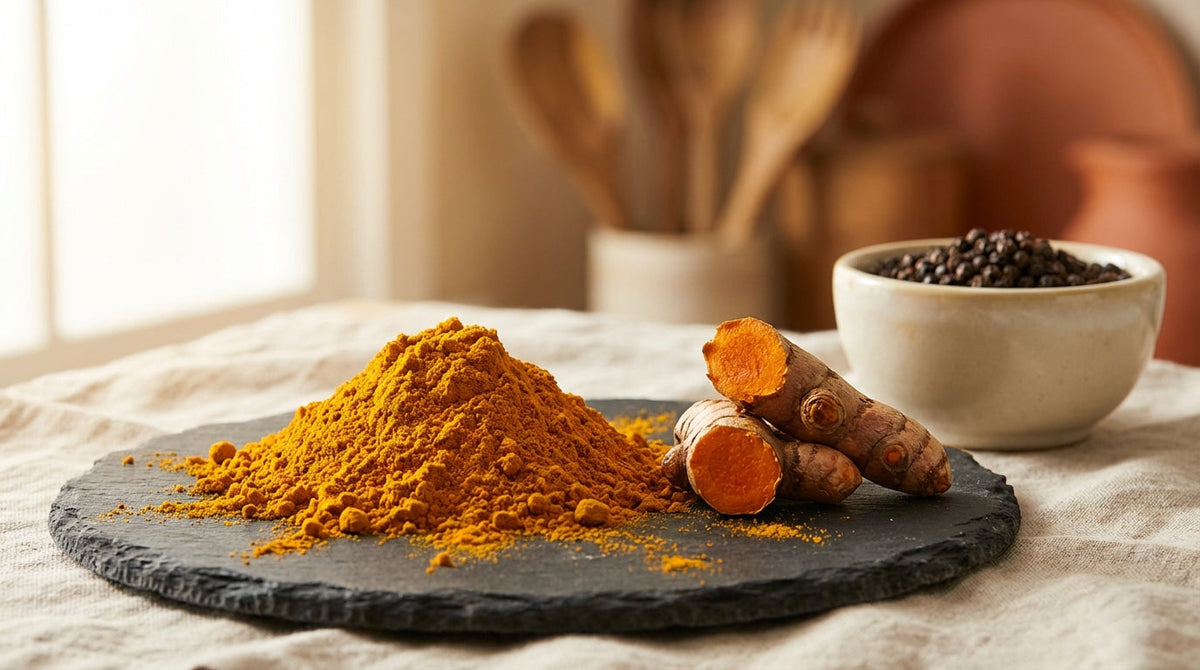
Turmeric (Curcuma longa) belongs to the ginger family (Zingiberaceae) and originally comes from South East Asia (Encyclopaedia Britannica). The rhizome owes its characteristic yellow colour to a group of polyphenols - the curcuminoids. The most important of these is curcumin, which, depending on variety and origin, makes up between 0.6 and 5.2 per cent of the dry weight (Spice Board India, 2025). According to Apotheken Umschau (Zharinova & Kremser, 2025), conventional turmeric powder from the supermarket contains only 45 to 100 mg of curcumin per half teaspoon - far less than is used in most studies.
The scientific fascination did not begin yesterday: archaeological finds from Farmana (India, 2600-2200 BC) document the use of turmeric since the Indus Valley Civilisation. Sushruta's Ayurvedic compendium recommended turmeric ointments as early as around 250 BC. Today, PubMed lists more than 15,000 publications on curcumin - an impressive figure, which, however, should not be equated with 15,000 positive results. In their review, Hewlings and Kalman (2017) describe curcumin as a substance with inflammation-modulating, antioxidant and neuroprotective properties in controlled studies. Nevertheless, the European Food Safety Authority EFSA has so far not authorised a single health claim for curcumin - a fact that matters when putting things into perspective.

How does turmeric affect inflammatory markers in the body?
The inflammation-modulating effect of curcumin observed in studies is the best-researched aspect. A comprehensive meta-analysis by Dehzad et al. (2023) evaluated 66 randomised controlled trials (RCTs) and found significant reductions in three key inflammatory markers: CRP fell by an average of 0.58 mg/L (95% confidence interval: -0.74 to -0.41), TNF-alpha by 3.48 pg/mL and IL-6 by 1.31 pg/mL. In addition, superoxide dismutase (SOD) activity rose by 20.51 U/L - a marker of the body's own antioxidant capacity.
These figures sound promising, but they need to be put into context. The umbrella review by Xu et al. (2025) shows that 55 per cent of the health outcomes examined were statistically significant, but 76 per cent of the underlying reviews were of "very low" methodological quality. This does not mean the results are wrong - but that bias due to small samples, short study durations or a lack of blinding is possible. The Barmer health insurance fund (2026) puts it this way: "The level of evidence is low to very low." Curcumin is being studied in research for inflammation-modulating properties - clinical guidelines do not currently recommend it as a therapy.
Does turmeric help with joint pain?
Joint pain in knee osteoarthritis is one of the areas in which curcumin can present the most convincing clinical data. A meta-analysis by Hidayat et al. (2024) evaluated 10 RCTs with a total of 786 participants: pain reduction on the visual analogue scale (VAS) was significantly better than with placebo (mean difference: 18.25 points, p = 0.0006). In individual studies, curcumin proved not inferior to the painkiller diclofenac - with fewer gastrointestinal side effects. Anyone suffering from joint complaints should nevertheless interpret these data with caution: in 2017 the EFSA expressly rejected the health claim "curcumin contributes to normal joint function" (EFSA, 2017) because no causal relationship could be demonstrated.
Important
This article is for information purposes and does not replace medical advice. If you have joint pain, digestive complaints or other health questions, please consult your doctor or pharmacist. Turmeric is a spice - not a medicine.

What does turmeric do for the heart and blood vessels?
An umbrella review by Unhapipatpong et al. (2025) summarised 26 meta-analyses with a total of 72 RCTs and found moderate effects on blood lipid levels: triglycerides fell by an average of 13.15 mg/dL, LDL cholesterol by 5.84 mg/dL, total cholesterol by 7.76 mg/dL, while HDL cholesterol rose by 2.4 mg/dL. The best effects were seen in people with type 2 diabetes and with an intake period of eight weeks or more. In addition, the umbrella review by Xu et al. (2025) observed a reduction in systolic blood pressure of 2.02 mmHg.
These changes are statistically significant but clinically moderate - a reduction in LDL of 5.84 mg/dL is not comparable with statins (typically: 30-50 per cent reduction). Curcumin is being studied as a potential supplement in trials, but it cannot replace drug therapy. For healthy people who regularly use turmeric as a spice in the kitchen, these data are an interesting additional signal - nothing more. Anyone who enjoys turmeric as golden milk or in a curry is doing so with a spice that is under observation in research.
Why are turmeric and pepper often combined?
Practical tip
For a balanced seasoning, turmeric can be combined with black pepper and a fat such as coconut oil, olive oil or ghee.
How much turmeric a day is safe?
According to EFSA (2010) and WHO/JECFA (2003), the acceptable daily intake (ADI) for curcumin is 0 to 3 mg per kilogram of body weight. For a person weighing 70 kg, that corresponds to around 210 mg of curcumin per day. According to Apotheken Umschau (Zharinova & Kremser, 2025), half a teaspoon of turmeric powder contains between 45 and 100 mg of curcumin - so typical use as a spice is well below the ADI. According to EFSA, intake through a normal diet amounts to less than 7 per cent of the ADI.
It becomes problematic with high-dose food supplements. A market check by the CVUA Stuttgart (2024) examined 86 curcumin supplements and objected to 88 per cent of them - because of illegal health claims and overdosing. 44 per cent of the products exceeded the ADI; the most highly dosed contained 2,660 mg of curcumin per day - 12 times the recommended upper limit. 65 per cent additionally contained piperine, 39 per cent of them more than 10 mg per day (BfR recommendation: a maximum of 2 mg of isolated piperine). The BfR (2021) expressly warns that for bioavailability-optimised preparations the ADI may "possibly not be applicable", because the uptake of curcumin in the body is many times higher than with the spice.
What makes turmeric quality?
Curcumin content varies considerably depending on variety and origin. According to Spice Board India (2025), the range worldwide extends from 0.6 to 5.2 per cent, with the Indian average at 2.86 per cent. According to the Department of Export Agriculture (Sri Lanka), Sri Lankan turmeric reaches 5 to 6 per cent curcumin content and 3 to 5 per cent essential oil - values at the upper end of the global scale. The growing areas in the Central and Western Provinces (Kurunegala, Matale, Kandy) benefit from mineral-rich soils, 1,500 mm of annual rainfall and temperatures between 20 and 35 °C - ideal conditions for curcuminoid synthesis in the rhizome.
Another quality criterion is purity. Öko-Test (2022, updated 2026) tested 21 turmeric powders and failed 18 of them - the main reasons were MOSH/MOAH mineral oil (detectable in all samples), pesticide residues and polycyclic aromatic hydrocarbons (PAHs). Organic products performed considerably better than conventional ones. We at MrCOLOMBO import our organic turmeric directly from smallholder farmers in Sri Lanka - we know every stage of the supply chain personally, from the field in the Central Province to dispatch in Germany. Anyone who uses turmeric as a spice in high-quality organic grade from Sri Lanka is taking a natural route - without the risks of high-dose food supplements.
Anyone who cuts open freshly harvested Sri Lankan turmeric experiences an intense orange-yellow that immediately stains the fingers - a visible sign of the high curcumin content. The scent is earthy and warm with light citrus notes, the taste subtly bitter and peppery-spicy - noticeably more aromatic than the pale yellow standard product from the supermarket. Harvesting takes place 8 to 10 months after planting, when the leaves turn yellow and the curcuminoid concentration in the rhizome has reached its peak. The rhizomes are then washed, boiled in water - which gelatinises the starch and distributes the curcumin evenly -, dried in the tropical sun and finally ground. At MrCOLOMBO we rely on cryogenic grinding at minus 196 °C: this preserves the essential oils and the delicate curcumin, which is partly destroyed by the heat generated in conventional grinding.

Evidence overview: turmeric effects fact-checked
| Claimed effect | Level of evidence | Key source |
|---|---|---|
| Lowering inflammatory markers (CRP, TNF-alpha) | Promising | Dehzad et al. (2023), 66 RCTs |
| Joint pain in osteoarthritis | Promising | Hidayat et al. (2024), 10 RCTs - EFSA claim rejected |
| Improving blood lipid levels | Moderate | Unhapipatpong et al. (2025), 72 RCTs |
| Improving cognitive function | Moderate | Wang et al. (2025), 9 RCTs - from age 60, at least 24 weeks |
| Relieving digestive complaints | Weak | Ng et al. (2018), 3 studies - not significant (p = 0.158) |
| Curing or preventing cancer | Not proven | de Waure et al. (2023), DKFZ - in-vitro results not clinically confirmed |
Note: "promising" means statistically significant results in several RCTs - not "proven". The EFSA has not authorised any health claim for curcumin. All information refers to curcumin in studies, not to turmeric as a spice in kitchen quantities.
Turmeric - a promising spice, not a miracle remedy
Science provides indications that, in controlled studies, curcumin can lower inflammatory markers and moderately improve blood lipid levels, and that it showed promising results for joint pain. At the same time, the EFSA has not authorised a single health claim, the methodological quality of many studies is low, and high-dose food supplements carry risks ranging from liver damage to drug interactions. Stiftung Warentest sums it up aptly: "Spice yes - superfood no."