



G olden milk - Haldi Doodh in Hindi - is a turmeric drink with more than 3,000 years of history in the Ayurvedic tradition. Unlike most recipes on the internet, this article shows why Ceylon turmeric from Sri Lanka, with its curcumin content of 4.48 %, contains almost twice as much of this valuable plant compound as standard Indian produce with 2.42 % (Global Press Journal / DEA Sri Lanka, 2021). One teaspoon of high-quality turmeric powder provides around 60-90 mg of curcumin - within the safe range of 3 mg per kilogram of body weight per day set by the EFSA (EFSA, 2010).
In this recipe you will learn, step by step, how to prepare golden milk at the right temperature, with a creamy texture and well-balanced spices.
At a glance
What is golden milk and where does it come from?
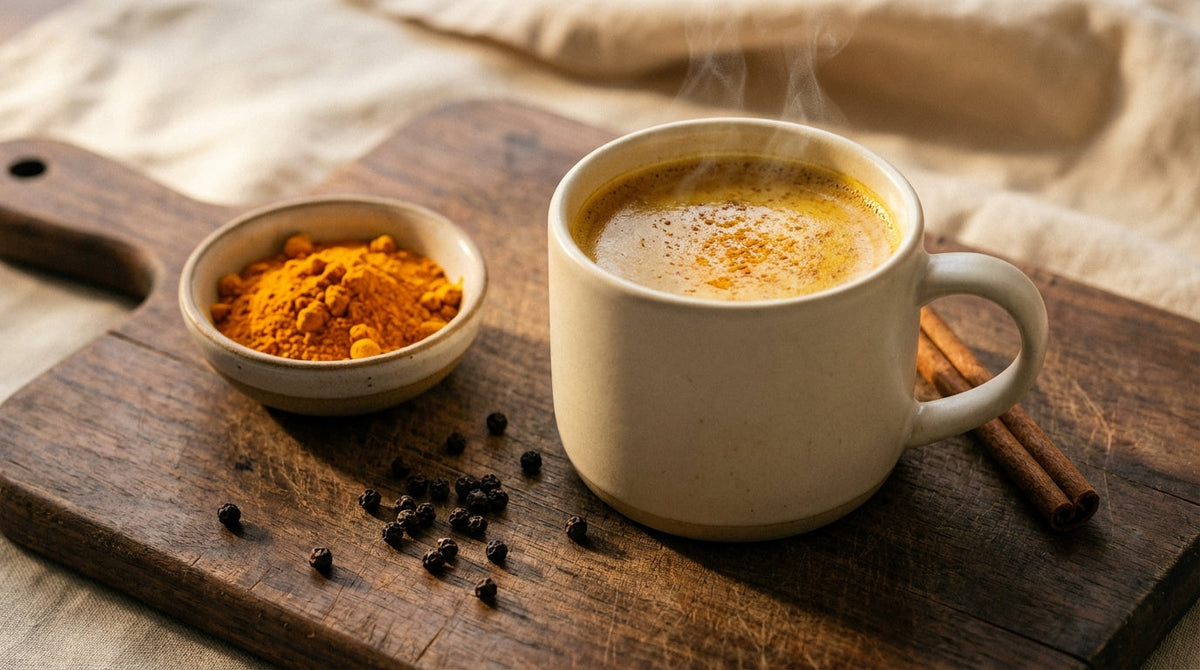
Golden milk is a warm drink made from milk, turmeric, black pepper and a fat such as coconut oil or ghee. In India and Sri Lanka it is called Haldi Doodh - literally translated: turmeric milk. The oldest written records are found in the Charaka Samhita, one of the foundational texts of Ayurvedic medicine from the Vedic era between 1500 and 3000 BC (Prasad & Aggarwal, 2020). Turmeric was classified there in several therapeutic categories and documented as haridrā. The traditional method of preparation was clear: simmer fresh turmeric root in milk, never boil it, and combine it with long pepper (Pippali).
In South Asian families, Haldi Doodh has been part of everyday life for generations - as a warming evening drink passed down by mothers and grandmothers. Turmeric had not only a culinary but also a sacred significance: in Vedic culture it was used in ceremonies and offerings to the gods (The Pinch Spices, 2021). As the spice island, Sri Lanka was at the centre of the ancient spice trade - Arab traders were already sailing directly to the island's spice sources before the turn of the era (Britannica, Spice Trade). These trade routes laid the foundation for turmeric being available worldwide today.
Golden milk found its way into Western kitchens via the yoga and wellness scene. Google searches for turmeric rose by 300 % between 2011 and 2016 (Think With Google, 2016). In 2017, Whole Foods predicted turmeric as a top trend. Today, golden milk sits in German cafés alongside cappuccino and Ayurvedic teas - as a caffeine-free alternative with the promise of Far Eastern tradition. According to Grand View Research, the global market for turmeric milk blends will grow to 220.1 million US dollars by 2030 (CAGR 5.9 %).
How do you prepare golden milk properly?
The perfect golden milk recipe needs five ingredients and ten minutes. The order is crucial: first heat the fat, then dissolve the turmeric in it - because curcumin is fat-soluble. Only then is the milk added. This step is what separates an aromatic drink from a grainy, bitter result. The temperature should not exceed 70 °C, as 70 % of curcumin is degraded at 180 °C after just five minutes (Esatbeyoglu et al., 2015). Gentle warming protects the active compound - so the Ayurvedic tradition of "simmering rather than boiling" is scientifically well founded.
Ingredients for 1 cup (approx. 300 ml)
| Ingredient | Quantity | Why it matters |
|---|---|---|
| Plant milk or cow's milk | 300 ml | Base - coconut milk provides its own fat |
| Ceylon turmeric | 1 tsp (approx. 2-3 g) | Provides 60-90 mg of curcumin |
| Coconut oil or ghee | 1 tsp | Fat increases absorption up to 63-fold |
| Black pepper | 1 pinch (approx. 1/4 tsp) | Aroma and heat |
| Fresh ginger | 1 cm piece, grated | Heat and aroma |
| Ceylon cinnamon | 1/2 tsp | Only 0.004 % coumarin - safe for daily use |
Preparation in 4 steps
Step 1: Melt the coconut oil or ghee in a small saucepan over a low heat. Add the turmeric and ginger and toast for 1-2 minutes, stirring, until it smells intensely fragrant. This step dissolves the fat-soluble curcumin and intensifies the aroma.
Step 2: Slowly pour in the milk and stir everything together. Turn to a medium heat and warm until the milk is steaming - but not boiling. 60-70 °C is ideal. A lipidic formulation (that is, curcumin dissolved in fat) increases bioavailability 63-fold compared with pure curcumin (Pawar et al., 2012).
Step 3: Remove from the heat and stir in the Ceylon cinnamon and black pepper. Sweeten with honey, maple syrup or agave syrup if you like. The pepper is only added at the end so that its heat stays fresh.
Step 4: Pour through a fine sieve into a cup - this removes the ginger fibres and gives the velvety texture that sets golden milk apart. Serve immediately.
Practical tip
Golden milk paste for preparing ahead: mix 50 g of turmeric, 120 ml of water and 1 tbsp of coconut oil over a low heat to form a paste. It keeps in the fridge for up to 4 weeks, and even longer frozen in ice cube trays. For one cup, simply stir 1.5 tsp of paste into warm milk.

What makes Ceylon turmeric so special?
Not every turmeric powder is the same. The Sri Lanka Department of Export Agriculture prescribes an SLSI standard of 5-6 % curcumin content for Ceylon turmeric - well above the average of 3.14 % found in an HPLC analysis of 28 turmeric products (Tayyem et al., 2006). A study by the Sri Lankan export authority shows that Ceylon turmeric contains 4.48 % curcumin, while standard Indian produce reaches only 2.42 % - almost half as much (Global Press Journal / DEA Sri Lanka, 2021). For your golden milk this means: with Ceylon turmeric you get almost twice as much of the valuable curcumin from the same quantity.
The growing regions in Sri Lanka's Central Province - around Kurunegala, Kandy and Matale - offer optimal conditions: temperatures between 20 and 35 °C and more than 1,500 mm of annual rainfall (DEA Sri Lanka). The volcanic soils provide minerals that are reflected in aroma and colour intensity. We know every stage of the supply chain personally - from the turmeric field in the Central Province to dispatch in Germany. Direct import without middlemen guarantees not only fair prices for the smallholder farmers, but also maximum freshness: rarely more than a few weeks pass between harvest and packaging.
Commercial curcumin consists of three curcuminoids: 77 % curcumin, 17 % demethoxycurcumin and 6 % bisdemethoxycurcumin (Sharifi-Rad et al., 2020). All three contribute to the characteristic properties - but it is the interplay with the essential oils of the whole turmeric root that makes the difference between an isolated extract and a high-quality turmeric powder such as Ceylon turmeric from MrCOLOMBO. Sri Lanka currently produces around 2,000 tonnes of turmeric a year - against a national demand of 6,000 tonnes, which explains the scarcity and the premium character.
What role does black pepper play in the flavour of golden milk?

What health effects does turmeric have according to studies?
Curcumin is one of the most intensively researched plant compounds of all - with more than 13,000 entries on PubMed (as of 2026). The state of research is nuanced, however: laboratory studies show clear effects, but transferring them to humans is complex. A meta-analysis of 66 randomised controlled trials (RCTs) found that curcumin supplementation lowered the inflammatory marker CRP by an average of 0.58 mg/l, reduced TNF-α by 3.48 pg/ml and IL-6 by 1.31 pg/ml, while antioxidant capacity (SOD) rose by 20.51 U/l (Dehzad et al., 2023). These values come from clinical trials with supplements - not from a cup of golden milk.
According to a systematic review, the clinically effective daily dose of curcumin is 500-1,500 mg (Gupta et al., 2012). One teaspoon of turmeric powder in golden milk provides 60-130 mg of curcumin depending on quality - significantly less than the study doses. According to the EFSA and JECFA, curcumin is safe up to a daily dose of 3 mg per kilogram of body weight, which for an adult weighing 70 kg corresponds to around 210 mg (EFSA, 2010). A cup of golden milk with 1 tsp of high-quality turmeric is therefore within the safe range - even when enjoyed daily.
Important
For curcumin there are zero authorised health claims in the EU - all applications were rejected by the EFSA (EFSA NDA Panel, 2017). Statements such as "strengthens the immune system" or "has an anti-inflammatory effect" are prohibited by law for curcumin products, as a 2018 ruling by the Lüneburg Regional Court confirmed (vzbv, 2018). This article is for information purposes and is no substitute for medical advice. If you have health concerns, consult your doctor or pharmacist.
Turmeric as a spice in golden milk is something different from high-dose curcumin supplements. The Verbraucherzentrale (German consumer advice centre) warns: a 2024 market check found that 44 % of curcumin food supplements in Germany exceed the safe limit (ADI) - one product even by 12 times (Verbraucherzentrale, 2026). In isolated cases, severe liver damage from supplements with enhanced bioavailability has been reported (BfR, 2021). In October 2025, Health Canada warned of 12 Canadian and more than 60 international cases of liver damage, including 3 deaths. The daily cup of golden milk with 1 tsp of turmeric is not affected by this - the doses are orders of magnitude below the problematic supplement quantities.
What variations of golden milk are there?
The basic recipe can be varied in many ways - from the choice of milk to seasonal versions and international interpretations. According to community surveys, oat milk is the most popular plant-based alternative because it brings sweetness and a creamy texture without masking the flavour of the turmeric. Coconut milk (full-fat, from the tin) also provides the fat that is important for curcumin absorption - so the extra spoonful of coconut oil can be left out. Almond milk works, but is thinner. In one study, soya milk achieved the highest antioxidant activity in combination with turmeric: 17.7 mmol Trolox per kilogram (Idowu-Adebayo et al., 2022).
Iced golden milk - the summer version
The viral TikTok version for warm days: heat half the amount of milk, dissolve the turmeric, pepper and fat in it, then pour over a glass full of ice cubes and top up with cold milk. The result is a refreshing turmeric iced coffee substitute that also wins you over visually with its typical golden hue. One such video reached 390,000 likes on TikTok (Ballerina Farm, 2024) - a sign that golden milk has long since stopped being just a winter drink.
Traditional Haldi Doodh - the Indian original
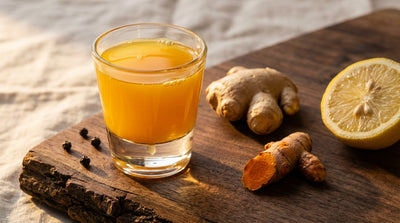
For authentic Haldi Doodh, whole spices are used instead of powder: simmer a fresh turmeric root (approx. 3 cm), split cardamom pods, whole peppercorns and half a cinnamon stick in whole milk over a low heat for 10-15 minutes. Then strain and drink hot. This method extracts the essential oils slowly and produces a more complex aroma than the powder version. In Indian families, Haldi Doodh is drunk especially in the evening - a tradition that the growing trend of functional evening drinks such as ginger and turmeric shots is picking up again.
What should you look for when buying turmeric?
The quality of your turmeric determines the colour, flavour and curcumin content of your golden milk. In 2022, ÖKO-TEST examined a total of 21 turmeric powders - and 18 of them failed (ÖKO-TEST, 07/2022). All the products tested contained MOSH (mineral oil saturated hydrocarbons), and four additionally contained pesticides. Only a single organic product received the grade "very good". These results show that when buying turmeric, it pays to look closely.
Three criteria help with the selection: first, origin - Ceylon turmeric from Sri Lanka, with 4.48 % curcumin, achieves almost twice the industrial average. Second, certification - organic seals (EU organic, Naturland) minimise the risk of pesticide and mineral oil residues. Third, processing: freshly ground turmeric retains more essential oils than powder that has been stored for a long time. A simple test helps you recognise spice quality: high-quality turmeric immediately colours an intense golden yellow and smells earthy and warm. Pale, dusty powder with no scent is a sign of inferior goods or overly long storage.
With around 1.1 million tonnes, India produces about 80 % of the world's turmeric harvest (Spice Board India / IBEF, 2024). The sheer volume often comes at the expense of quality. Sri Lanka, by contrast, relies on a quality standard (SLSI) with minimum requirements for curcumin content. Direct import from smallholder farmers ensures that turmeric is processed and dispatched directly, without intermediate storage in wholesale warehouses - which preserves aroma and constituents. Our organic-certified partner farms in Sri Lanka confirm this too.

Golden milk - tradition meets science
Golden milk is more than an Instagram trend: it combines more than 3,000 years of Ayurvedic tradition with modern nutritional science. The decisive difference lies in the quality of the ingredients: Ceylon turmeric with 4.48 % curcumin, freshly ground black pepper and a good fat turn a simple turmeric milk into a drink that unites colour, flavour and nutrient content.
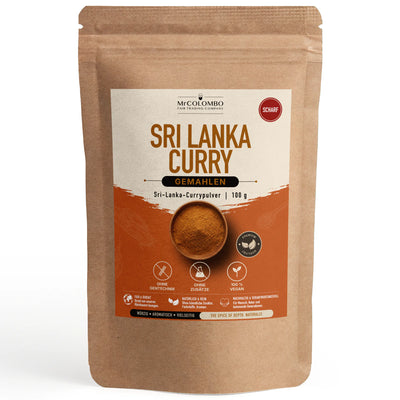
If you would like to dive deeper into the world of spices from Sri Lanka, you will find more recipes and background with us - from authentic Sri Lankan curry to the question of why Ceylon cinnamon makes the difference.