




True Ceylon cinnamon (Cinnamomum verum) from Sri Lanka contains under 8 mg of coumarin per kilogram - around 250 times less of this liver-straining substance than conventional cassia cinnamon, which according to the German Federal Institute for Risk Assessment (BfR) averages 3,000 mg/kg. Anyone who uses cinnamon daily should therefore opt for true Ceylon cinnamon and recognise it by its light, multi-layered sticks.
At MrCOLOMBO we import Ceylon cinnamon directly from smallholder farmers in the central region of Sri Lanka - the country of origin of true cinnamon, which according to the International Finance Corporation (2024) meets around 90 per cent of global demand. From this direct supply chain we know how the variety can be reliably identified and why the coumarin content is decisive for daily use. The following sections explain what exactly coumarin is, how large the difference between the varieties is, how you can identify true cinnamon yourself with five simple tests and what studies say about its effects. If you are looking purely for the variety comparison, you will find it in our article on Ceylon cinnamon and cassia cinnamon.
Quick answer
Why is Ceylon cinnamon so much safer when it comes to coumarin? Ceylon cinnamon contains only traces of coumarin (under 8 mg/kg), whereas cassia cinnamon averages around 3,000 mg/kg and in extreme cases reaches up to 10,000 mg/kg (BfR; Woehrlin et al., 2010). The BfR guideline value (TDI) is 0.1 mg of coumarin per kilogram of body weight per day - with cassia, a child reaches this limit with just half a teaspoon.
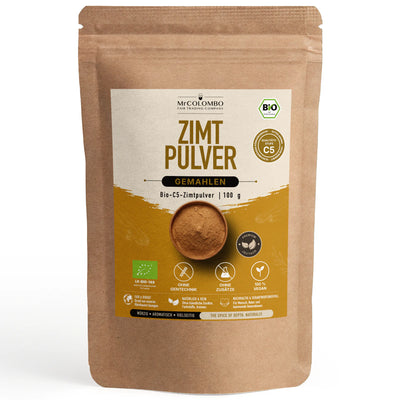
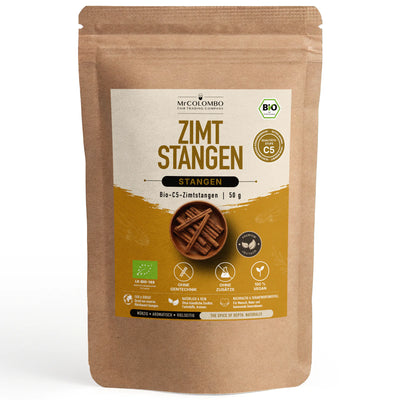
You will find powder and sticks in our Ceylon cinnamon range.
At a glance
What is coumarin and why is it a problem in cinnamon?
Coumarin is a naturally occurring flavouring substance that gives many plants their typically sweet, hay-like scent - including the bark of the cinnamon tree. In larger quantities, however, coumarin can put a strain on the liver. According to the German Federal Institute for Risk Assessment (BfR), the tolerable daily intake (TDI) is 0.1 mg of coumarin per kilogram of body weight. The problem is not cinnamon as such, but the type of cinnamon: cassia cinnamon contains a great deal of coumarin, true Ceylon cinnamon only traces. A laboratory analysis by Pitaro and colleagues (2022) shows that the body safely breaks down around 97 per cent of the coumarin via the enzyme CYP2A6 - a permanently high intake is nevertheless not advisable.
Important for context: there is not a single documented case in the scientific literature of liver failure caused by normal cinnamon consumption (Pitaro et al., 2022). Coumarin is therefore not an acute poison, but a question of quantity over time. That is precisely why the EU has set maximum levels for foods containing coumarin in Regulation 1334/2008: desserts may contain a maximum of 5 mg/kg, seasonal baked goods such as gingerbread up to 50 mg/kg (LGL Bayern). There is no legal maximum for loose cinnamon spice itself - here the consumer bears the responsibility for choosing the variety.
How much coumarin is there in Ceylon and cassia cinnamon?
The difference is drastic and scientifically well documented. A widely cited analysis by Wang and colleagues (2013) in the Journal of Agricultural and Food Chemistry found that true cinnamon (Cinnamomum verum) contains only traces of coumarin, while all three cassia species contain substantial amounts. Healthline (2026) puts the difference at around 250-fold: cassia is at about 1 per cent (around 10,000 mg/kg), Ceylon at 0.004 per cent. Particularly treacherous: Woehrlin and colleagues (2010) showed that the coumarin content varies enormously even within the same cassia tree - some branches contain barely measurable coumarin, others the full maximum amount. This makes cassia consumption hard to calculate.

A recent field study by Waman and colleagues (2026) examined 25 Ceylon cinnamon origins over two years and found values from below the detection limit up to a maximum of 398 mg/kg - even the highest Ceylon value measured thus remains well below the cassia average. Stiftung Warentest confirmed the picture in November 2024: in its test of 14 cinnamon powders, the cassia products were at 2,300 to 3,500 mg/kg of coumarin, while five of six Ceylon products stayed under 20 mg/kg. So anyone who uses cinnamon regularly reduces their coumarin intake by more than 99 per cent by switching to Ceylon.
How do I identify true Ceylon cinnamon myself?
The surest way to identify true Ceylon cinnamon is by the stick, because ground powder looks similar for both varieties. A Ceylon stick consists of 7 to 10 wafer-thin layers of bark rolled into one another and resembles a cigar. Cassia sticks, on the other hand, consist of just one or two thick layers of bark with a distinct hollow in the middle. The colour also reveals a lot: Ceylon is light brown to beige, cassia reddish-brown and darker. The following checklist summarises the five most reliable tests that you can carry out at home without a laboratory.
Five tests for true Ceylon cinnamon
Layer test? Ceylon has 7 to 10 thin layers (cigar shape), cassia only one or two thick layers with a hollow.
Colour test? Ceylon is light brown to beige, cassia reddish-brown and strongly dark.
Bend test? A Ceylon stick splinters into fine layers, cassia breaks hard and cleanly.
Light test? The thin Ceylon bark lets light shine through, thick cassia remains opaque.
Price test? According to the Verbraucherzentrale Thüringen (2025), Ceylon powder costs an average of 62.72 euros/kg, undeclared goods only 36.75 euros/kg - a conspicuously low price points to cassia.

With powder it gets more difficult, because scent and colour are easily confused. Here the declaration helps above all: if "Cinnamomum verum", "Ceylon" or "true cinnamon" is on the packet, the variety is certain. If there is no indication at all, it is usually cassia, because true cinnamon is almost always advertised as such on account of its premium character. If you want to be completely sure, buy sticks instead of powder and grind them yourself - that way the variety can be checked at any time. You will find more background on how to recognise high-quality spices in general in our guide to spice quality.
Anyone who buys sticks has the advantage that the layer and bend tests can be carried out directly - with loose powder this is impossible. Our Ceylon cinnamon sticks come from the central region of Sri Lanka, where the humid climate and sandy soils produce the thinnest, most aromatic bark. A whole stick can be stored dry for months and freshly grated or crushed in a mortar as needed.
How much cinnamon a day is safe?
The safe amount depends on body weight and above all on the type of cinnamon. The BfR does the maths: an adult weighing 60 kg can take in around 2 g of cassia cinnamon daily without exceeding the TDI - that corresponds to roughly one heaped teaspoon. With Ceylon cinnamon, the safe amount is many times higher thanks to the minimal coumarin content, so that daily consumption is practically unproblematic. ConsumerLab (2025) puts the coumarin content of one teaspoon of cassia at 8.5 to 15.5 mg - enough to use up an adult's guideline value with half a teaspoon.
| Person | Max. cassia cinnamon per day | Corresponds roughly to |
|---|---|---|
| Adults (60 kg) | 2 g | 1 heaped teaspoon |
| School child (30 kg) | 1 g | half a teaspoon |
| Toddler (15 kg) | 0.5 g | amount in approx. 6 cinnamon star biscuits |
Children in particular reach the guideline value quickly, because it is based on body weight. According to the BfR, a toddler weighing 15 kg already uses up its daily guideline value with the amount of coumarin in about six cinnamon star biscuits. This is exactly where the practical advantage of Ceylon lies: if you use true cinnamon in your Christmas baking or your daily porridge, you do not need to do this calculation at all. It is also important to keep an eye on food supplements - according to the Verbraucherzentrale (2025), cassia-based cinnamon capsules can easily exceed the TDI and interact with blood thinners such as Marcumar.
Important
This article is for information purposes and does not replace medical advice. Anyone who regularly takes cinnamon preparations or blood-thinning medication should discuss this with their doctor or pharmacist.
What effects does Ceylon cinnamon have according to studies?
Cinnamon is not only a spice but also the subject of intensive research. A meta-analysis by Moridpour and colleagues (2024) in Phytotherapy Research evaluated 24 randomised controlled trials and observed an effect of cinnamon on fasting blood glucose (SMD: -1.32; p less than 0.001) as well as on the HbA1c value. In a crossover study by Hajimonfarednejad and colleagues (2024), a lower 24-hour blood glucose curve was measured in prediabetics taking 4 g of cinnamon per day than under placebo. These results come from science and are no promise of healing - they show what nutritional research is currently working on.
The antioxidant side has also been well studied. Abeysekera and colleagues (2019) determined a total polyphenol content of 215 mg gallic acid equivalents per gram of extract for mature Ceylon cinnamon leaves - the highest value of all Cinnamomum species examined. Cinnamaldehyde, which occurs in Ceylon at 50 to 63 per cent (King Arthur Baking, 2021), is primarily responsible for the aroma and the properties studied. An umbrella analysis by Keramati and colleagues (2022) also found indications of an effect of cinnamon on body weight and BMI at amounts from 3 g per day - one reason why Ceylon is in demand in the current TikTok trend "cinnamon in coffee".
For daily use in coffee, porridge or tea, ground Ceylon cinnamon is practical because it can be stirred in immediately. Its mild, slightly citrusy aroma does not overpower other ingredients and is therefore also suitable for savoury dishes. We have collected recipe ideas from cinnamon tea to cinnamon buns in our Ceylon cinnamon recipes. In the entire Ceylon cinnamon range you will find sticks and powder from the same origin. For everyday use, half to a whole teaspoon per cup or portion is usually enough - in coffee, in a smoothie or sprinkled over porridge. Store the powder airtight, dry and protected from light so that the fine aroma is preserved for a long time. If you prefer to use whole sticks, grind them fresh shortly before use - the powder is simply the quick, everyday version of it.
Why does true cinnamon only come from Sri Lanka?
True Ceylon cinnamon is inseparably linked to Sri Lanka. According to the International Finance Corporation (2024), the island meets around 90 per cent of global demand for true Ceylon cinnamon and employs over 70,000 smallholder farmers as well as more than 350,000 workers, the majority of them women. Since 23 February 2022, "Ceylon Cinnamon" has been registered in the EU as a protected geographical indication (PGI) (European Commission, 2022) - a seal of quality that protects true cinnamon from imitation. Cultivation is concentrated in the warm, humid coastal belt and the central region, where the climate and sandy soils produce the characteristically thin bark.

Behind the premium price lies laborious manual work. According to a report by Al Jazeera (2021), traditional craftsmen, the Chalias, harvest the cinnamon twice a year after the rainy season and scrape off the fine inner bark entirely by hand. At MrCOLOMBO we source our cinnamon directly from such smallholder farmers in the central region - without intermediaries, so that we know every stage of the supply chain personally. Freshly rolled bark from this region smells warm and floral rather than sharp and burning, and the wafer-thin layers can be pushed apart with a fingernail - two characteristics that we check with every delivery before packing. You can find out more about the country, cultivation and our partner farms in our article on spices from Sri Lanka.
Our approach at MrCOLOMBO
We import exclusively true Cinnamomum verum directly from Sri Lanka and declare the variety transparently. So with every stick and every powder you know exactly what you are getting - with no coumarin surprises. You can read exactly where the cinnamon comes from and how it is grown and harvested in our article on Ceylon cinnamon from Sri Lanka.
How to recognise true Ceylon cinnamon in the shops
The biggest problem in German retail is the lack of labelling. In December 2024, the Verbraucherzentrale Berlin examined a total of 65 Christmas products containing cinnamon and found a clear indication of the variety on only four of them (6.2 per cent) - all were Ceylon. In 2025, the Verbraucherzentrale Thüringen found 13 products (42 per cent) without any indication of the variety among 31 packaged cinnamon powders, with not a single discounter product stating the variety. There is no legal obligation in Germany to label the type of cinnamon, which is why consumers have to look closely themselves.
If you use cinnamon daily, it is best to buy declared Ceylon goods from specialist retailers rather than anonymous supermarket cinnamon.
MrCOLOMBO experience report
In practice, this means: look for the terms "Ceylon", "Cinnamomum verum" or "true cinnamon", prefer organic products (85 per cent correctly declared according to the Verbraucherzentrale Thüringen) and be sceptical of very cheap offers with no variety stated. ConsumerLab (2025) also warns of mislabelled goods and recommends buying from specialist retailers rather than the supermarket. Our entire spice range is transparently declared by variety and origin - so you can make an informed decision.
Is switching to true Ceylon cinnamon worth it?
For anyone who uses cinnamon more than occasionally, the switch is clearly worthwhile. True Ceylon cinnamon contains around 250 times less coumarin than cassia, tastes milder and is clearly identifiable thanks to EU GI protection. With the five stick tests and a glance at the declaration, you can reliably recognise true cinnamon. If you want to go deeper into the direct comparison of varieties, you will find all the details in our guide to Ceylon and cassia cinnamon. True cinnamon is not a luxury, but the simpler choice for everyday life.