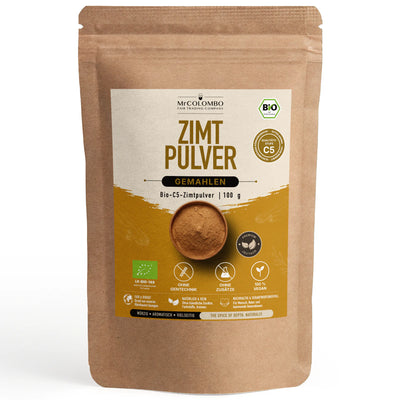
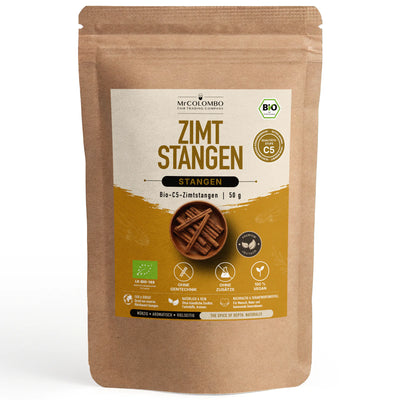


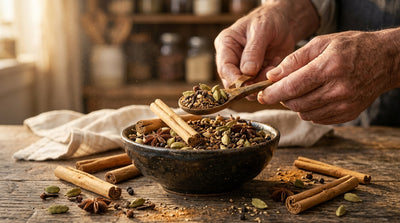
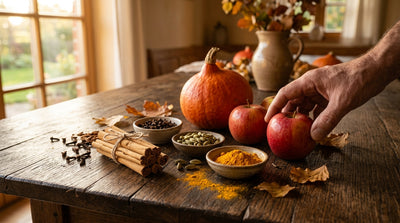
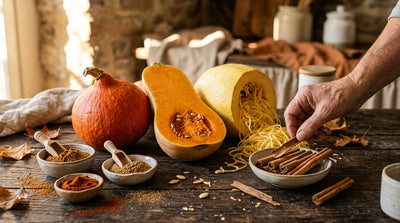



A chai spice blend classically consists of five to six spices: Ceylon cinnamon, green cardamom, ginger, cloves, black pepper and, optionally, star anise, in a ratio of roughly 8-10 cinnamon sticks to 4-5 tablespoons of cardamom pods each and one tablespoon each of cloves and pepper. The cinnamon share shapes the flavour most strongly: true Ceylon cinnamon (Cinnamomum verum) delivers 49.9 to 62.8 per cent cinnamaldehyde in the essential bark oil (Ranasinghe et al., 2013) and at the same time contains considerably less coumarin than the cheaper cassia cinnamon from the supermarket shelf.
At MrCOLOMBO we put this distinction at the start of every recipe, because it appears in no nutrition table yet shapes every chai flavour. Our Ceylon cinnamon comes directly from smallholder farmers in the central region of Sri Lanka, where the trees grow under precisely the climatic conditions that produce a mild, slightly sweet rather than sharp, burning cinnamon flavour. Those who put the spice blend together themselves also decide for themselves on freshness, degree of roasting and dosage, and are not dependent on ready-made sachet blends with cinnamon of unknown origin.
Quick answer
Which spices and in what ratio? Ceylon cinnamon, cardamom, ginger, cloves and black pepper in an approximate ratio of 8-10 cinnamon sticks to 4-5 tablespoons each of the remaining spices, briefly toasted and coarsely ground in a mortar. A quarter of a teaspoon of the finished blend is enough for one cup of chai (according to Vegan Richa); the caffeine comes exclusively from the black tea component and amounts to around 25 milligrams per cup (Healthline, 2023).
At a glance
Which spices belong in a classic chai spice blend?
The core of every chai spice blend is five spices with clearly distinct functions. Ceylon cinnamon provides the sweet, warm base note through cinnamaldehyde, which according to a systematic review of over 70 studies accounts for between 49.9 and 62.8 per cent of the essential bark oil (Ranasinghe et al., 2013). Green cardamom brings the typical floral freshness, ginger the heat, cloves an intense, slightly numbing spiciness through the active compound eugenol, and black pepper rounds off the blend with a fine sharpness. Star anise is optional, but boosts the sweetness without additional sugar.
| Spice | Active compound | Role in chai |
|---|---|---|
| Ceylon cinnamon | Cinnamaldehyde (49-63 %) | Sweet, warm base note |
| Green cardamom | Essential oils, cineole | Floral freshness |
| Ginger | Gingerols | Heat and warmth |
| Cloves | Eugenol | Intense depth of spice |
| Black pepper | Piperine (2-10 %) | Fine sharpness, aroma carrier |
Black pepper has a dual function here that goes unmentioned in most chai recipes: according to a review of 14 clinical studies, the piperine content lies between 2 and 10 per cent (Dludla et al., 2023), and piperine has been shown to be able to increase the bioavailability of other plant compounds by 30 to 200 per cent (Kesarwani and Gupta, 2013). In one much-cited human study, combining 20 milligrams of piperine with 2 grams of curcumin even increased the latter's bioavailability in the human body by 2,000 per cent (Shoba et al., 1998). A further market data analysis even found a piperine content of around 15.6 per cent, or 1,555 milligrams per 100 grams, in fresh fruits of Piper nigrum (Al-Khayri et al., 2022) - an indication of how strongly the active compound content can fluctuate depending on degree of processing, variety and time of harvest. For enjoying chai this simply means: the pepper is not a random addition, but a functionally justified component of the traditional recipe.
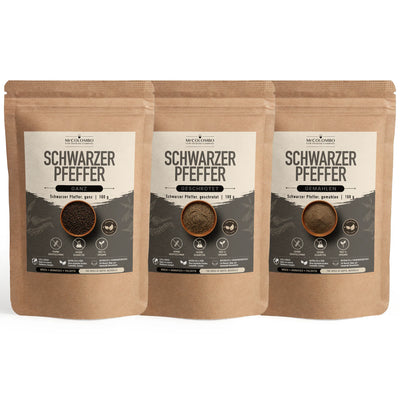
For the chai blend, pepper that is already cracked is quite sufficient, because the corns are broken up further anyway during toasting and grinding in the mortar. Those who prefer to use whole peppercorns, in order to control the toasting intensity themselves, will also find the suitable variant in our range. In both cases the origin matters: black pepper from the highland regions of Sri Lanka ripens more slowly than mass-produced goods from intensively irrigated plantations, which according to the experience of our trading partners has a direct effect on the aroma content.
In what ratio should the chai spices be mixed correctly?
A well-established German basic recipe relies on 5 teaspoons of pepper, 10 small cinnamon sticks, 5 tablespoons of cardamom, 5 teaspoons of cloves and 5 star anise to 80 grams of black tea (essen-und-trinken.de). If you detach this blend from the tea base, what remains is a pure spice framework that is suitable for about 20 cups of chai and can be varied slightly according to preference. In most recipes ginger is added dried and ground, because fresh ginger would considerably shorten the shelf life of the dry blend.
| Spice | Quantity (for approx. 20 cups) | Form |
|---|---|---|
| Ceylon cinnamon sticks | 8-10 sticks (approx. 30 g) | Whole, coarsely broken |
| Green cardamom | 4-5 tbsp pods | Lightly crushed |
| Cloves | 1 tbsp (approx. 5 tsp) | Whole |
| Black pepper | 1 tbsp (approx. 5 tsp) | Coarsely ground in a mortar |
| Star anise | 4-5 stars | Whole |
| Ginger, dried | 2 tbsp | Ground |
Whole cinnamon sticks instead of cinnamon powder for the basic blend are no coincidence: according to Stiftung Warentest, of 51 cinnamon samples tested only 2 of 21 cinnamon sticks were conspicuously high in coumarin, whereas 23 of 30 cinnamon powders (over 75 per cent) showed elevated coumarin levels (Stiftung Warentest, test.de). So anyone who prepares the basic blend with whole sticks and only breaks them up shortly before boiling reduces the risk of an unnecessarily high coumarin intake, in addition to choosing Ceylon rather than cassia cinnamon. For a milk-based chai latte, a quarter of a teaspoon of the finished blend per cup is enough (Vegan Richa); for a more intense cup it can be up to half a teaspoon.

Do the spices for chai have to be toasted and ground?
The blend does not strictly have to be toasted, but doing so changes the result considerably: brief, dry toasting in a pan (around 5 minutes over medium heat) releases essential oils that in the raw state are still firmly bound in the plant tissue. Since cinnamaldehyde and the other essential compounds are volatile, the toasting should be neither too hot nor too long, otherwise precisely the aroma that is supposed to be intensified evaporates. Several international recipe sources also expressly recommend whole rather than already ground spices, because whole spices keep their aroma considerably longer than already milled powder (Feasting at Home).
Preparation checklist
Toast? Toss the whole spices in a pan without fat for 4-5 minutes over medium heat until they begin to smell fragrant.
Leave to cool? Let the toasted spices cool completely to room temperature before processing them further.
Grind or coarsely crush in a mortar? For tea chai, crush coarsely in a mortar (prevents fine sediment in the cup); for baked goods, grind more finely.
Sieve and fill? Remove coarse husk residues through a fine sieve, then fill into an airtight jar.
Those who use the blend exclusively for tea should grind coarsely rather than finely: one English-language competitor explicitly points out that chai spices ground too finely leave a bothersome sediment at the bottom of the cup when brewed (Plays Well With Butter). A fine tea strainer or a piece of muslin cloth when boiling solves this problem reliably. For biscuits, porridge or home-made chai syrups, by contrast, the blend may be milled more finely, since no bothersome sediment forms here.

How do you store the finished blend correctly?
Essential oils are volatile and react sensitively to light, warmth and oxygen. A finished chai spice blend should therefore be stored in an airtight sealed glass container, in the dark and cool, ideally well away from the hob or windowsill. Under these conditions, according to the consistent information of several practical sources (including birgitd.com, Swasthi's Recipes), the blend remains aromatically usable for at least 12 months, although the intensity slowly diminishes over time. A simple sniff test before use reliably shows whether the blend still has its full aroma or would better be renewed.
Is Ceylon cinnamon or cassia cinnamon the safer choice for the chai blend?
The difference lies in the coumarin content: in an investigation of 60 ground cassia cinnamon samples from 12 brands, the mean coumarin content was 3,856 milligrams per kilogram (range 2,650 to 7,017 mg/kg), whereas a Ceylon cinnamon control sample remained below the limit of detection (Blahova and Svobodova, 2012). The German Federal Institute for Risk Assessment sets the tolerable daily intake (TDI) for coumarin at 0.1 milligrams per kilogram of body weight, which allows a 60 kilogram adult around 6 milligrams per day without concern (BfR, 2012). The EFSA confirmed this TDI value in 2008 on the basis of a two-year animal study (EFSA, 2008). EU Regulation (EC) No 1334/2008 additionally grades the maximum coumarin levels according to food category: 5 milligrams per kilogram for desserts, but up to 50 milligrams per kilogram for traditional fine bakery wares with explicit cinnamon labelling, in force since January 2011.
| Criterion | Ceylon cinnamon | Cassia cinnamon |
|---|---|---|
| Botanical name | Cinnamomum verum | Cinnamomum cassia |
| Average coumarin content | Below the limit of detection | Around 3,856 mg/kg |
| No concerns for daily consumption | Yes | Only in moderation |
| Proof of origin Sri Lanka (Pure Ceylon Cinnamon) | Yes | No |
Important
The Verbraucherzentrale Berlin (Berlin consumer advice centre) recommends an upper limit for cassia cinnamon of around 2 grams daily for adults weighing 60 kilograms and a maximum of 0.5 grams for children weighing 15 kilograms (Verbraucherzentrale Berlin, 2024). With Ceylon cinnamon this restriction practically does not apply, since the coumarin content is so low. This article is for information purposes and does not replace medical advice. For health-related questions, during pregnancy or for children, consult your doctor or pharmacist.
For a chai spice blend that is drunk regularly and also by children, the choice of cinnamon is therefore not purely a matter of taste. Monitoring by the Bavarian State Office for Health and Food Safety of 208 cinnamon samples found that only around 1.4 per cent exceeded the legal coumarin limit (LGL Bayern) - an indication that origin and labelling nowadays mostly work reliably, provided that true Ceylon cinnamon is used rather than an unclearly labelled cinnamon mix. Those who work exclusively with Ceylon cinnamon from the Ceylon cinnamon range practically no longer need to worry about coumarin limits.
How do you use the chai spice blend in everyday life?
The most common preparation is as a classic chai latte: a quarter to half a teaspoon of the blend is boiled up with black tea and hot milk and then strained. We have already described a detailed preparation including steeping times and milk ratio in our iced chai latte recipe, which can also be prepared cold with the same spice blend. A current trend for 2026 is the so-called dirty chai, in which an espresso shot is added to the finished chai latte and which, according to Meininger's Beverage Trends 2026, ranks among the most sought-after café drinks of the year.
Beyond the cup, the same blend is suitable for porridge, home-baked biscuits, apple cake or as seasoning for a golden milk drink. Those who like the combination of turmeric and chai spices will find detailed instructions in our recipe for golden milk. Ayurvedic preparations also traditionally combine similar spice profiles: our article on Ayurvedic tea shows how cardamom, ginger and cloves are also boiled up as a pure spice drink without black tea.

Our approach at MrCOLOMBO
We mix our own chai recipe exclusively with Ceylon cinnamon and black pepper from direct trading relationships with smallholder cooperatives in Sri Lanka - without intermediaries and with organic certification of the partner farms where available. That way we know every stage of the supply chain personally, from the field to dispatch.
Why does high-quality cinnamon for chai come from Sri Lanka?
Sri Lanka is the world's only significant supplier of true Ceylon cinnamon and in 2025 exported spices worth 449.91 million US dollars with a volume of 40,302 tonnes (Sri Lanka Export Development Board). The Pure Ceylon Cinnamon seal of quality is an EU-registered geographical indication and protects exclusively cinnamon that has been grown and processed 100 per cent in Sri Lanka (Sri Lanka Export Development Board). Over 350,000 families in Sri Lanka live directly or indirectly from cinnamon cultivation, and true Ceylon cinnamon costs more than ten times as much as cassia cinnamon (Suriyagoda et al., 2021) - a price difference explained by the more elaborate, largely manual processing of the paper-thin cinnamon bark.
For the growing regions in the Central Province and around Kandy and Matale, the humid, warm tropical climate means ideal growing conditions for the thin, aromatic inner bark of the cinnamon tree. Current consumer tests at the same time show why transparency of origin is becoming increasingly important: a foodwatch laboratory test from May 2026 found pesticides banned in the EU in 45 of 64 tested rice, spice and tea products, with 13 of 19 German products affected (foodwatch, 2026). Direct import with personally known smallholder cooperatives and documented organic certification considerably reduces this risk compared with anonymous supply chains via several intermediaries.
We know every stage of the supply chain personally - from the cinnamon field in the central region of Sri Lanka to dispatch to Germany.
MrCOLOMBO experience report
Is a home-made chai spice blend worth it?
A home-made chai spice blend takes little time, but delivers considerably more control over freshness, degree of toasting and above all cinnamon quality than any ready-made sachet blend. With Ceylon cinnamon instead of cassia cinnamon, clear gram quantities and a brief toasting, a blend can be produced in a few minutes that is low in coumarin, aromatically intense and keeps for at least 12 months. Once the basic blend has been prepared, it can be used in many ways for chai latte, iced chai, baked goods or as a basis for further spice recipes in the kitchen. When a blend is fundamentally worthwhile and when single spices are the better choice is something we have written down in our comparison of spice blends and single spices.