




A n iced chai latte brings together what coffee-house culture and a spice tradition stretching back thousands of years have in common: aromatic depth in a single glass. Instead of reaching for a ready-made mix from the supermarket, it is worth taking a closer look at the individual spices - because Ceylon cinnamon, cardamom, ginger and cloves bring not only flavour but also an impressive range of bioactive compounds. A homemade iced chai latte made with fresh, whole spices tastes more intense, costs less than the café version and can be tailored precisely to your own taste. According to an analysis by Mintel (2022), 68 % of German consumers now prefer café quality in their own four walls - and that is exactly where this recipe comes in.
The six core spices of an authentic chai - Ceylon cinnamon, cardamom, ginger, cloves, black pepper and star anise - each bring their own bioactive compounds, from cinnamaldehyde and gingerols to eugenol. The choice between Ceylon cinnamon and cassia cinnamon is relevant to health here: the BfR (2012) expressly recommends Ceylon cinnamon for daily consumption because of its 250 times lower coumarin content. Two preparation methods - the classic hot infusion and gentle cold extraction - produce different caffeine and flavour profiles, which we break down here with scientific evidence.
At a glance
Where does the chai latte originally come from?
The word "chai" simply means "tea" - derived from the Chinese "chá". What we know today as a chai latte has its roots in the Indian masala chai tradition, which according to historical sources emerged around 5,000 years ago as an Ayurvedic healing drink (Tea India, 2024). Back then it was not a drink for pleasure but a medicinal preparation made from spices such as ginger, cardamom and cloves - without black tea, which was only added in the 19th century under British colonial rule. The spices came from regions that today belong to Sri Lanka, India and Indonesia. When the British East India Company promoted tea consumption in India, the phenomenon of the "chaiwallas" arose at railway stations - itinerant vendors who sold sweet, spiced tea in clay cups. This masala chai was boiled up with milk and remains India's national drink to this day.
The spice trade routes that made chai possible go back even further. According to Britannica, cinnamon and cassia reached the Middle East more than 4,000 years ago. Arab traders spread stories of "gorges full of venomous snakes" to protect their trade monopoly - until Vasco da Gama found the sea route to India in 1498 and broke the monopoly. Sri Lanka played a central role in this spice trade: the island was so famous for its Ceylon cinnamon that the Portuguese made the felling of cinnamon trees punishable by death (Department of Cinnamon Development, Sri Lanka). Today, according to Mintel (2022), Germany accounts for around 25 % of all chai latte product launches in Europe.

Which spices belong in a real chai?
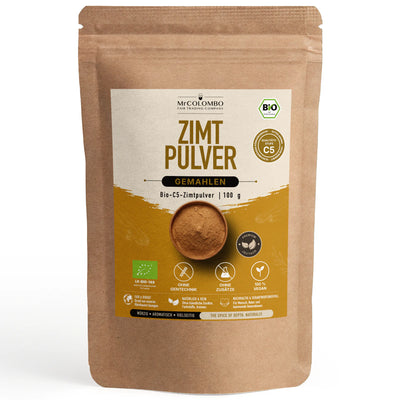
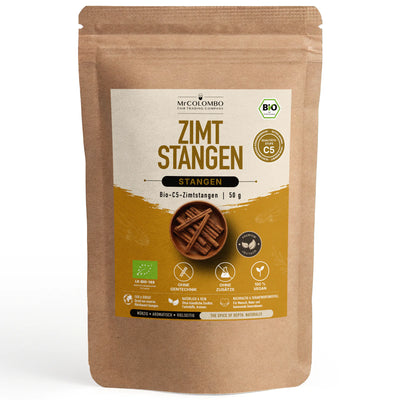
An authentic masala chai is based on six core spices, each of which brings its own bioactive compounds. Ceylon cinnamon (Cinnamomum verum) contains cinnamaldehyde as its main aroma compound and differs from cassia cinnamon in its extremely low coumarin content of just 0.004 % - according to the German Federal Institute for Risk Assessment (BfR, 2012), that is around 250 times less than cassia. Cardamom is regarded as the "queen of spices" and contains 1,8-cineole as the main component of its essential oil. In a single clinical study, an influence on blood pressure and antioxidant status was observed with a daily intake of 3 g of cardamom powder (Verma et al., 2009) - further research is needed. Ginger owes its characteristic heat to the gingerols, which make up 23-25 % of its bioactive compounds (Mao et al., 2019).
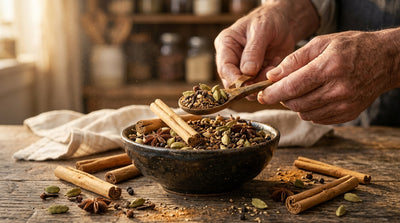
Cloves (Syzygium aromaticum) contain 70-95 % eugenol in their essential oil and, according to a systematic review, show the highest ORAC values of all spices (Cortés-Rojas et al., 2014). Star anise rounds off the blend with anethole, which makes up 80-90 % of its essential oil (Wang et al., 2020). For the best release of aroma, professional tea sommeliers recommend using whole spices and only lightly crushing them shortly before preparation. At MrCOLOMBO we source our Ceylon cinnamon sticks and black pepper directly from smallholder farmers in Sri Lanka's Central Province - with no middlemen and full traceability right back to the plantation.
Important
The compounds mentioned describe the material properties of the spices, not promises of healing. This article is for information purposes and is no substitute for medical advice. If you have health questions, please consult your doctor or pharmacist.
Overview of studies: chai spices
Why is black tea the ideal base for chai?
Black tea provides the aromatic foundation of a good chai. Robust varieties such as Assam or CTC tea (crush-tear-curl) stand up to the intense spice aromas without being drowned out. According to a review by Dufresne and Farnworth (2001), a cup of black tea contains around 262 mg of polyphenols - including theaflavins and thearubigins, which are formed during fermentation and give the tea its dark colour and full-bodied flavour. In 2024 Germany drank just under 47 billion cups of tea in total, and the organic share rose to 17.7 % (Deutscher Teeverband, 2025). In a contaminant test, Stiftung Warentest confirmed that 28 of 30 black teas performed well - organic quality generally fared better.
Of particular interest to chai drinkers is the amino acid L-theanine, which occurs naturally in tea. Nobre et al. (2008) showed that L-theanine increases alpha waves in the brain - a state associated with relaxed attention. This effect works synergistically with the caffeine in tea: instead of the typical coffee high, the result is a more even, longer-lasting alertness. A meta-analysis of 50 randomised controlled trials examined dose-dependent effects of L-theanine on cognitive function and subjectively perceived stress (Hidese et al., 2019). For your iced chai latte we recommend loose-leaf Assam black tea of organic quality. Professional tea sommeliers also advise using filtered water, as the taste depends heavily on water quality. If you are interested in further spices from Sri Lanka, it is worth taking a look at the island's variety.
How do you prepare an iced chai latte step by step?
Ingredients for 2 glasses
| Ingredient | Quantity |
|---|---|
| Water | 400 ml |
| Assam black tea (loose-leaf) | 3 tsp (approx. 6 g) |
| Ceylon cinnamon stick | 1 piece |
| Cardamom pods (green, lightly crushed) | 4 pieces |
| Fresh ginger (sliced) | 3 cm piece |
| Cloves (whole) | 3 pieces |
| Star anise | 1 piece |
| Black peppercorns (lightly crushed) | 3 pieces |
| Honey or maple syrup | 2 tsp (to taste) |
| Milk or barista oat milk | 200 ml |
| Ice cubes | as needed |
Preparation in 5 steps
Step 1 - toast the spices: Toast the Ceylon cinnamon stick, cardamom pods, cloves, star anise and peppercorns in a small saucepan without fat over a medium heat for 60-90 seconds until fragrant. Toasting activates the essential oils and intensifies the aroma - a principle that is also applied in Sri Lankan spice processing. As soon as the cardamom pods split slightly and a warm, sweetish-resinous scent rises that is reminiscent of eucalyptus and citrus, the spices are ready. We know this process from our partner plantations in Sri Lanka's Central Province, where the spices are traditionally sun-dried after harvest and only toasted shortly before dispatch.
Step 2 - bring to the boil: Add 400 ml of water and the ginger slices to the toasted spices. Bring to the boil, then reduce to a low heat and simmer for 8-10 minutes. The longer the spices steep, the more intense the flavour.
Step 3 - steep the tea: Add the black tea and take the pan off the heat. Leave to steep for 4-5 minutes. No longer, otherwise the tea becomes bitter through excessive tannin extraction.
Step 4 - strain and sweeten: Pour the chai base through a fine sieve. Stir in the honey or maple syrup while the tea is still warm - warm liquid dissolves sweeteners better. According to Sanlier et al. (2018), honey has a glycaemic index of 50 compared with household sugar at 80.
Step 5 - serve over ice: Fill glasses with ice cubes, pour in the cooled chai base up to halfway and top up with cold milk or barista oat milk. For an especially photogenic layered effect: milk first, then pour the chai slowly over the back of a spoon.
Practical tip
To avoid dilution: freeze chai concentrate in ice-cube trays. When the chai ice cubes melt, your drink becomes more intense rather than watery - a trick that has proved itself in the food community.

Cold brew or hot infusion - which method is better?
The cold-brew method has established itself as a gentle alternative to the classic hot infusion. Whole spices and black tea are extracted in cold water in the fridge for 12-16 hours. The decisive difference lies in the chemistry: Fernando and Soysa (2015) showed that cold extraction at 5-10 °C releases around 30-60 % less caffeine than a hot infusion. At the same time, the antioxidant content reaches about 90 % of the hot-infusion value after 12-16 hours - and thus remains well below the caffeine limit of 400 mg per day assessed as safe by the EFSA (2015). The reason is physical: hot water swells the cell walls of the tea leaves and accelerates the diffusion of caffeine and polyphenols (Lanczky & de Gruyter, 2022). Cold water extracts more slowly and more selectively - bitter compounds and tannins largely remain in the leaf.
Comparison: hot infusion vs. cold brew
In practice this means: cold-brew chai tastes milder, sweeter and less astringent than the hot infusion. For the cold-brew method, experienced tea merchants recommend double the amount of tea - that is, 4 tsp per cup instead of 2 tsp - as cold extraction is less efficient. The spices should remain whole and not be ground, since ground spices cloud the filtrate. If you would like to try both methods, it is best to start with the hot infusion for immediate enjoyment and set up a cold brew alongside it that will be ready overnight.
Which milk goes best with an iced chai latte?
The choice of milk has a considerable influence on the taste, texture and nutritional profile of the finished drink. Oat milk has established itself in recent years as the favourite for chai latte - and not without reason: its natural sweetness harmonises with the warm spice notes, its creamy texture comes closest to cow's milk, and barista editions froth reliably. According to Camellia Sinensis, a Canadian specialist tea retailer, oat milk is the best plant-based alternative for chai because it neither masks the flavour nor competes with the spices. Cow's milk (3.5 % fat) remains the classic, with the highest protein content per 100 ml and the best natural froth. Almond milk is lower in calories, tastes slightly nutty and is particularly suitable for a lighter summer version - but it has less protein and a thinner consistency.
For a vegan version we recommend barista oat milk, which thanks to added rapeseed oil and stabilisers offers better emulsion and froth than standard oat milk. Tinned coconut milk (not the drink from the chiller cabinet) lends the iced chai a tropical note and is reminiscent of Sri Lankan tea preparations in which coconut milk is traditionally used. An exciting trend: the "dirty chai" - an iced chai latte with a shot of espresso - went viral on TikTok and appeals particularly to coffee drinkers who want to discover chai as an alternative in taste.

How much caffeine is in an iced chai latte?
A homemade iced chai latte contains around 40-70 mg of caffeine per cup - roughly half as much as a cup of filter coffee with 90-200 mg (gesundheit.de). The European Food Safety Authority (EFSA, 2015) assesses a daily caffeine intake of up to 400 mg as safe for healthy adults; for pregnant women the recommendation is a maximum of 200 mg per day. The German Nutrition Society (DGE) recommends 3-4 cups of black tea as a moderate daily amount.
A particular advantage of tea caffeine over coffee: the tannins contained in black tea bind the caffeine, which according to established tea expertise may contribute to a slower release in the body. Many tea drinkers therefore report a gentler, longer-lasting alertness compared with coffee. If you want to reduce the caffeine content further, opt for the cold-brew method: with cold extraction (12-16 hours at 5-10 °C), according to Fernando and Soysa (2015), 30-60 % less caffeine is released than with a hot infusion. Steeping time also plays a role: 3 minutes instead of 5 minutes gives a noticeably lower-caffeine chai. If you are looking for suitable spices for a ginger-turmeric shot, you will find there a caffeine-free alternative with a similar spice profile.
Your perfect iced chai latte - what comes next
A good iced chai latte starts with the spices - and with the question of where they come from. Ceylon cinnamon instead of cassia, whole cardamom pods instead of powder from a packet, fresh ginger instead of dried extract: the quality of every single ingredient makes the difference between an average and an exceptional result in the glass. Whether you choose the quick hot-infusion method or the gentle cold brew remains a matter of taste - both routes lead to a result that puts any ready-made mix in the shade.
If you would like to dive deeper into the world of spices, our article on golden milk offers another recipe that puts turmeric and Ceylon cinnamon centre stage. And if you want to store your spices properly so that they keep their aroma for as long as possible, you will find what you need there.