


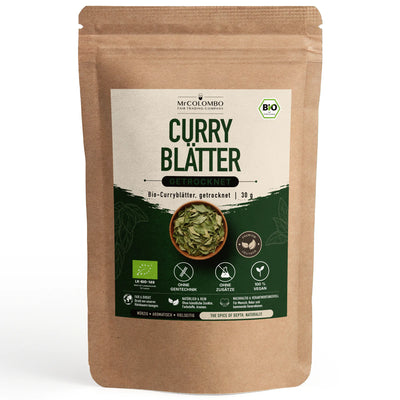
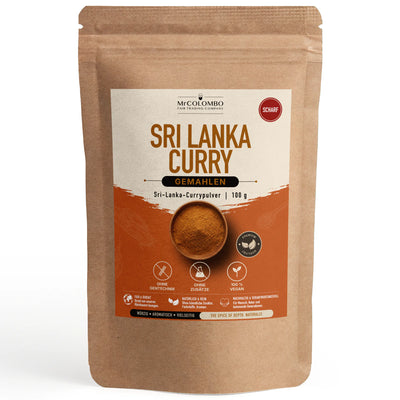


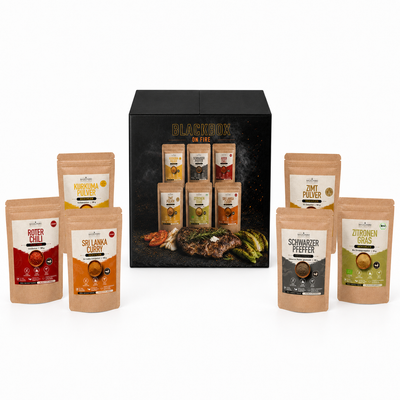
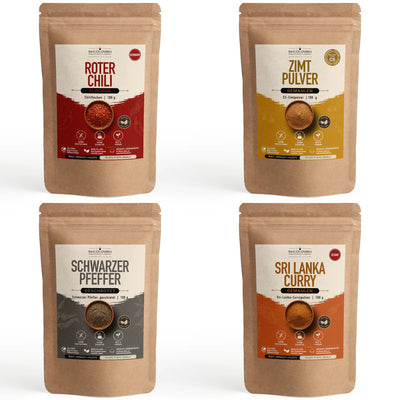


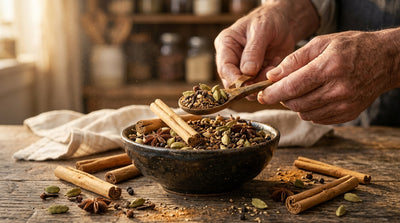


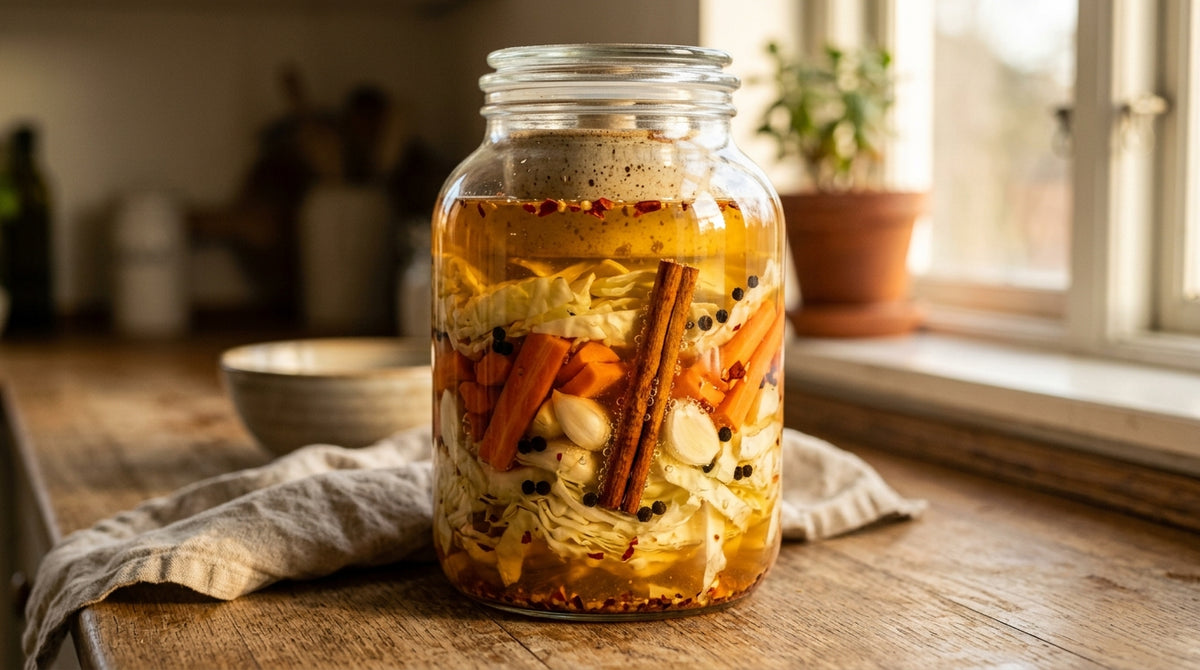
Whole, dry spices are best suited to fermenting: peppercorns, mustard seeds, coriander seed, caraway, bay leaf, chilli flakes, Ceylon cinnamon sticks, cardamom pods and curry leaves, reckoned at 1 to 2 teaspoons per 500 grams of vegetables. They determine not only the flavour but also which bacteria gain the upper hand in the jar: chilli powder measurably shifts the lactic acid bacteria in kimchi in favour of Lactobacillus sakei and at the expense of Leuconostoc mesenteroides, while the capsaicinoid content remains stable throughout the entire fermentation (Chung et al., 2021). So whoever seasons also helps steer the fermentation.
For a reliably successful result you need three things: 1 to 3 per cent salt by vegetable weight, a fermentation temperature of 18 to 22 degrees for the first 14 days (Stiftung Warentest, 2025) and spices that are dry, non-irradiated and free from foreign aromas. It is at this last point that many attempts fail, because the packaging rarely tells you how much moisture a spice still holds. We at MrCOLOMBO import chilli from Jaffna, black pepper (Piper nigrum) from the highlands around Matale, as well as turmeric and Ceylon cinnamon (Cinnamomum verum) directly from smallholders in Sri Lanka. From this supply chain we know how strongly drying and residual moisture decide whether a spice works cleanly in brine or introduces off-flavours. A chilli flake that bends between your fingers instead of snapping brings too much water into the jar, and that water dilutes the brine exactly where it needs to be strongest.
Short answer
Which spices are suitable for fermenting? The most reliable are whole, dry spices: peppercorns, mustard seeds, coriander seed, caraway, bay leaf, chilli flakes, Ceylon cinnamon sticks, cardamom pods and curry leaves. As a rule of thumb, allow 1 to 2 teaspoons of spice per 500 grams of vegetables. According to the World Institute of Kimchi, garlic and cabbage supply the actual starter cultures, whereas ginger and chilli contribute hardly any bacteria of their own - they act mainly through aroma and heat.
At a glance
What happens when you ferment with spices?
When vegetables are fermented, lactic acid fermentation is at work: salt draws water out of the vegetables, lactic acid bacteria multiply in the absence of air and convert sugar into lactic acid. The pH value drops below 4.6 in the process, and this acidity is what preserves the jar. Clostridium botulinum multiplies poorly in acidic environments; the German Federal Institute for Risk Assessment classifies foods with a pH value above 4.6 as low-acid and advises either pressure-canning them at 121 degrees or acidifying them far enough that the measured pH value lies below 4.6 (BfR, 2023). Spices intervene in this process in two ways. Firstly, some of them bring their own microorganisms: the World Institute of Kimchi was able to show that the fermenting strains such as Leuconostoc gelidum and Lactobacillus sakei come predominantly from the cabbage and the garlic, while ginger and chilli contribute hardly any strains of their own (World Institute of Kimchi, 2020). Secondly, essential oils and pungent compounds act selectively: they slow down unwanted microbes more strongly than the salt-tolerant lactic acid bacteria and thus shift the composition of the culture.
This selection is measurable. In a study of kimchi, added chilli powder changed the bacterial composition markedly: Lactobacillus sakei increased, Leuconostoc mesenteroides decreased, while the capsaicinoid content itself remained stable throughout the fermentation (Chung et al., 2021). Garlic, too, behaves differently depending on its state. Its antimicrobial effect is due to allicin, which only forms when the enzyme alliinase meets the precursor alliin during cutting or crushing. In a comparative study, raw garlic achieved an inhibition zone of 26.7 millimetres against Escherichia coli, the highest value measured; the highest content of phenolic compounds, however, was found by the same study not in fermented but in aged garlic that had matured for six months at 60 degrees (Cocom et al., 2025). Spices are thus a lever and not merely a flavouring ingredient. Whoever doubles the quantity shifts not only the aroma but also the pace and course of the fermentation, and not necessarily in the desired direction.

How much salt and what temperature does lactic acid fermentation need?
The amount of salt decides pace, texture and safety. Stiftung Warentest (2025) recommends 1 to 3 per cent salt relative to the vegetable weight and 18 to 22 degrees for the first 14 days; after that the ferment keeps for 6 to 12 months when refrigerated. The Verbraucherzentrale Berlin (the Berlin consumer advice centre) reckons with 20 to 30 grams of salt per litre of water for brines. A study of fermented beetroot shows why the middle of the range is the best choice: at 2 to 3 per cent salt, the decline in lactic acid bacteria during storage was lowest at 16.6 and 15.7 per cent respectively, while at 6 per cent salt bacterial growth remained below 8 log CFU/ml (Janiszewska-Turak et al., 2024). Too little salt makes the vegetables soft and opens the door to spoilage fermentation; too much salt holds back the desired culture. The percentage alone is not enough, though: water-rich varieties such as cucumber release so much liquid over the course of fermentation that they dilute the brine, whereas firm radish releases hardly any water.
Temperature acts as the second control and speeds up or slows down everything. A textbook chapter on lactic acid fermentations puts the difference in drastic terms: sauerkraut with around 2 per cent salt needs about a month at 7.5 degrees to reach full acidity, but only 8 to 10 days at 32 degrees (Steinkraus, 1992). For spice-led ferments the cooler option is almost always the better one, because the essential oils from cinnamon, cardamom or curry leaves evaporate more slowly at moderate temperature and infuse the vegetables more finely. In Ceylon cinnamon the aroma is carried above all by cinnamaldehyde in the bark and eugenol in the leaf; for Ceylon cinnamon leaf extract, 104.38 milligrams of eugenol per gram of extract were measured (Abeysekera et al., 2022). In concrete terms for your batch this means: weigh out 2 per cent salt instead of estimating, keep the vegetables fully under the brine, put the jar in a spot at 18 to 20 degrees and release the gas daily during the first few days. Once the desired acidity is reached, the jar goes into the fridge, where fermentation almost comes to a halt.
Your own ferment in five steps
Weigh the salt. 2 per cent of the vegetable weight, iodine-free and without anti-caking agents.
Choose the spices. 1 to 2 teaspoons of whole spices per 500 grams of vegetables, such as peppercorns, chilli flakes or a piece of Ceylon cinnamon.
Fill the jar. Layer vegetables and spices, top up with brine and keep everything below the liquid with a fermentation weight.
Hold the temperature. 18 to 22 degrees for the first 14 days, releasing the gas daily during the first few days.
Chill. Into the fridge once the desired acidity is reached; there the ferment keeps for 6 to 12 months.
| Spice | Quantity per 500 g of vegetables | Add whole | Goes with |
|---|---|---|---|
| Black peppercorns | 1 tsp | Yes | Cucumbers, carrots, cauliflower |
| Chilli flakes | 1/2 to 1 tsp | Yes | Kimchi, radish, beans |
| Ceylon cinnamon stick | 1 small piece | Yes | Pumpkin, beetroot, chutney |
| Turmeric powder | 1/2 tsp | No | Cauliflower, carrots, achar |
| Curry leaves, dried | 6 to 8 leaves | Yes | Sri Lankan-style pickles |
Which spices does real kimchi need?
Real kimchi needs five seasoning building blocks: coarsely ground gochugaru chilli, garlic, ginger, spring onions and a salty umami component. Everything else is regional variation. Kimchi is the world's best-known spice-led fermentation, and its communal preparation, kimjang, has been on the UNESCO list of intangible cultural heritage since 2013 (UNESCO, 2013). Serious Eats reckons with 110 grams of gochugaru for a batch of around three litres, which is just under 39 grams per litre; at Maangchi, a cooled rice-flour porridge additionally binds the paste. The Chinese cabbage (Brassica rapa subsp. pekinensis) is salted for 4 to 5 hours beforehand and turned every 30 minutes before the paste is rubbed in. The order matters too: salt first, then season, because otherwise the paste meets taut leaves and does not get into the spaces between the cells.
If you cannot get hold of gochugaru, the best substitute is low-seed chilli flakes with mild to medium heat rather than hot cayenne powder, otherwise the balance of fruit to fire tips over. Our chillies come from the north of Sri Lanka and are gently dried and processed without stems, which keeps the share of bitter notes low; in the jar they smell more of dried peppers and raisins than of smoke. Add to that a detail from research: a citizen-science study by NC State University showed in 2025, using samples taken on day 3 and day 10, that cabbage kimchi and radish kimchi develop completely different microbial communities. The same spice profile therefore leads to a different result depending on the vegetable. Honesty also demands mentioning the flip side: Öko-Test points out that kimchi contains comparatively large amounts of sodium because of the salting process. You will find more on heat levels and varieties in our coconut sambal recipe and in the chilli range.

How do you season pickled vegetables Sri Lankan style?
Sri Lankan style, pickled vegetables are seasoned with curry leaves, cardamom pods, a piece of Ceylon cinnamon, pandan leaf and tamarind instead of dill and mustard seeds. Sri Lanka thus has its own pickling tradition, little known in Europe, which has found its best-known form in seeni sambol, the caramelised onion relish. For lacto-fermented vegetables this profile can be transferred directly: 500 grams of carrots, green beans or young cucumbers, 2 per cent salt, plus 6 to 8 dried curry leaves (Murraya koenigii), two lightly crushed cardamom pods, a thumbnail of Ceylon cinnamon and one teaspoon of black peppercorns. The curry leaf does not replace bay leaf here but brings its own, slightly resinous-citrusy note that builds up in the brine over about a week. The tamarind additionally brings fruit acid into the jar and helps the batch pull the pH value down from the start, instead of relying on the lactic acid bacteria alone. The result is noticeably more floral than classic pickled gherkins and goes with rice dishes just as well as with cheese.
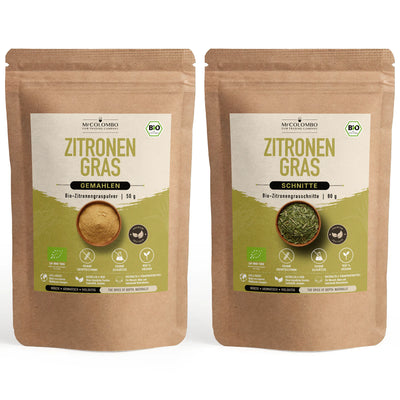
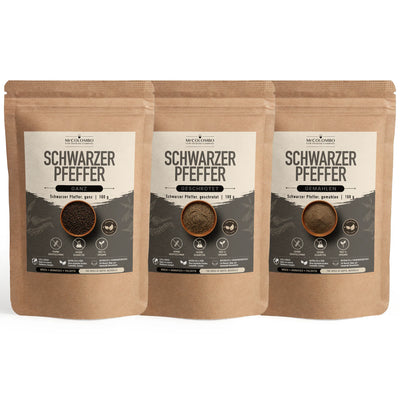
Dried lemongrass (Cymbopogon citratus) in coarse pieces is probably the most underrated fermentation addition of all. Two to three pieces of stalk in the jar give a citrusy freshness that carries the acidity without masking it, and they go particularly well with carrot, kohlrabi and radish. Use only dried or thoroughly washed ingredients, and consistently keep everything fully under the brine. Stiftung Warentest (2025) also advises sterilising the jars for 10 minutes before filling, and names spinach, tomatoes and salad cucumbers as unsuitable for lactic acid fermentation. Black pepper from the Sri Lankan highlands around Matale additionally brings a resinous depth to the jar; its pungent compound piperine sits mainly in the outer fruit husk, which is why whole peppercorns release their aroma slowly and leave the brine clear. How strongly growing altitude and drying affect the result is something we have described in detail in the article Black pepper quality.
Our way at MrCOLOMBO
We buy chilli, pepper and turmeric directly from smallholders in Jaffna and the Central Province and know every stage of the supply chain personally. Our turmeric from Jaffna is EU-certified organic under DE-ÖKO-005. What counts most for fermentation is how consistently the produce is re-dried: in Sri Lanka's monsoon climate, goods lying on open mats absorb moisture again within a few hours. If the residual moisture rises, so does the risk of mould formation and aflatoxins, for which limits of 5 ppb (B1) and 10 ppb in total apply in the EU. More on this in our overview of spices from Sri Lanka.
What distinguishes chutney from fermented vegetables?
The difference lies in the principle of preservation: classic cooked chutney is preserved by sugar and vinegar, fermented vegetables by lactic acid bacteria. A cooked-down mango chutney is therefore preserved and not fermented, so it contains no live cultures. It falls into the same category as jam: kept by sugar and acid, not by microorganisms. The word goes back to the Hindi word chatni, derived from chatna for "to lick" or "to taste"; the British spread the principle across their entire Empire during the colonial era. Typical of the North Indian spice profile are mustard seed, fenugreek seeds, coriander and green cardamom, whereas English-influenced variants tend to reach for curry powder and fresh ginger. Cooking shifts the aroma further: mustard seed loses its sharp pungency because the enzyme myrosinase needed for it is destroyed by heat. If you want to keep that pungency, stir part of the seed in only after cooking.
But there is also the uncooked variant: raw chutneys made from coconut, fresh coriander, chilli and lime, which are prepared fresh every day in South India and Sri Lanka and turn slightly sour within hours at room temperature. If you want to ferment deliberately, salt such a chutney with 2 per cent and leave it covered for 24 to 48 hours. Half a teaspoon of turmeric powder (Curcuma longa) not only adds colour but gives the mixture an earthy base that goes superbly with bean dishes; its pigment curcumin is fat-soluble, which is why a dash of coconut oil brings out the colour much more strongly than water alone. For the cooked variant, real Ceylon cinnamon is worth it instead of cassia: it is milder, more floral and contains considerably less coumarin. We have broken down the difference in detail in the post Ceylon cinnamon versus cassia cinnamon. Since 2 February 2022, Ceylon cinnamon has held EU protected status as a protected geographical indication, the very first Sri Lankan product to do so (Sri Lanka Export Development Board, 2022).
How do you tell whether a fermentation has failed?
The most important safety mechanism of lactic acid fermentation is the pH value: if it drops below 4.6, the BfR regards the food as sufficiently acidified, and Clostridium botulinum multiplies poorly in this acidic environment (BfR, 2023). Hence the simple rule that vegetables must be completely covered by brine at all times. A white, wrinkled layer on the surface is usually kahm yeast: harmless, unpleasant in taste, easy to skim off. Fuzzy, fluffy growth in green, black or pink, on the other hand, is mould, and then the entire batch must be discarded, not just the affected spot. Further warning signs are a putrid rather than sour smell, slimy brine and limp, mushy vegetables. Added to this is a caveat that is rarely spelled out: spices do shift the culture in the jar, but they compensate neither for unclean jars nor for too little salt nor for an interrupted cold chain. A pH test strip costs pennies and, in case of doubt, replaces any gut feeling.
Important
This article is for information purposes and does not replace medical advice. Fermented foods contain biogenic amines such as histamine and tyramine. If you have histamine intolerance, are pregnant or take MAO inhibitors, please discuss consumption with your doctor or pharmacist.
Keeping an eye on biogenic amines and nitrite
Two groups of substances deserve particular attention here. A review of biogenic amines in fermented foods concludes that toxic effects can occur well below the limit and threshold values discussed so far (Saha Turna et al., 2024). A series of measurements on four fermented vegetables found in fermented cabbage an average of 426.96 mg/kg biogenic amines and 12.13 mg/kg nitrite, and in individual samples up to 893.77 and 31.82 mg/kg respectively (Yu et al., 2021). In its opinion, EFSA (2011) points out that outside fishery products there are no EU-wide limits for tyramine and phenylethylamine. For a sense of scale: Regulation (EU) 2023/2108 lowered the permitted nitrite addition in meat products from 150 to 120 mg/kg sodium nitrite as of 9 October 2025, which corresponds to 80 mg/kg nitrite ions. Short fermentation times, clean jars and cool storage keep amine formation low. Anyone who reacts sensitively starts with small portions and young ferments, because the amine content increases with maturing time.

How do you recognise spices that are suitable for fermenting?
Not every spice from the supermarket shelf is suited to the fermentation jar. Three criteria decide. Firstly, dryness: the Spices Board India names a safe limit of under 15 per cent residual moisture for dried chilli pods; above that, the risk of mould and aflatoxin rises. Secondly, wholeness: whole seeds, sticks and leaves release their essential oils slowly and do not cloud the brine, whereas fine powders float, settle and oxidise faster. Thirdly, purity: ready-made spice blends often contain anti-caking agents, sugar or yeast extract, and all three play an unpredictable part in a fermentation. Sugar, for instance, gives the lactic acid bacteria extra food and speeds up the fermentation so much that the jar over-acidifies before the spice aromas have even infused the vegetables. So buy single spices instead and blend them yourself. To be fair, it should be said: whole Ceylon cinnamon sticks or peppercorns cost more than ground supermarket goods and release their aroma more slowly. In return they do not cloud the brine and can simply be fished out again at the end.
What the trade delivers
A look at commercial products shows why quality counts here. In May 2026 the Austrian consumer magazine Konsument tested thirteen kimchi products; active lactic acid bacteria could still be detected in only 3 unpasteurised products (Konsument, 2026). Öko-Test found, among 28 sauerkraut products, bisphenol A levels in several tinned products that were classified as strongly elevated, and in 4 products the insecticide spirotetramat, no longer approved in the EU since 2024; 11 of the 28 products received the top rating, and half of the tested goods carried an organic seal (Öko-Test, 2025). Anyone who ferments themselves avoids these problems entirely, provided the raw ingredients are right. As the world's largest cinnamon exporter, Sri Lanka covers around 27 per cent of global cinnamon demand and over 85 per cent of the market for true cinnamon, as well as around 7 per cent of global pepper demand (Sri Lanka Export Development Board). How to preserve freshness and grind in your store cupboard is explained in our post on storing spices properly.
Checklist before you start a batch
Is the spice really dry? Seeds must rattle when shaken, flakes must not stick together.
Is the origin stated on the packaging? A specific growing region is a better quality signal than any seal without an address.
Are additives declared? Anti-caking agents, sugar and yeast extract have no place in the fermentation jar.
Is the salt iodine-free and free from anti-caking agents? Iodine and anti-caking agents can slow down the lactic acid bacteria.
Is everything under the brine? A fermentation weight or a clean cabbage leaf reliably keeps the vegetables down.
Anyone who thinks of spices only as aroma gives away half the fermentation. They help decide which culture wins out.
MrCOLOMBO experience report
Is fermenting with your own spices worth it?
Fermenting with your own spices is worth it above all because you control two things at once: the aroma and the safety. With 2 per cent salt, 18 to 22 degrees and whole, dry spices, practically every batch succeeds, and unlike with pasteurised commercial goods, you know exactly what is in the jar. The global market for fermented foods stood at 258.97 billion US dollars in 2025, and 394.91 billion is forecast by 2034 at an annual growth rate of 4.80 per cent (Precedence Research, 2025). This figure comes from a commercial market researcher and remains an estimate, but it shows how quickly this old technique is currently making a comeback. Start with a single jar of carrots, peppercorns and a piece of Ceylon cinnamon. If you like the result, you will find in the Ceylon cinnamon range and in our spice range the right basic kit, and in the Sri Lanka curry recipe a dish that home-made pickles go with perfectly.