




A beetroot latte is a warm or cold drink made from beetroot juice or beetroot powder, plant-based milk and warming spices such as Ceylon cinnamon and cardamom, which contains no caffeine at all and gets its bright pink colour from the pigment betanin. With around 43 calories per 100 grams of beetroot (USDA data via Healthline) and a naturally high content of nitrate, folate and betalains, it has become a colourful alternative to the milky coffee.
The trend originally came to Europe from Australia and the USA and first became widely known in Germany in 2018 at the Berlinale (Fitness First, 2024). At MrCOLOMBO we are particularly interested in the spice side of things: the Ceylon cinnamon and the cardamom that give this latte its warm character come from exactly the regions of Sri Lanka from which we have been importing directly for years. This article explains the science behind the colour, provides a basic recipe and puts into perspective how much of it is safe to drink.
Short answer
What is a beetroot latte and is it healthy? It is a caffeine-free hot or cold drink made from beetroot juice or powder, plant-based milk and spices. Beetroot provides nitrate, which the body converts into nitric oxide via oral bacteria; in a meta-analysis of 11 studies, a systolic blood pressure that was on average 5.31 mmHg lower was observed afterwards (NMCD Journal, 2024).
At a glance
What exactly is a beetroot latte?
A beetroot latte, often called a "Beetroot Latte" or "Pink Latte", belongs to the group of caffeine-free feel-good drinks that serve as an alternative to the classic milky coffee, much like matcha or turmeric lattes. The base is beetroot juice or finely ground beetroot powder, a frothy plant-based milk and a pinch of warming spice. The market driver is a clear consumer trend: the global market for functional beverages stood at 151.7 billion US dollars in 2025 and, according to IMARC Group (2026), is growing by 5.5 per cent a year, with beetroot, matcha and turmeric explicitly named as colour and growth drivers. The choice of milk also follows the trend: in Germany, consumers spent 632 million euros on plant-based milk in 2025, an increase of 7.7 per cent (GFI Europe, 2026).

Beetroot itself is anything but a short-lived hype. The root has been cultivated in the eastern Mediterranean for around 4,000 years (samen.de, 2024) and still plays a central role in Eastern European cuisine today, for example as borscht, which was declared intangible cultural heritage by UNESCO in 2022. The fact that beetroot was voted "Vegetable of the Year" for 2023 and 2024 by the Association for the Preservation of Crop Diversity underlines its renaissance. The latte thus combines a winter vegetable steeped in tradition with a modern café format that became popular above all through social media.
What are betalains and where does the pink colour come from?
The intense colour of beetroot does not come from artificial additives but from a group of natural plant pigments, the betalains. Beetroot contains a total of around 30 of these pigments, divided into red-violet betacyanins and yellow-orange betaxanthins (PMC, 2024). The most important of these is betanin, which is responsible for the characteristic pink to magenta tone and is approved in the food industry as the natural colouring E162. It is precisely these pigments that distinguish the beetroot latte from other red drinks and make it more than just an eye-catcher. A review (Srivastava et al., 2024) described that betanin can inhibit the enzyme COX-2 in the laboratory; such effects are the subject of current research and are not to be equated with an effect in the human body.
How much pigment is contained in the root depends heavily on the variety, degree of ripeness and growing conditions. A study (MDPI Agronomy, 2024) showed that antioxidant capacity correlates directly with betalain content and that red varieties contain significantly more of it than yellow or white ones. In practical terms for the latte, this means: if you work with powder, you should look for gently cold-dried produce, because betalains are heat-sensitive. Consumer comparisons (topratgeber24.de, 2026) recommend powder that has been dried below 45 degrees Celsius in order to preserve the pigments. When making the drink, the rule is therefore: first dissolve the powder in a little hot liquid, then add the milk, never the other way round.
How does the nitrate from beetroot work in the body?
The second interesting constituent of beetroot is its naturally high nitrate content, and here it is worth taking a look at the mechanism that most recipe sites leave out. Fresh beetroot contains on average 1,904 milligrams of nitrate per kilogram (LGL Bayern, 2013). After consumption, the salivary glands take up around a quarter of the dietary nitrate, bacteria on the tongue reduce it to nitrite, and in the acidic stomach this turns into nitric oxide (NO). This gas relaxes the smooth muscle of the blood vessels by activating the enzyme guanylate cyclase (PMC, 2020). It is precisely via this nitrate-nitrite-NO pathway that researchers explain the effect on the circulation observed in studies.

What matters here is the distinction between nitrate from vegetables and nitrate from processed meat. Both measurably raise nitrate and nitrite levels in the blood (Examine.com, 2024), but vegetable nitrates always come combined with vitamin C and antioxidants, which inhibit the formation of unwanted nitrosamines. The German Federal Institute for Risk Assessment (BfR) therefore expressly recommends a varied selection of vegetables rather than abstaining, and states that the benefits of nitrate-rich vegetables outweigh the risks. Unlike for spinach or lettuce, there is no maximum nitrate level for beetroot in EU law.
Is a beetroot latte good for blood pressure, sport and concentration?
Research on beetroot revolves mainly around three fields: circulation, athletic endurance and cognitive performance. For blood pressure, a meta-analysis of 11 randomised studies with 349 participants (NMCD Journal, 2024) showed a systolic value that was on average 5.31 mmHg lower after consuming beetroot juice. One caveat belongs here: in an investigation with continuous intake over four weeks, this effect did not persist consistently (Jonvik et al., 2024). Beetroot is therefore not a medicine but a food, whose observations should be put into sober perspective. Anyone with blood pressure requiring treatment should not replace medical advice with a drink.
In sport, beetroot juice is regarded as a well-researched aid. An umbrella review of 15 meta-analyses (PMC, 2025) found small but consistent improvements in time to exhaustion and oxygen uptake (VO2max effect size 0.26 in non-athletes), although the amounts studied, at 515 to 1,017 milligrams of nitrate per day, are well above a single latte. Cognition is also exciting: in a randomised study with 44 participants (PMC, 2024), better memory performance was observed after beetroot consumption, with an improvement in immediate recall of just under 21 per cent. Researchers attribute this to the increased cerebral blood flow via nitric oxide. Such results are promising, but they are snapshots from individual studies and not a promise of healing.
Important
This article is for information purposes and does not replace medical advice. Anyone taking blood pressure medication, who is pregnant or prone to kidney stones (oxalate) should discuss the regular consumption of larger amounts of beetroot with a doctor or pharmacist. Beetroot can also harmlessly turn urine and stool reddish.
Which spices go into a beetroot latte?
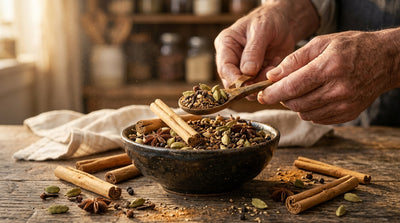
The classic spice combination for a beetroot latte consists of Ceylon cinnamon, cardamom and a hint of ginger, in other words exactly the warm aromas that also characterise a chai. This selection is no coincidence: the earthy-sweet beetroot needs an aromatic counterpoint, and Ceylon cinnamon provides it with its fine, less pungent note. True Ceylon cinnamon (Cinnamomum verum) from Sri Lanka contains considerably less coumarin than the cassia cinnamon commonly found in shops, which makes it more pleasant for daily enjoyment. We have described the difference between the two types of cinnamon in detail in the article Ceylon cinnamon versus cassia cinnamon. For the latte, a small pinch of ground Ceylon cinnamon or a cinnamon stick simmered along with the milk is enough.
These spices also fit well from a scientific point of view, because they are examined in research in similar contexts to beetroot. For cardamom, a meta-analysis of 8 studies with 769 participants (PMC, 2024) described changes in inflammation markers such as hs-CRP and IL-6 at an intake of 3 grams per day. For Ceylon cinnamon, laboratory investigations (PMC, 2022) found COX-inhibiting activity, carried by the main aroma compounds eugenol and cinnamaldehyde. If you want to learn more about the world of flavours on the island, you will find the background in our overview of spices from Sri Lanka. We source our Ceylon cinnamon directly from the central region of the island, where the warm, humid climate produces the trees with the thin, multi-layered bark.
How do you make a beetroot latte step by step?
A beetroot latte is ready in under five minutes and works with just a few ingredients. For one cup (about 250 millilitres) you need around 60 millilitres of beetroot juice or a heaped teaspoon of beetroot powder, 200 millilitres of oat milk, a small pinch of Ceylon cinnamon, a knife tip of ground cardamom and, to taste, a little honey or maple syrup. Oat milk is not just a matter of taste: with an EU market share of 38.6 per cent it is the most purchased plant-based milk (GFI Europe, 2026) and froths particularly well thanks to its protein and fat content. If you prefer something more classic, use a barista-grade soya drink. The colouring power of beetroot is enormous; a splash is enough for a strong colour.
Beetroot latte in 4 steps
Prepare powder or juice? Stir one teaspoon of beetroot powder into two tablespoons of hot water until smooth, so that no lumps remain. If using juice, skip this step.
Heat and spice the milk? Heat 200 millilitres of oat milk with Ceylon cinnamon and cardamom to about 65 degrees, do not boil, so that the heat-sensitive betalains are preserved.
Froth? Whip the spiced milk until frothy with a milk frother or whisk and stir it into the beetroot base.
Season and garnish? Sweeten to taste and dust with a pinch of cinnamon. For the look, put a little foam on top.
When buying the fresh root, a look at the season helps: beetroot has its main season from September to March, keeps in the fridge for up to two weeks and, at about 40 kilocalories per 100 grams, is comparatively light (BZfE). Wear gloves or an apron when cutting, because the colour is stubborn. If you do not want to press fresh beetroot, go for a high-quality not-from-concentrate juice or for powder, which is particularly easy to measure out. Our beetroot powder is practical for this because it keeps for a long time and can also be stirred into smoothies, porridge or dough.
What variations of the beetroot latte are there?
The basic recipe is easy to vary, and it is precisely this variety that has made the drink popular on social media. The fact that cold, ready-to-drink formats in particular set the tone is also shown by the market: the ready-to-drink segment accounted for over 45 per cent of sales in the global superfood beverages market in 2024 (Fortune Business Insights, 2025). For summer, the iced version is popular: prepare beetroot juice cold with cardamom and vanilla, pour over ice cubes and top up with cold oat milk. The Dalgona beetroot latte is considered a TikTok trend, in which beetroot powder is whipped up with hot water until frothy and placed as a pink cap on cold milk. If you like it dessert-style, combine the beetroot with chocolate plant-based milk and vanilla to make a "Red Velvet Latte". And for caffeine lovers there is the Pink Flat White with a shot of espresso.

If you fancy a slightly warmer flavour profile, add fresh ginger, briefly boiled up with the juice, or stick to a chai-like blend of cardamom, cinnamon, ginger and a clove. These spice ideas combine well with other latte classics: if you enjoy caffeine-free indulgence, you will find a related feel-good drink in our recipe for golden milk with turmeric, and for the spicy black-tea note it is worth taking a look at our iced chai latte recipe. In this way, a single spice drawer gives rise to a whole range of drinks for every season.
How much beetroot latte is safe?
For healthy adults, one beetroot latte a day as part of a varied diet is safe. As a guide, the acceptable daily intake for nitrate set by EFSA is 3.7 milligrams per kilogram of body weight, which for a person weighing 60 kilograms corresponds to around 222 milligrams of nitrate per day (EFSA, 2017). A single glass of latte with 60 millilitres of juice stays well below this; even concentrated juice provides about 300 milligrams per 70 millilitres (Bescos et al., 2023). What matters is the total amount from all sources over the day, which is why the BfR advises variety rather than one-sidedly high amounts.
We treat beetroot like our spices: an honest food with character, not a remedy. If you enjoy it instead of overdoing it, you get the best out of it.
MrCOLOMBO experience report
Caution is called for in a few cases: people with a tendency to oxalate kidney stones should avoid larger amounts, and anyone taking blood pressure medication is better off discussing regular consumption with a doctor. The reddish colouring of urine or stool is harmless and affects roughly one in ten to one in four people, depending on iron status and stomach acid. Overall, the benefits of a colourful, vegetable-rich diet outweigh, and a beetroot latte fits into it wonderfully, precisely because it contains no caffeine at all and can still be enjoyed in the evening.
Our approach at MrCOLOMBO
We import Ceylon cinnamon, cardamom and beetroot powder directly from partner farms in Sri Lanka and know every stage of the supply chain personally. Our aim is gentle processing so that colour and aroma are preserved. You will find the full range in our spice range.
Is the beetroot latte worth it?
The beetroot latte is more than a pretty social media drink: it combines a winter vegetable steeped in tradition with genuine functional constituents such as betalains and nitrate, and contains no caffeine at all. Science provides exciting observations on circulation, endurance and concentration, which should, however, be read soberly as study results and not as a promise of healing. If you prepare the drink with true Ceylon cinnamon and cardamom from Sri Lanka, you lift it to another level in terms of taste. As a next step, try our recipe for golden milk if you like caffeine-free latte variations.