


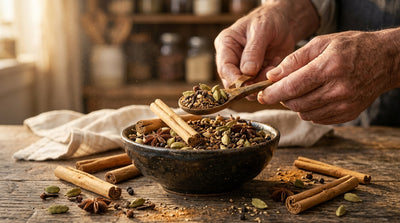
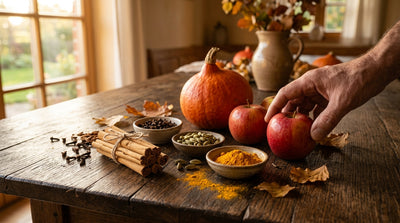
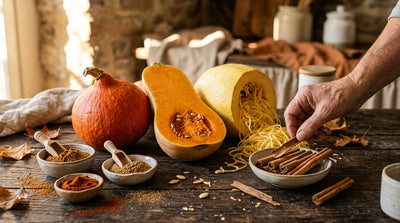
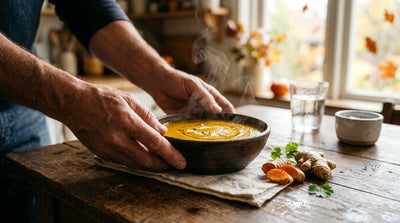

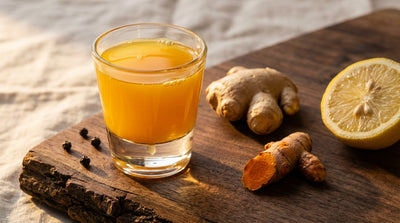


At its core, a mango and turmeric smoothie needs only five ingredients: a ripe mango, 1 teaspoon of turmeric powder, 200 to 250 ml of plant-based milk, a small piece of ginger and a pinch of black pepper. In around five minutes, this combination gives you a bright golden summer breakfast with roughly 150 to 214 kcal per glass.
At MrCOLOMBO we import turmeric and black pepper directly from smallholder farmers in Sri Lanka and know every stage of the supply chain personally. In this recipe we explain how to combine both ingredients properly and how to recognise good quality.
Short answer
How do you make a mango and turmeric smoothie properly? Blend ripe mango, 1 tsp of turmeric, plant-based milk, a little ginger and a pinch of black pepper in a blender for 20 to 30 seconds until creamy.
At a glance
How do you prepare a mango and turmeric smoothie?
The basic recipe makes two glasses and comes together in around five minutes. You will need: 1 ripe mango (about 200 g of flesh), 1 ripe banana or alternatively 70 g of silken tofu for more protein, 1 level teaspoon of turmeric powder, a piece of fresh ginger about 1 cm in size, 200 to 250 ml of plant-based milk (coconut or oat milk), the juice of half a lime and a generous pinch of freshly ground black pepper. If you like, sweeten with a teaspoon of honey or agave syrup. All the ingredients go into the blender together and are blended on the highest setting for 20 to 30 seconds until the mixture is creamy. Depending on the ingredients, a finished portion comes to between 150 and 214 kcal (FitTasteTic, 2024).

For the summer version, use frozen mango pieces and a frozen banana instead of fresh fruit. This makes the smoothie creamy and cool without ice cubes and without watering it down. In our review of eight common mango and turmeric recipes, five recommend frozen fruit as standard because it improves the texture. If you blend all the ingredients frozen and use a little less liquid, you get a spoonable smoothie bowl. If you prefer something more traditional, you will find essentially the same idea in Indian golden milk, only warm instead of cold. In a sense, the smoothie is the summery evolution of this centuries-old turmeric drink.
Three steps to your smoothie
Prepare? Peel and dice the mango, peel the ginger, peel the banana. For the chilled version, freeze the fruit in advance.
Blend? Put all the ingredients, including the pinch of pepper, into the blender and blend for 20 to 30 seconds until creamy.
Season? Balance with lime juice and a little sweetness, then enjoy straight away while the vitamins and colour are at their brightest.
What makes turmeric so special in a smoothie?
Turmeric (Curcuma longa) owes its sunny yellow colour to a group of plant compounds, the curcuminoids. The most important of these is curcumin, which makes up around 75 per cent of the curcuminoids (El-Saadony et al., 2023). Depending on the harvest season, turmeric contains between 3 and 8 per cent curcumin by dry weight, so a level teaspoon of powder (about 3 g) provides roughly 30 to 90 mg of curcumin. Curcumin is one of the most extensively studied natural substances of all: the PubMed database lists over 13,000 studies on it (Examine.com, 2026). In the Ayurvedic tradition, turmeric has been used for more than 4,000 years and is mentioned in writing as early as the Atharva Veda. If you want to dive deeper into the substance, you will find the details in our article on the effects of turmeric.
What is in a ripe mango?
The mango is more than just the sweet base of the smoothie. Per 100 g of flesh it provides 36.4 mg of vitamin C, 640 µg of beta-carotene and 169 mg of mangiferin at around 60 kcal (Lebaka et al., 2021). A cup of fresh mango (about 165 g) therefore covers roughly two thirds of the daily vitamin C requirement at less than 100 kcal (Healthline, 2025). Vitamin C contributes to the normal function of the immune system; this is a nutrient claim authorised by the EFSA. Added to that is potassium, at about 277 mg per cup. The bright colour and natural sweetness make the mango the ideal partner for the rather earthy, bitter turmeric.

In Sri Lanka, the mango has a long history and an established place in agriculture. Varieties such as Karthakolomban, Betti and Vellaicolomban grow on around 28,372 hectares, with two harvest peaks a year from April to July and from October to January (Idirisinghe, 2024). Worldwide, about 61 million tonnes of mango were harvested in 2023, with India leading at around 43 per cent (FAO, 2024). We know the growing regions from our own experience: the combination of tropical fruit and spice is everyday life in South Asia, not a trend. For our spices we maintain direct trading relationships with cooperatives whose fields we have visited in person, as we describe in our overview of spices from Sri Lanka.
What flavour note does black pepper bring to the smoothie?
A small pinch of freshly ground black pepper complements mango and ginger with a mild heat.

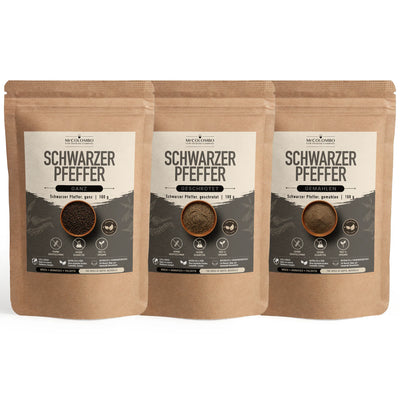
Freshly ground pepper brings a more intense aroma to the smoothie. Our black pepper comes from the highlands of Sri Lanka, where the warm, humid climate produces particularly aromatic peppercorns. You will find a wider selection of whole and ground black pepper, imported directly, in our shop.
How do fat and ginger complement the turmeric smoothie?
The ginger in the recipe is also more than a flavouring. In a laboratory study (Zhou et al., 2022), the combination of ginger and turmeric in a ratio of 5:2 inhibited the inflammatory messenger IL-6 more strongly than either component alone; the measured combination index of 0.23 points to a synergistic interaction. This is basic research in the laboratory and not a promise of healing, but it shows why the classic trio of turmeric, ginger and pepper has a long tradition in many cultures. Gingerols give ginger its characteristic heat and round off the fruity sweetness of the mango pleasantly.
What does the research on turmeric really show?
With turmeric, it is worth taking a sober look at the state of the research rather than at advertising promises. An umbrella meta-analysis of ten studies with 5,870 participants found a statistically significant effect of curcumin supplements on inflammation markers such as CRP, IL-6 and TNF-alpha (Naghsh et al., 2023). At the molecular level, researchers are investigating how curcumin influences the NF-kB signalling pathway (Liu et al., 2025) and acts on enzymes such as COX-2 (Hewlings and Kalman, 2017). Important for context: many of these results come from studies with high-dose supplements, not from the kitchen quantity in a smoothie.
Our approach at MrCOLOMBO
We see the smoothie as a delicious breakfast with a high-quality spice, not as medicine. If you are interested in the scientific mechanisms, you will find a detailed assessment compliant with the Health Claims Regulation (HCVO) in our article on the effects of turmeric.
Consumer advocates urge realism: for many of the advertised effects in humans, robust evidence is lacking, and 88 per cent of 86 curcumin supplements tested showed shortcomings (Verbraucherzentrale, 2026). A court also prohibited the name “Immun-Smoothie” for a children's product as an inadmissible health claim (foodwatch, 2026). That is why we deliberately word things cautiously: turmeric can be a valuable part of a varied diet, but it does not replace a balanced diet or medical advice.
Is a smoothie suitable as breakfast?
As an occasional breakfast, a home-made fruit smoothie is a sensible choice. Fruit smoothies have a low glycaemic index of 36 to 39 and a moderate glycaemic load of about 9.7 to 11.4 (Saltaouras et al., 2019). Even after blending, around 17 per cent of the fibre is retained, unlike with clear juice. To keep you feeling full for longer at breakfast, it is advisable to combine fruit with a source of protein and healthy fats (ÖKO-TEST, 2024), for example silken tofu, Greek yoghurt or hemp seeds.
| Criterion | Home-made | Ready-made from the bottle |
|---|---|---|
| Fresh ingredients freely selectable | Yes | No |
| Sugar content controllable | Yes | No |
| Price per litre | inexpensive | €3.45 to 10.15 |
A word on context: the German Nutrition Society (DGE) counts smoothies as at most one portion of fruit and vegetables per day and prefers whole fruit, because fibre is lost during blending and the feeling of fullness is lower (DGE, 2024). So a smoothie does not replace the recommended five portions a day, but it can cover one of them. In the Stiftung Warentest test (2021), only 6 out of 25 ready-made smoothies were convincing, which makes the home-made version all the more attractive. Freshly blended, you know exactly what is in it and can dose the sweetness yourself.
What should you look for when buying turmeric?
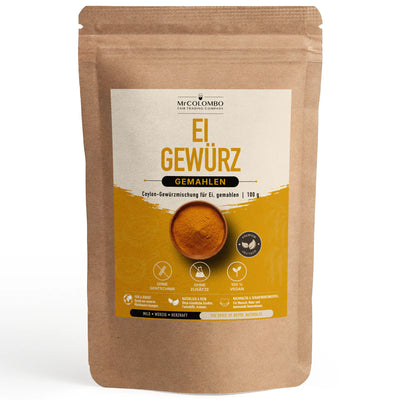
The quality of the turmeric determines the colour, aroma and purity of the smoothie. A laboratory test by ÖKO-TEST (2022) examined 19 turmeric powders, and only one was rated very good: 16 out of 19 products contained strongly elevated mineral oil hydrocarbons, and one organic product even contained banned ethylene oxide. The curcumin content also varies enormously; in an analysis of commercially available powders it ranged between 0.58 and 3.14 per cent, with an average of just 1.51 per cent (Tayyem et al., 2006). Organic produce reduces the pesticide risk but is no guarantee against mineral oil. Our organic turmeric from the Jaffna region in the north of Sri Lanka is EU organic certified and comes directly to us without intermediaries.
Checklist for good turmeric
Bright colour? A deep sunny yellow suggests a high curcumin content; pale powder often points to bulking or age.
Origin clearly declared? A specific growing region is a good sign; anonymous blended goods rather less so.
Organic seal present? EU organic lowers the pesticide risk and usually stands for stricter controls.
You can recognise fresh turmeric by its intense, slightly resinous scent and by its colour, which comes through strongly the moment you blend it. If you value purity and a traceable origin, certified organic produce is a good choice. Our entire range of turmeric comes from Sri Lanka, where we know the fields and processing facilities personally. That way, the spice that ends up in your smoothie has a fully documented journey from field to glass.
How much turmeric a day is safe?
For the kitchen quantity in a smoothie, you need not worry. The German Federal Institute for Risk Assessment and the EFSA cite an acceptable daily intake (ADI) of 3 mg of curcumin per kilogram of body weight (BfR, 2021; EFSA, 2014). For a person weighing 70 kg, that corresponds to about 200 mg of curcumin or around 7 g of turmeric powder per day (Verbraucherzentrale, 2026). A teaspoon in a smoothie, at about 3 g, is well below that. High-dose food supplements, on the other hand, are the critical issue: the BfR warns that their ADI is easily exceeded and that isolated cases of liver problems have occurred.
Important
This article is for information purposes and does not replace medical advice. Anyone taking blood thinners, who has gallstones, is pregnant or wishes to consume large quantities of turmeric regularly should discuss this beforehand with a doctor or pharmacist. For health-related questions, please consult a medical professional.
Is the mango and turmeric smoothie worth it as a summer breakfast?
The mango and turmeric smoothie combines a quick, summery breakfast with a well-considered use of spice. The details are what count: fresh, high-quality ingredients, a little fat from plant-based milk and honest expectations without exaggerated healing promises. That is how five simple ingredients become a breakfast that tastes good and is fun. If you want to start with good spices, you will find our directly imported range from Sri Lanka in the shop - the button below takes you straight there. Enjoy, and have a golden summer.