



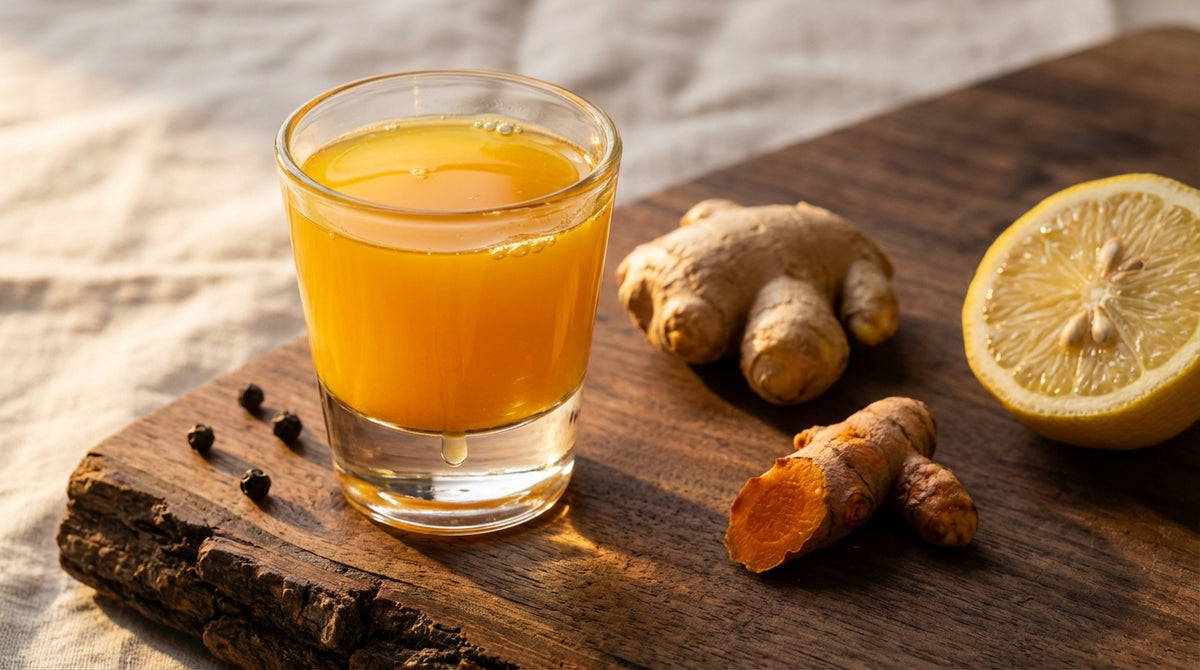
A home-made ginger-turmeric shot consists of fresh ginger, turmeric, lemon juice and a pinch of black pepper - ready in three minutes and keeps for up to five days in the fridge. The decisive difference from a ready-made product: according to Stiftung Warentest (2021), a freshly prepared shot contains around a third more pungent compounds than the best shop-bought products tested. The global market for wellness shots is growing at an annual rate of 8.7 % and is expected to reach a volume of 2.97 billion US dollars by 2033 (Growth Market Reports, 2024). In this article you will learn how to prepare the shot with the optimal ratio, which active compounds it actually contains and what you should look out for when it comes to dosage and the quality of the ingredients.
Turmeric and ginger have been used in combination in the Ayurvedic tradition for more than 4,000 years (Prasad & Aggarwal, 2011). Archaeological finds near New Delhi date the joint use of both rhizomes to around 2,500 BC (PBS Food). What began as a traditional home remedy is today the subject of more than 13,000 scientific publications on curcumin alone on PubMed. The ginger-turmeric shot combines this millennia-old knowledge with modern nutritional science - and can be prepared at home with just a few organic-quality ingredients.
At a glance
Which active compounds are found in ginger and turmeric?
Ginger (Zingiber officinale) contains at least 115 identified bioactive compounds, with the gingerols - in particular [6]-gingerol - regarded as the main active compounds (Bode & Dong, 2011). Gingerols give ginger its characteristic pungency and are being studied in research for their inflammation-modulating properties. Four further relevant groups of substances are shogaols, paradols, zingerone and essential oils, which form in varying concentrations during drying and heating (Ayustaningwarno et al., 2024). A fresh ginger shot contains mainly gingerols, as these are heat-sensitive and are preserved in cold preparation.
Turmeric (Curcuma longa) owes its intense yellow colour to the polyphenol curcumin, which makes up 2-9 % of the dry weight depending on the variety and growing region (Restivo, 2024). Curcumin is the subject of more than 13,000 scientific publications on PubMed and is being studied for a wide range of biological properties - including antioxidant and inflammation-modulating mechanisms (Zeng et al., 2022). The biggest challenge with curcumin is its low bioavailability: without auxiliary substances, it is barely absorbed in the gut and is rapidly excreted via the liver. If you would like to delve deeper into the effects of turmeric, you will find further details in our golden milk guide.
More recent research is also looking into the effect of ginger on the immune system: a clinical study at the University of Michigan medical centre showed that as little as 100 mg of ginger extract daily over seven days influenced the activity of neutrophil immune cells (Ali et al., 2023, JCI Insight). In this process, the active compound [6]-gingerol activates the TRPV1 receptor on neutrophils at a concentration of around 15 µg/L - a value which, according to an investigation by the Leibniz Institute (2023), can be reached with one litre of ginger tea made from 100 g of fresh ginger.

Why do ginger and turmeric belong together?
The combination of ginger and turmeric is not a modern marketing gimmick but a tradition thousands of years old: in the Ayurveda compendium of Susruta (c. 250 BC), both rhizomes are already recommended together (Prasad & Aggarwal, 2011). Modern research offers a possible explanation for this tradition. A cell study by Zhou et al. (2022) examined various mixing ratios and found that ginger and turmeric in a 5:2 ratio showed a synergistic inhibition of inflammatory markers such as NO, TNF-α and IL-6 - with a combination index of 0.23 to 0.61, which points to genuine synergy. Used individually, the effect in this laboratory model was considerably smaller.
In practical terms, this result means: anyone preparing a ginger-turmeric shot should use more ginger than turmeric by quantity. A tried-and-tested ratio is 50 g of ginger to 20-25 g of turmeric for around 4-5 shots. This ratio also works in terms of flavour, since too much turmeric makes the shot bitter and earthy, while ginger provides the pleasant pungency and freshness. In Ayurvedic cooking, the combination of both spices with black pepper is known as "Trikatu" - if you would like to learn more about this tradition, you will find further background in our article on spices from Sri Lanka.
How does black pepper complement the flavour of the turmeric shot?
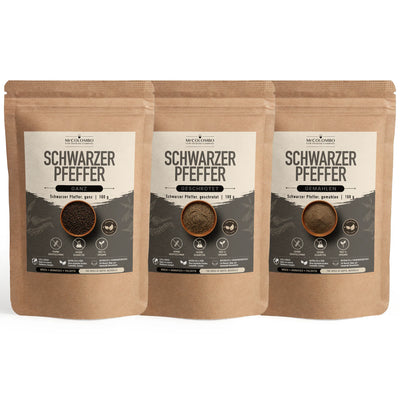
A pinch of freshly ground black pepper complements the shot with heat. A teaspoon of cold-pressed linseed oil or coconut oil gives it a rounder flavour.
Practical tip
For a fresh aroma, add three to five twists from the pepper mill directly into the finished shot.

How do you make a ginger-turmeric shot yourself?
For four to five shots you only need a handful of ingredients and a blender or hand blender - a juicer is not necessary. The following basic recipe is based on the scientifically studied 5:2 ratio of ginger to turmeric (Zhou et al., 2022) and has been optimised along the lines of the home recipe validated by Apotheken Umschau (Kailitz-Kunz/Kremser, 2025).
Ingredients (for 4-5 shots of 40 ml each)
| Ingredient | Quantity | Function |
|---|---|---|
| Fresh ginger (organic) | 50 g | Gingerols, pungency |
| Fresh turmeric (organic) | 20 g | Curcumin, colour |
| Lemons (freshly squeezed) | 2 pieces | Vitamin C, acidity |
| Orange juice (fresh) | 100 ml | Mildness, sweetness |
| Black pepper | 1 pinch | Heat and aroma |
| Honey or agave syrup | 1 tsp (optional) | Sweetness, digestibility |
Preparation step by step
Step 1: Wash the ginger and turmeric thoroughly. With organic quality, leave the skin on - most of the gingerols sit directly beneath the skin. Cut roughly into pieces. Caution: turmeric stains fingers and chopping boards an intense yellow - use gloves and a dark board.
Step 2: Squeeze the lemons. Put the ginger, turmeric, lemon juice and orange juice into the blender. Blend at the highest setting for 30-45 seconds until a smooth, golden-yellow mixture forms.
Step 3: Strain the mixture through a fine sieve or a nut-milk bag and press out well. The remaining pulp can be dried and reused as a spice for curries or smoothies.
Step 4: Pour the finished shot into small glasses or bottles. Only now stir in the freshly ground pepper and, optionally, the honey. Drink 30-40 ml per portion in one go - ideally in the morning before breakfast.
Three popular variations
Orange-mild (beginners): 30 g of ginger, 10 g of turmeric, 2 oranges, 1 lemon, pepper. Less pungent, ideal for getting started. Power variation with oil: add a teaspoon of cold-pressed linseed oil to the basic recipe. Batch method for freezing: prepare four times the basic recipe and pour into ice-cube trays. Frozen, the shots keep for up to three months. In the morning, simply let a cube thaw or dissolve it in warm water - this saves you the daily preparation.
Home-made or shop-bought - which is better?
In 2021, Stiftung Warentest examined a total of 19 ready-made ginger shots and compared their content of pungent compounds (gingerols and shogaols) with a home-made reference recipe. The result: the home-recipe shot contained around a third more pungent compounds than the best shop-bought products tested. Heat-treated ready-made products - that is, the majority in the supermarket - contained only half as many pungent compounds as the freshly prepared shot. Some commercial shots also contained more sugar per 100 ml than cola.
ÖKO-TEST (2022, updated 2026) tested 20 ready-made ginger shots with sobering results: 7 products were contaminated with pesticides - one product contained no fewer than three different residues. A further 7 products contained no detectable vitamin C, even though they were advertised as strengthening the immune system. Only 2 of the 20 products received the rating "very good". When it comes to price, too, everything speaks for making your own: a home-made shot costs between 0.30 and 0.80 euros, while ready-made products cost 2.50 to 4.50 euros per portion - a saving of 75-90 %. If you rely on organic turmeric of verified quality, you also minimise the pesticide risk at the same time.
How do you store and dose ginger-turmeric shots correctly?
In the fridge, freshly prepared shots keep in sealed glass bottles at below 7 °C for up to five days - the lemon juice acts as a natural preservative and slows down oxidation (Fitrezept.com). Frozen in ice-cube trays, the shots keep for up to three months without the gingerols being degraded to any notable extent. The batch method is particularly suitable for working people: prepare once a week, freeze, thaw a cube in the morning - done.
As for dosage, Apotheken Umschau (Kailitz-Kunz/Kremser, 2025) recommends one 40 ml shot per day. The European Food Safety Authority (EFSA, 2010) sets the ADI value for curcumin at 0-3 mg per kilogram of body weight per day - for a person weighing 70 kg, that is a maximum of 210 mg of curcumin daily. A shot with 20 g of fresh turmeric - which contains around 80 % water - provides roughly 80-240 mg of curcumin. The German Federal Institute for Risk Assessment (BfR, 2021) points out that a normal diet typically accounts for less than 7 % of the ADI value. Anyone who also takes curcumin food supplements should keep an eye on their total intake.
Important
This article is for information purposes and does not replace medical advice. If you have gallstones or liver disease, are pregnant or are taking blood thinners, consult your doctor or pharmacist before consuming ginger-turmeric shots regularly.

Why is the origin of the ingredients decisive?
Sri Lanka is the world's tenth-largest spice-exporting nation, with an export volume of 449.91 million US dollars and more than 40,000 tonnes per year (Sri Lanka Export Development Board, 2025). The tropical climate of the Central Province - with growing regions around Kandy, Matale and Kurunegala - offers ideal conditions for turmeric with a curcumin content of 2-6 %, depending on the variety and growing zone (Department of Export Agriculture Sri Lanka, 2023). Ginger thrives in the same regions and benefits from the volcanic soils and the even humidity. Freshly harvested Sri Lankan turmeric can be recognised by its bright orange-yellow cut surface and its intensely earthy, slightly resinous aroma - noticeably stronger than the pale yellow imported goods that have often been held in interim storage for months.
The ÖKO-TEST results on turmeric powder (2022) show why origin matters: 16 of the 19 products tested contained mineral oil residues (MOSH) above 4 mg/kg, and one organic product even contained ethylene oxide, which is banned in the EU. If you want quality in your shot, you need ingredients from controlled cultivation with a transparent supply chain. At MrCOLOMBO we import turmeric and ginger directly from smallholder farmers in Sri Lanka - from the field in the Central Province to dispatch in Germany, we know every stage personally. If you would also like to prepare golden milk yourself, our recipe offers a further way to use high-quality turmeric in everyday life.
Making a ginger-turmeric shot yourself - the key points summarised
A home-made ginger-turmeric shot is prepared in three minutes, costs a fraction of ready-made products and, according to Stiftung Warentest, contains considerably more pungent compounds. If you pay attention to organic quality and transparent origin, you avoid the pesticide and contaminant problems of many ready-made products documented by ÖKO-TEST.
You will find further recipe ideas with turmeric and ginger in our articles on golden milk and on spices from Sri Lanka.