



The classic cooling summer spices in Ayurveda are green cardamom, fennel and coriander. All three belong to the sweet, bitter and astringent tastes which, according to traditional teaching, pacify the Pitta dosha, while salty, sour and pungent tastes aggravate it (Kripalu Center; Ayurveda Journal). In Ayurveda, summer is regarded as the Pitta season, in other words the time of year in which heat and sharpness already predominate in the body. The simplest everyday form is the CCF infusion: bring half a teaspoon each of cumin, coriander and fennel to the boil in 500 millilitres of water, leave to steep for five to ten minutes and drink it lukewarm, spread over the day. For cardamom there is even a clinical dosage on record: in a double-blind randomised study with 87 overweight and obese participants, two capsules of 500 milligrams of cardamom each were given three times a day over three months, in total 3 grams per day (Daneshi-Maskooni et al., 2019).
What is missing from almost all German-language Ayurveda summer articles is the origin. Cardamom originally comes from the humid mountain rainforests of southern India and Sri Lanka (Plantura, 2024), and we at MrCOLOMBO import our spices directly from smallholder farmers in Sri Lanka, without intermediaries. The cardamom that sits on European shelves today, however, mostly comes from Kerala or Guatemala, because that is where the bulk of production is now based. That also explains why quality and price fluctuate so strongly with cardamom: the global market is estimated at 1.73 billion US dollars for 2026, with erratic harvests in India and Guatemala as the main drivers of volatility (estimate by Mordor Intelligence, 2026). Anyone who cooks with these spices every day in summer notices the difference between fresh stock and two-year-old stock immediately in the aroma. And we are not talking about tiny quantities: half a teaspoon each of fennel, coriander and cumin per day adds up over the three summer months to around 280 grams of seeds per household, a quantity at which growing region and harvest year make a noticeable difference.
Short answer
Which spices have a cooling effect in summer according to Ayurveda? Green cardamom, fennel and coriander are regarded as the three classic Pitta-balancing summer spices, supplemented by mint, rose petals and lemongrass (Ayurveda Journal; Kripalu Center). They taste sweet, bitter or astringent, whereas pungent, sour and salty flavours such as chilli, ginger and cinnamon aggravate Pitta according to classical teaching. In practice this is put into action with CCF tea, lassi with cardamom or a fennel and cardamom lemonade - all at room temperature rather than ice-cold.
At a glance
What does the Pitta season mean in Ayurveda?
Ayurveda assigns the Pitta dosha to summer, the one of the three fundamental forces that stands for heat, transformation and metabolism. The Tridosha teaching of Vata, Pitta and Kapha is described in the Charaka Samhita, one of the two founding texts of Ayurveda (Britannica). Modern attempts at interpretation assign Pitta to energy metabolism, for instance in a review that proposes four complementary research approaches to the Tridosha theory (Hankey, Ancient Science of Life, 2010). The practical rule for summer cooking is simple: of the six Ayurvedic tastes, sweet, bitter and astringent balance Pitta, while salty, sour and pungent aggravate it (Kripalu Center). In Sanskrit they are called madhura, amla, lavana, katu, tikta and kashaya; cooling refers to the attributed potency shita virya, the counterpart to the heating ushna virya. This is why leafy vegetables, mint, fennel and cardamom move to the fore in summer, while chilli, garlic and ginger are used more sparingly. In terms of nutritional physiology, this coincides with the recommendation to eat light, water-rich food in hot weather and to drink around 1.5 litres a day, more on hot days (DGE, 2025).
How robust is the Ayurvedic constitution teaching of Vata, Pitta and Kapha? Honestly speaking: the assignment of a person to a constitution type has not yet been clinically standardised. An evaluation of 64 Prakriti assessment tools developed between 1987 and 2024 found only two tools that met seven of nine criteria of a validation framework (Venkatesh et al., Frontiers in Medicine, 2025). That does not mean the summer recommendations are useless, but that they should be read as experiential knowledge and not as medical diagnostics. The legislator also draws a clear line here: health-related claims for plant substances such as fennel and cardamom have been on hold at the EFSA since 2010, because the European Commission has suspended their assessment (EFSA, Health Claims Article 13). So there are no approved healing claims for these spices. The division into cooling and heating spices also comes from Ayurvedic teaching texts and specialist portals, not from clinical studies. What remains is a practicable, centuries-old kitchen logic plus individual studies on the plant substances themselves.

Which cooling spices have been scientifically studied?
Green cardamom (Elettaria cardamomum), a member of the ginger family Zingiberaceae, is the best-studied of the three summer spices. A review summarises which parameters have actually been investigated: blood lipid levels, blood pressure and markers of insulin resistance (Yahyazadeh et al., Iranian Journal of Basic Medical Sciences, 2021). These are research parameters, not proven effects for kitchen use. The most concrete dosage figure comes from a double-blind, randomised and placebo-controlled study of 87 overweight and obese people with non-alcoholic fatty liver disease: two capsules of 500 milligrams three times a day, in total 3 grams of cardamom per day over three months (Daneshi-Maskooni et al., 2019). Depending on the grind, 3 grams is roughly one to one and a half teaspoons of ground cardamom per day, divided into three doses, and thus many times the pinch that usually ends up in a lassi. A study dose is not dietary advice; it only shows the quantities that have been researched. When buying, the rule is: Stiftung Warentest recommends whole, closed green pods rather than ready-made powder, because the essential oils keep considerably longer inside the pod. Green Kerala cardamom is regarded as the highest grade.
Fennel (Foeniculum vulgare), an umbellifer from the Apiaceae family, carries its active substances mainly in the form of flavonoids, phenolic acids and the aroma compounds trans-anethole and fenchone. A recent review summarises that fennel extracts have been investigated in cell and animal models for ACE-inhibiting and vascular properties (Zahi et al., Pharmaceuticals, 2025). These are laboratory findings with concentrated extracts and say nothing about what half a teaspoon of fennel seeds in an infusion does. For the kitchen, a different point matters anyway: trans-anethole carries the typically sweetish fennel aroma and passes into the infusion when boiled. Coriander (Coriandrum sativum), likewise an umbellifer, is usually only discussed in terms of leaf and seed. A laboratory study was the first to examine the root extract specifically and classified it on the basis of its antioxidant activity in cell tests (Tang, Rajarajeswaran, Fung, Kanthimathi, BMC Complementary and Alternative Medicine, 2013). Such in-vitro findings are basic research and cannot be transferred to the plate, but they explain why coriander attracts any attention in research at all.
| Spice | Everyday quantity in summer | Studied in research |
|---|---|---|
| Green cardamom | 3 to 5 pods per pot of tea or 1/4 tsp ground in lassi | 3 g per day over 3 months in an RCT with 87 people (Daneshi-Maskooni et al., 2019) |
| Fennel seeds | 1/2 tsp per 500 ml of CCF infusion | Flavonoids, phenolic acids, trans-anethole and fenchone as lead substances (Zahi et al., 2025) |
| Coriander seeds | 1/2 tsp per 500 ml of infusion, leaves fresh in chutney | Cell study on root extract and DNA protection in MCF-7 cells (Tang et al., 2013) |
| Mint | 5 to 8 fresh leaves per glass of lemonade | L-menthol improved the sensation of coolness at 33.5 °C (Barwood et al., 2015) |
| Rose petals | 1 tsp of dried petals per pot | Rosa damascena investigated for antioxidant properties in a pharmacological review (Boskabady et al., 2011) |
| Lemongrass | 1 tsp of cut stalks per 500 ml of infusion | Cymbopogon citratus, citrus aroma via citral, traditionally used in Sri Lanka |
Why does spicy food paradoxically have a cooling effect in hot weather?
The apparent contradiction between Ayurvedic teaching and the cuisine of hot countries resolves itself when two levels are separated: perceived and measured temperature. Capsaicin, the pungent compound in chilli, applied as a patch on the skin, delayed the rise in core body temperature in an exercise trial because it increased blood flow to the skin and triggered the onset of sweating earlier (Botonis et al., Physiological Reports, 2019). Pungency can therefore prompt the body to switch on its own cooling mechanism earlier. Importantly: what was studied was application to the skin, not eating chilli, so a transfer to consumption has not been demonstrated. Menthol works exactly the other way round: L-menthol sprayed onto T-shirts improved the subjective sensation of coolness in eight cyclists in a 33.5-degree heat trial, without actually lowering core temperature (Barwood et al., Scandinavian Journal of Medicine and Science in Sports, 2015). So mint feels cool but does not cool; chilli feels hot but can promote heat release. Ayurveda nevertheless rates pungency as Pitta-aggravating, because it puts the immediate sensation and the digestive reaction in the foreground.
In Ayurveda, cinnamon counts alongside chilli, ginger and garlic as one of the heating spices and is used more sparingly in summer. Responsible for the typical cinnamon aroma is cinnamaldehyde, which makes up the largest part of the bark's essential oil and passes into the infusion immediately on boiling. Anyone who does not want to do without it should pay attention to the variety. Stiftung Warentest points out that cinnamon contains coumarin and that around 6 per cent of Germans react sensitively to it, which is why a maximum of half a teaspoon per day is recommended. Ceylon cinnamon from Sri Lanka is the better-tolerated variant here, something we have broken down in detail in our comparison Ceylon cinnamon versus cassia cinnamon. Ceylon cinnamon is also protected as a geographical indication, and the Sri Lankan standard SLS 81:2021 regulates grades as well as limits for pesticides and heavy metals (Sri Lanka Export Development Board).
Where do cardamom, lemongrass and Ceylon cinnamon come from?
Cardamom grows best where it is humid, shady and mild: in the mountain rainforests of southern India and Sri Lanka, today above all in Kerala, Karnataka, Tamil Nadu and Guatemala (Plantura, 2024). In Sri Lanka, the cardamom plantings lie in the highlands of the Central Province around Kandy, mostly in shady spots between roughly 600 and 1,200 metres above sea level, where the south-west monsoon from May to September provides the even moisture that pepper and Ceylon cinnamon also need. It is precisely this geographical proximity that is the reason why Sri Lanka was historically the hub of the spice trade: Arab traders controlled the cinnamon trade for centuries and kept the origin of the bark secret, until first the Portuguese and, from 1658, the Dutch controlled the island's cinnamon trade (Britannica). Just how valuable the goods were back then is shown by the sheer effort of this secrecy alone: whoever controlled the origin controlled the price. If you would like to get to know the growing regions and their harvest times, you will find the overview in our article on spices from Sri Lanka.
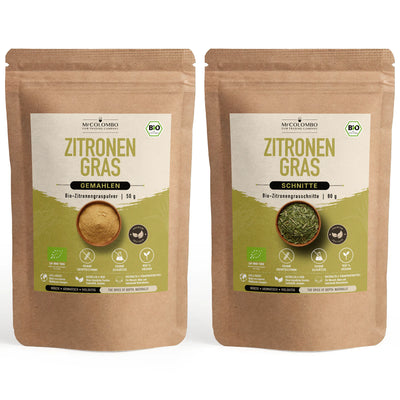
One spice that is almost always missing from German Ayurveda lists, but that features in every summer kitchen in Sri Lanka, is lemongrass. The stalks of Cymbopogon citratus grow in the north of the island around Jaffna in full sun and, via the aroma compound citral, deliver a citrus note that tastes fresh and light without being sour. In the Ayurvedic logic of tastes, that is a welcome alternative to lemon juice, which counts as sour and tends to aggravate Pitta. We source our lemongrass in organic quality directly from Jaffna and know the drying methods on site, because with lemongrass the drying temperature decides almost everything: stalks dried too hot lose their citral and taste of nothing but hay. Cutting takes place several times a year, as soon as the stalks are knee-high, because older stalks turn woody and give off noticeably less aroma in the infusion. Exports of spices and essential oils from Sri Lanka stood at 449.9 million US dollars in 2025, 2.59 per cent below the previous year (Sri Lanka Export Development Board, 2025).

How do you actually use cooling spices in summer?
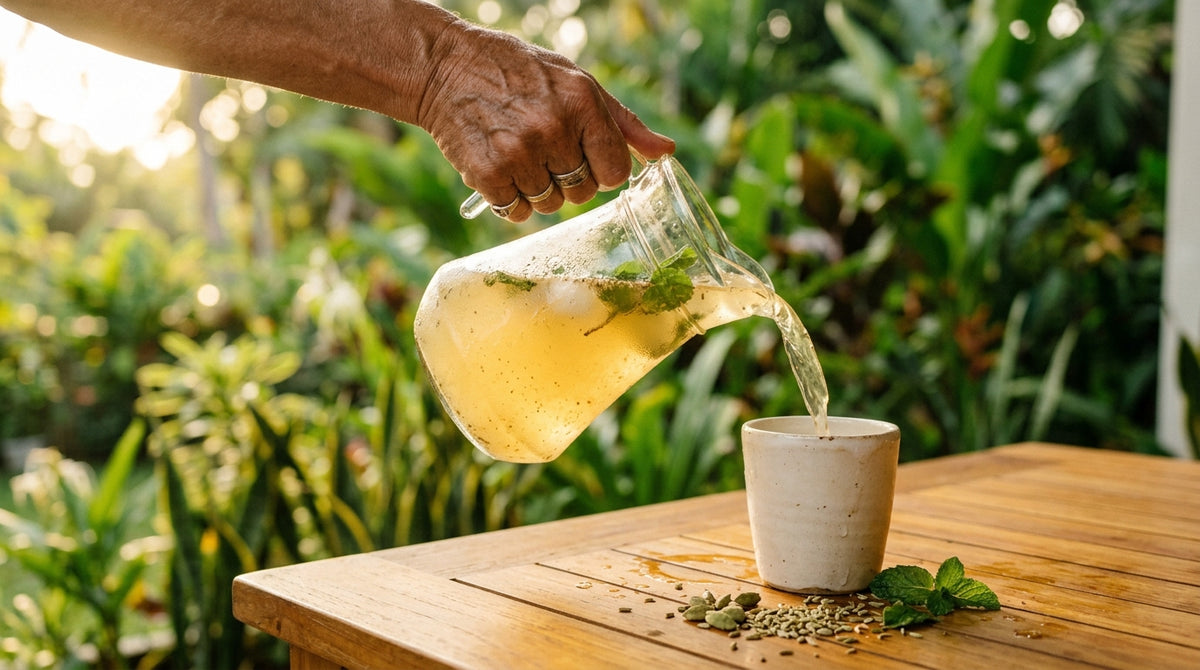
The lowest-threshold routine is CCF tea, named after cumin, coriander, fennel. Bring half a teaspoon each of cumin, coriander and fennel seeds to the boil in 500 millilitres of water, leave to steep for five to ten minutes, strain and drink spread over the day. The second classic is cardamom lassi: 200 grams of yoghurt, 100 millilitres of water, a quarter of a teaspoon of ground green cardamom, one teaspoon of cane sugar, blend briefly. For a fennel and cardamom lemonade, one teaspoon of fennel seeds and three lightly crushed cardamom pods are boiled in 500 millilitres of water, cooled and served with mint leaves. And as a main course, a summer kitchari of green mung beans and basmati rice with fennel instead of root vegetables works well: for two portions, 150 grams each of mung beans and basmati rice, half a teaspoon each of fennel and coriander seeds and around 25 minutes of cooking time are enough. Ayurvedic sources consistently recommend drinking summer drinks at room temperature or lukewarm rather than ice-cold, because according to classical understanding cold weakens the digestive fire Agni (Art of Living; Essen und Trinken).
When measuring, a feel for orders of magnitude helps. A level teaspoon of fennel seeds weighs around 2.5 grams, a teaspoon of coriander seeds about 2 grams, a teaspoon of cumin a good 2 grams, and three green cardamom pods yield just under 0.3 grams when ground. That puts a pot of CCF tea with half a teaspoon of each at a good 3 grams of spice to half a litre, a quantity that clearly stays within the usual kitchen range. If you grind the spices yourself, you should do so shortly before use, because the essential oils fade noticeably within a few weeks of grinding. Whole seeds, on the other hand, keep for one to two years without any problem in a tightly sealed jar in a dark, cool place. With fennel, it is above all trans-anethole and fenchone that escape first as volatile aroma compounds and thus determine the loss of aroma in ground stock (Zahi et al., 2025). We have summarised how aroma and colour behave under proper storage in our guide to storing spices properly.
Checklist for the Ayurvedic summer kitchen
Bought whole seeds instead of powder? Whole fennel, coriander and cardamom seeds keep their aroma for one to two years; ground stock loses it within a few weeks.
Drinks at room temperature instead of ice-cold? Ayurvedic sources recommend lukewarm or room-temperature drinks, because cold is said to weaken the digestive fire Agni.
Reduced the pungent spices? Chilli, ginger, garlic and cinnamon are regarded as heating in the Pitta season and are dosed more sparingly in summer.
Preferred sweet, bitter and astringent? According to classical teaching, these three tastes balance Pitta; salty, sour and pungent aggravate it.
Checked origin and organic certification? With spices, traceability back to the growing region is the best protection against pesticide and mineral oil residues.

How do you recognise good quality in summer spices?
With spices, the question of quality is not a nicety but consumer protection. In a laboratory test by Foodwatch, 45 of 64 samples from Germany, Austria, France and the Netherlands contained pesticides banned in the EU; one cumin was at 217 times the permitted limit. In an investigation of 30 paprika, oregano and curry powders, Öko-Test found up to 15 different residues in a single product, and it rates more strictly than the legal limit. A turmeric test was particularly striking, in which 16 of 19 ground turmerics failed and saturated mineral oil hydrocarbons were detected in all samples (Öko-Test, 2022). Legally, Regulation (EU) 2023/915 has set EU-wide maximum levels for contaminants in spices and dried herbs since 25 May 2023, and the German guidelines for spices additionally regulate labelling and collective designations (BMLEH).
Important
The German Federal Institute for Risk Assessment advises against consuming fennel tea permanently in quantities that go beyond usual culinary use, because fennel contains estragole and methyleugenol. The BfR bases this on animal studies with considerably higher doses than in usual consumption (BfR). This article is for information purposes and is no substitute for medical advice. In the case of pregnancy, chronic illness or regular medication, please consult a doctor.
Lemongrass that has been dried too hot smells of hay instead of lemon. You cannot see it, but you smell it immediately - which is why we check every batch by hand before dispatch.
MrCOLOMBO experience report
Our approach at MrCOLOMBO
We buy directly from smallholder farmers in Sri Lanka, without intermediaries, and know the growing regions personally, from Jaffna in the north to the Central Province. We show which spices are actually used in everyday Ayurvedic cooking in our overview of Ayurveda spices in the kitchen.
What does Ayurvedic summer cooking really offer in the German high summer?
Cardamom, fennel and coriander are no miracle remedies, but they are an astonishingly practical system for hot days. Their tastes suit light, water-rich food, as the DGE also recommends in hot weather (2025), and the preparations need neither time nor technique: an infusion, a lassi, a lemonade. What science contributes is, honestly speaking, a mixed picture - a solid RCT on cardamom with 3 grams daily over three months (Daneshi-Maskooni et al., 2019), reviews on fennel constituents (Zahi et al., 2025), cell studies on coriander (Tang et al., 2013), but no approved health claims, because the EFSA assessment for botanicals has been suspended since 2010. If you are looking for a way in, start with CCF tea and a lassi and expand from there. And when the heating spices return in autumn, the path leads almost automatically to golden milk or to an iced chai latte as a transitional drink.