






Spicy food really can create a cooling sensation in summer, because capsaicin, the pungent compound in chilli, irritates the heat receptors on the tongue and thereby stimulates sweating. The fresh sweat evaporates on the skin and draws heat away from the body. This process is called evaporative cooling and is the reason why a spicy meal can, paradoxically, feel refreshing in hot weather.
In tropical countries such as Sri Lanka, where we at MrCOLOMBO source our spices directly from smallholder farmers, spiciness has been part of everyday cooking for centuries. People on the equator eat spicy food not in spite of the heat, but because of it. Anyone who understands the mechanism behind this can use chilli, pepper and ginger deliberately in summer instead of avoiding them.
Quick answer
Why does spicy food cool you down in summer? Capsaicin activates the TRPV1 heat receptors and triggers what is known as "gustatory sweating", in other words sweating triggered by taste. When this sweat evaporates, the skin cools down. According to the German Federal Centre for Nutrition (BZfE, 2022), the cooling effect arises from sweating and increased blood flow, not from the spice itself.
At a glance
Why does spicy food cool the body at all?
The key lies in a deception of the nervous system. Capsaicin, the pungent compound in the chilli pod, binds to a receptor called TRPV1, which actually responds to real heat. The body therefore believes it is getting warm, even though the temperature stays the same. In response, it starts its cooling programme: the blood vessels in the skin dilate and the sweat glands become active. According to the German Federal Centre for Nutrition (BZfE, 2022), capsaicin thus promotes blood flow and sweating, and the evaporating sweat draws heat away from the skin. It is precisely this effect that explains the pleasant feeling of freshness after a spicy curry on a hot day.
The order of events matters: first comes the subjective feeling of heat in the mouth, then the sweating, then the evaporative cooling. The physics behind it is the enthalpy of vaporisation of water: every gram of sweat that evaporates draws around 0.58 kcal (about 2.4 kJ) of heat from the skin. So the cooling effect does not set in immediately, but only once the sweat can evaporate on dry, well-ventilated skin. In muggy, saturated air this works considerably less well, because the sweat does not evaporate. That is also why spicy food cools better in dry heat, as in parts of India or Mexico, than in humid, sultry weather.

What happens in the body when you eat capsaicin?
The TRPV1 receptor is the body's first line of defence against harmful heat. According to Rosenberger et al. (2020), the human pain threshold for heat lies at around 52 to 55 °C, and it is precisely this range that TRPV1 monitors. Capsaicin binds to this receptor and triggers the same signalling cascade as real heat. Amaya-Rodriguez et al. (2024) describe how the compound docks in a "tail-up, head-down" pattern and triggers an influx of calcium into the nerve cell. The brain interprets this signal as warmth and initiates countermeasures.
Several studies show that measurable temperature changes occur in the process. Szolcsányi (2015) reports that subcutaneous capsaicin doses of 0.1 to 0.2 mg/kg lowered body temperature in experiments by about 1 °C. Kawakami et al. (2016) measured a rise in fingertip temperature of 0.83 °C after capsaicin administration, controlled via the anterior insular cortex in the brain. Both are evidence of active vasodilation. A meta-analysis of 13 controlled studies (Irandoost et al., 2021) also found that capsaicinoids can increase resting metabolic rate by an average of around 34 kcal per day.
Behind the sweating there is a second effect: thermogenesis, that is, the body's own heat production. A research collection by Frontiers (2024) describes the signalling pathway via TRPV1, beta3 and alpha1 adrenoceptors in fat cells, through which capsaicinoids can briefly increase energy expenditure. Botonis et al. (2019) even measured a roughly 12 per cent lower oxygen consumption at rest under topical capsaicin, along with a marked vascular response. Important for context: these observations come from controlled studies, and the EFSA (2011) rejected health-related advertising claims about capsaicin for lack of sufficient evidence. For everyday life this means: spiciness can influence how the body feels, but it is not a slimming aid and not a medicine.
An honest assessment
The data is not clear-cut. Nelson et al. (2000) gave seven men oral capsaicin (2 mg/kg) at 38 °C and found no significant change in core temperature compared with placebo. So the cooling effect is not automatic, but depends on dose, climate and the form of administration.
Which spices cool best?
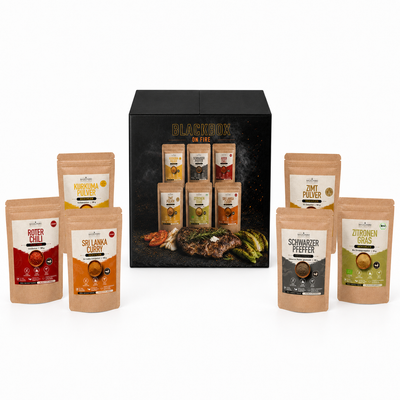
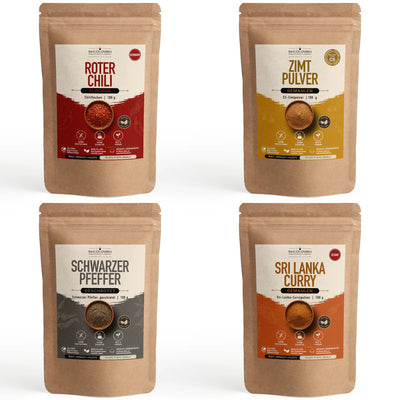
It is not only chilli that acts on the heat receptors. Black pepper and ginger also contain pungent compounds that can stimulate sweating, although partly via different routes. Chilli, with its capsaicin, remains the strongest trigger. Our roasted chilli from Sri Lanka delivers the necessary heat even in small quantities, which is why a quarter teaspoon in a salad is often enough.
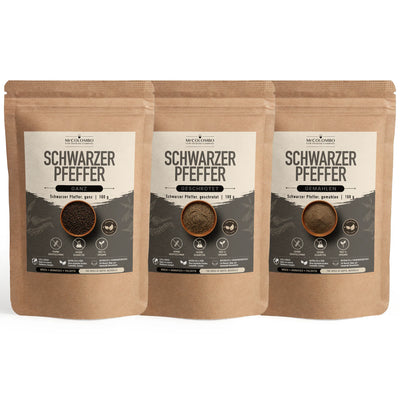
Black pepper works via the compound piperine, which, depending on origin, makes up around 2 to 9 per cent of a dried peppercorn. Stojanovic-Radic et al. (2019) describe piperine as thermogenically active, that is, heat-generating via increased catecholamine release, and as vasodilating. Interesting for us: according to the Sri Lanka Export Development Board (EDB, 2023), Ceylon pepper has one of the highest piperine contents in the world. Ginger, in turn, contains gingerols and shogaols. Sugimoto et al. (2018) showed that a ginger drink raised palm temperature for significantly longer than a placebo, because gingerol also activates TRPV1, only more mildly than capsaicin.
If you like it spicy but not burning, you can reach for pepper and ginger, which have a warming rather than fiery heat profile. A deliberate blend of different pungent compounds is found in many tropical curry mixes, for example in our pepper range from Sri Lanka. This allows the heat to be finely graded instead of relying solely on maximum fire.
| Spice | Pungent compound | Activates TRPV1 | Character |
|---|---|---|---|
| Chilli | Capsaicin | Strong | fiery, immediately sweat-inducing |
| Black pepper | Piperine | Medium | warming, thermogenic, aromatic |
| Ginger | Gingerol | Mild | gently spicy, long-lasting |
Why do people in hot countries eat especially spicy food?
The link between climate and spiciness is well documented. In a classic analysis of 4,570 recipes from 93 cookbooks in 36 countries, Billing and Sherman (1998) found a strong correlation: the higher a country's average annual temperature, the more and the hotter the spices that go into the pot. Their main thesis, however, is not cooling but protection against spoilage. According to the study, capsaicinoids inhibit or kill up to 75 per cent of the food bacteria tested, a vital advantage in hot climates without refrigeration.
Bosland (2016) names four explanations for spicy tropical cuisine, with the antimicrobial effect regarded as the main driver and cooling as a secondary factor. In Sri Lanka, where our spices come from, both combine with a centuries-old history of trade. According to EDB Sri Lanka (2023), the island supplies around 27 per cent of global cinnamon demand and 85 per cent of true Ceylon cinnamon. How deeply spices are rooted in the food culture there is shown in our article on spices from Sri Lanka.
In the villages of the Central Province, almost every meal begins with roasting chilli and pepper. Spiciness there is not a dare-you trend, but everyday life at 30 degrees in the shade.
MrCOLOMBO experience report
This trading history goes back a long way. As early as 1505, Portuguese seafarers discovered Ceylon cinnamon, and from 1658 the Dutch secured the monopoly on the Asian spice trade. To this day, according to EDB Sri Lanka (2020), the island counts more than half of its agricultural exports among spices, including ginger with a high gingerol content and pepper from the traditional highland regions. So anyone who eats spicy food is drawing on knowledge that has grown over centuries in tropical climates. It is precisely this heritage that we want to make accessible with our direct imports, without long chains of middlemen.
The Ayurvedic tradition also takes a nuanced view of spiciness. Some spices are regarded there as hot in the mouth but cooling in the metabolism. This perspective shows that spiciness is not a simple either-or. You can read more about this in our overview of organic spices and their benefits.

How much heat makes sense in summer?
The difference between food cultures is enormous. According to AOK (2022), people in South-East Asia consume 25 to 200 mg of capsaicinoids a day, whereas in Central Europe it is only around 1.5 mg. So anyone wanting to use the cooling effect does not have to go to extremes, but should get the body used to a little more heat gradually. Kwon (2021) determined an average intake of 3.25 mg per day for Korea and cites around 30 mg per day as an upper limit that is well tolerated in the long term without adverse effects.
For home use, this means: better to start with small amounts and build up. A pinch of roasted chilli in a cold salad or freshly ground pepper on melon is often enough to stimulate light sweating. Drinking remains important: the German Nutrition Society (DGE, 2025) recommends drinking around 0.2 litres of water every one to two hours in hot weather and eating smaller meals. Spiciness does not replace drinking, it complements it.
Checklist for spicy summer eating
Start small? Begin with a pinch and increase the amount slowly, rather than going for maximum heat straight away.
Drinking enough? In hot weather, water every one to two hours; spicy food does not replace this (DGE, 2025).
Making use of dry air? The cooling effect works best when the sweat can evaporate.
Checking quality? Look for spices low in contaminants, ideally certified organic.
When does spicy food do harm instead of cooling?
Spiciness has limits, and they should be taken seriously. In its opinion 027/2024, the German Federal Institute for Risk Assessment (BfR, 2024) recommended mandatory labelling from 100 mg of capsaicin per kilogram and classifies products from 6,000 mg/kg as questionable in terms of being a safe food. Very hot sauces and viral chilli challenges can lead to nausea, vomiting and circulatory problems. Capsaicin is fat-soluble, which is why water helps little with acute heat, whereas milk or yoghurt do.
Important
If you have a sensitive stomach, irritable bowel syndrome or gastritis, spicy food can make symptoms worse. Very high amounts of capsaicin from extreme products are not a summer trick but a health risk. This article is for information purposes and does not replace medical advice.
Contaminant levels are also an issue. An ÖKO-TEST of 30 paprika powders (2024) failed 12 out of 30 products, and in a single one up to 23 different pesticide residues were detected. Organic products consistently performed better. A Foodwatch investigation (2026) found traces of banned pesticides in 10 of 64 foods tested. So anyone who wants to enjoy spiciness should pay attention to origin and quality, as we explain in our article on the benefits of organic spices.
Which spicy summer dishes are genuinely refreshing?
The best summer recipes combine spiciness with cooling ingredients. A classic is cold gazpacho, a Spanish chilled tomato and cucumber soup that gets an elegant heat from freshly ground pepper instead of cayenne. In South Asia, cucumber raita is part of the picture, a thick yoghurt with grated cucumber, mint and roasted cumin that balances the heat of a curry. Both demonstrate the principle: first the spiciness that stimulates sweating, then the cool, water-rich accompaniment.
If you like it authentically tropical, you will find many light, spicy summer dishes in Sri Lankan cuisine. A sambal made from fresh coconut, chilli and lime is quick to make and goes with rice or vegetables. Our recipe for coconut sambal shows you how. For a complete summer menu, it is also worth taking a look at our Sri Lanka curry recipe, which combines well with yoghurt side dishes.
A tip from Mexican street food rounds off the picture: mango con chile, that is, fresh mango slices with lime juice and a pinch of chilli. Sweet, sour and hot at the same time, this combination is surprisingly refreshing on hot days and shows that spiciness and freshness are not a contradiction.
Market figures confirm that this combination is on trend: according to Innova Market Insights, the number of sweet-and-spicy product launches worldwide rose by 47 per cent between 2023 and 2025, and in Europe the so-called swicy trend is growing by around 8 per cent per year. If you want to try the effect for yourself, the best way to start is with a small amount of high-quality chilli and to work your way slowly towards your own comfortable level of heat.
Is spicy food worthwhile in summer?
Yes, in moderation. The cooling effect of hot spices is not a myth, but is based on the stimulation of the TRPV1 heat receptors and the subsequent evaporative cooling through sweating (BZfE, 2022). It is not universal or automatic, however, as the counter-evidence from Nelson et al. (2000) shows. If you start with small amounts, drink enough and rely on high-quality spices low in contaminants, you can enjoy chilli, pepper and ginger deliberately in summer. A good basic kit for this can be found in our range of spices from Sri Lanka.