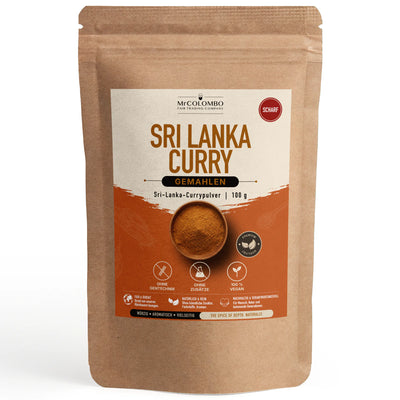




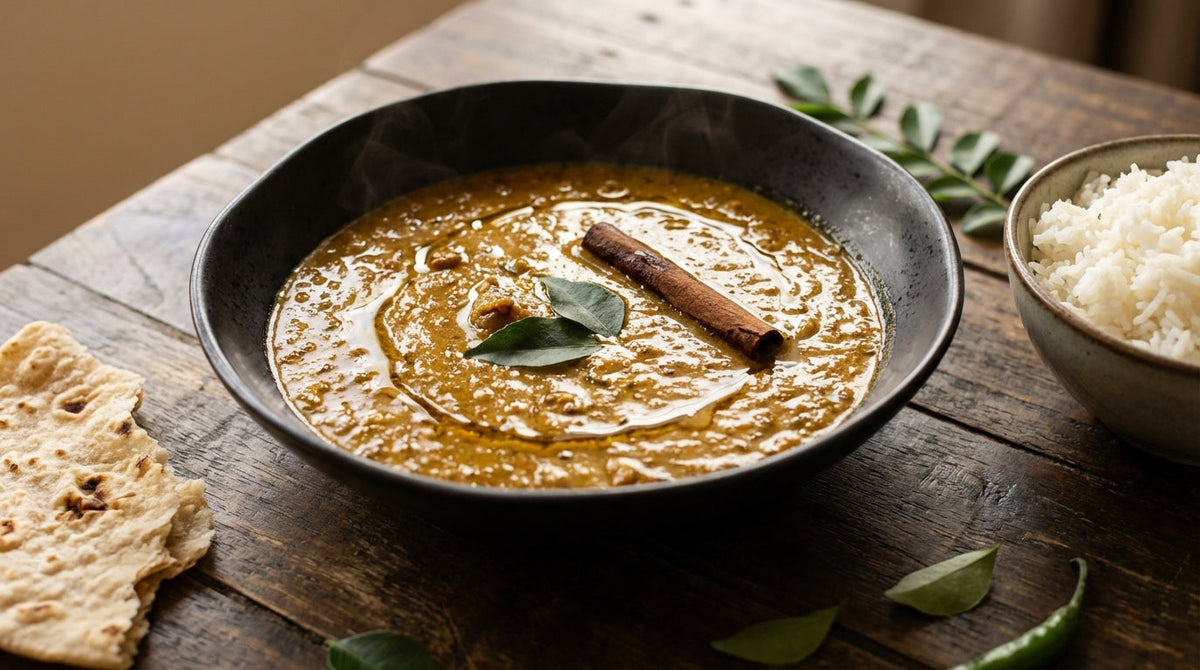
S ri Lanka curry is a dish based on coconut milk, fresh curry leaves and Thuna Paha - a blend of five freshly roasted spices that has been part of the island's culinary identity for over 3,000 years (Jayawardena et al., 2020). The base differs fundamentally from what is sold in German supermarkets as “curry powder”: real Thuna Paha consists of individually roasted coriander, cumin, fennel, Ceylon cinnamon and cardamom. Sri Lanka is the world's only producer of true Ceylon cinnamon and exported spices worth US$449.9 million in 2025 (Sri Lanka Export Development Board, 2025). The global curry powder market stands at US$3.5 billion, with forecast growth to 5.2 billion by 2033 (Cognitive Market Research, 2024). In this article we show you how to prepare a real Sri Lanka curry at home - with the right spices, the traditional roasting method and knowledge we brought back directly from smallholder farmers in the Central Province.
What many people don't know: Sri Lanka has not one curry but three fundamentally different types - white, red and black - which differ in the degree to which the spices are roasted. Each type produces a completely different flavour profile. In everyday Sri Lankan cooking, all three are often on the table at a single meal. We explain the differences and the science behind the spice combination, and give you an original recipe you can cook with organic spices in direct-import quality.
At a glance
Key takeaways
- Sri Lanka curry is based on coconut milk, curry leaves and roasted Thuna Paha - not on ready-made curry powder. Three curry types (white, red, black) differ in the degree to which the spices are roasted.
- Ceylon cinnamon contains only 0.004% coumarin - 250 times less than cassia cinnamon (BfR, 2012).
- Home-made Thuna Paha is ready in 15 minutes, keeps for 3 months and outperforms any ready-made product because the essential oils are still intact after roasting.
- Organic spices perform significantly better in tests: 88% of conventional cinnamon was contaminated with pesticides, while all organic samples passed without objection (CVUA Stuttgart, 2024).
What is an authentic Sri Lanka curry?
An authentic Sri Lanka curry is based on coconut milk, fresh curry leaves and an individually composed spice blend - not on ready-made curry powder from the supermarket. A survey of 1,080 Sri Lankan households identified 24 different spices and 7 herbs as fixed components of traditional cooking (Withanachchi, 2019). The central spice element is Thuna Paha, literally “five spices”: a blend of coriander, cumin, fennel, Ceylon cinnamon and cardamom. In practice, further ingredients are added depending on region and family - from curry leaves and fenugreek to mustard seeds.
Sri Lanka has three basic curry types, which differ in the degree to which the spices are roasted. White curry (Kiri Hodi) is the mildest: the spices are cooked unroasted in coconut milk. Red curry gets its colour and heat from dried chillies and lightly roasted spices. Black curry (Kalu Pol Maluwa) uses dark-roasted desiccated coconut and maximally roasted spices for an intensely smoky aroma - the supreme discipline of Sri Lankan cooking. At a typical “rice and curry” meal, all three types are on the table at the same time, complemented by sambols, dhal and papadams (Jayawardena et al., 2020). This interplay of different flavour profiles is what makes Sri Lankan cuisine unique.
Sri Lanka curry versus Indian curry
While Indian curries are often based on ghee, yoghurt and unroasted garam masala, Sri Lankan cooking relies consistently on coconut oil, coconut milk and roasted curry powder. The acidic component comes not from tomatoes but from vinegar, tamarind or goraka (Garcinia cambogia), which is typical of Sri Lanka. Ceylon cinnamon replaces the sharper cassia cinnamon, and pandan leaves (rampe) give the curry a distinctive, slightly sweet aroma that has no equivalent in Indian cooking. The cooking time is considerably longer - a good Sri Lankan curry simmers for 45 to 60 minutes without a lid, until the oil visibly settles on the surface.

Which spices belong in a real Sri Lanka curry?
The spice list of a Sri Lankan curry reads like a botanical compendium. Each individual spice brings specific aroma compounds that interact during roasting and cooking. Sri Lankan spices are characterised by their cultivation in a tropical climate with up to 7,000 mm of annual rainfall in the Central Province around Matale - ideal conditions for cinnamon, cardamom and cloves (Sri Lanka Tourism, 2025). Anyone who has walked through a spice plantation in Matale never forgets the scent: damp earth, freshly peeled cinnamon bark and the sharp hint of wild pepper blend into an aroma that no spice rack can replicate. The following spices form the foundation.
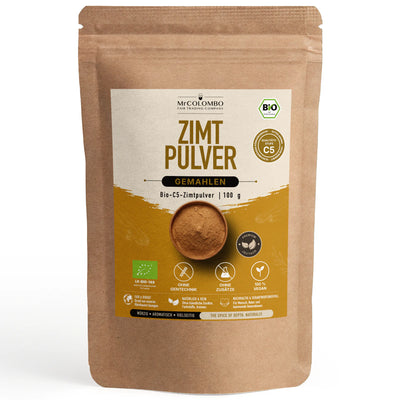
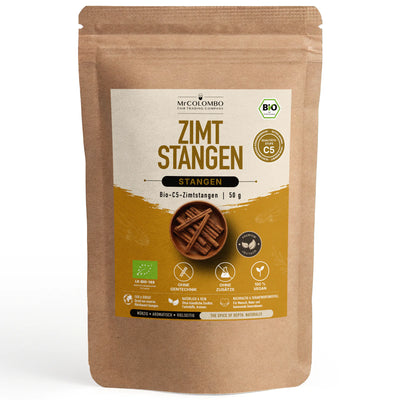
Ceylon cinnamon (Cinnamomum verum): Ceylon cinnamon is milder and more complex than the widespread cassia cinnamon. The decisive difference lies in the coumarin content: Ceylon cinnamon contains only 0.004% coumarin, whereas cassia cinnamon is at around 1% - 250 times as much. The German Federal Institute for Risk Assessment explicitly recommends Ceylon cinnamon for heavy consumers (BfR, 2012). The main active compound, cinnamaldehyde, makes up 65-80% of the essential oil (Ranasinghe et al., 2013). In a curry, a whole Ceylon cinnamon stick is cooked with the dish and removed before serving.
Turmeric (Curcuma longa): Turmeric gives the curry its characteristic golden-yellow colour. The bioactive constituent curcumin makes up 3-5% of the spice and is the subject of over 13,000 studies on PubMed (as of 2026). The EFSA confirms an ADI (acceptable daily intake) of 3 mg per kilogram of body weight for curcumin as a food additive - the usual amount in a curry is far below this (EFSA, 2014).
Black pepper, cardamom and cloves: Black pepper provides heat. Cardamom, known in Sri Lanka as the “queen of spices”, contains flavonoids such as kaempferol and quercetin (Singh et al., 2022). Cloves, with 70-95% eugenol in their essential oil, bring one of the strongest natural antioxidants (Anwar et al., 2024). Coriander seeds, with 60-70% linalool as the main component of their essential oil, round off the aroma profile (Teixeira et al., 2023). Fennel seeds complete the classic Thuna Paha blend with the sweet aroma compound trans-anethole (Badgujar et al., 2014).
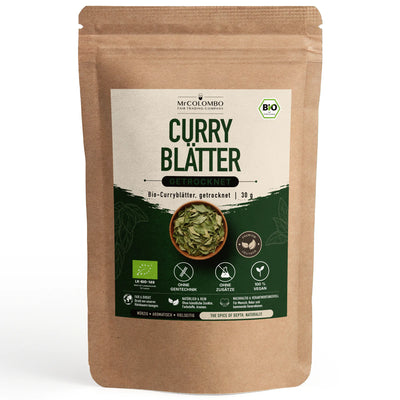
Curry leaves (Murraya koenigii): Fresh curry leaves are the heart of every Sri Lankan curry and cannot be replaced by dried ones. The leaves contain carbazole alkaloids, which have been used in Sri Lanka's traditional medicine for centuries (Chandra et al., 2020). They are roasted in hot oil together with mustard seeds and fenugreek - the so-called tempering technique (tarka) - releasing their nutty, lemony aroma in the process.
How do the spices complement each other in flavour in a curry?
In a Sri Lanka curry, turmeric, black pepper and coconut milk complement each other in flavour to form a warm, spicy profile.
When the spices are roasted, the Maillard reaction creates hundreds of new aroma compounds. Crucially, each spice has a different optimal roasting point: coriander seeds need 3-4 minutes over medium heat, whereas cumin reaches its turning point after just 2 minutes and becomes bitter. In Sri Lanka, the spices are therefore traditionally roasted individually and only mixed afterwards - a technique that no industrially produced curry powder can replicate. A ranking of the antioxidant capacity of spices shows that cloves achieve the highest value, followed by cinnamon, turmeric and cumin - all four are components of Sri Lanka curry (Yashin et al., 2017).
Practical tip
Always roast the spices individually in a dry pan without oil. Start with the more robust ones (coriander, fennel), then the more delicate ones (cumin, cinnamon). As soon as the spice becomes fragrant and changes colour, remove it from the pan immediately. Burnt spices make the whole curry bitter.
The role of coconut milk
Coconut milk is not just a flavour carrier - the fats it contains transport fat-soluble aroma compounds and constituents such as curcumin along with them. 100 ml of coconut milk provides around 230 kcal and 24 g of fat, with lauric acid at 48% being the dominant fatty acid (Da Silva et al., 2025). The DGE (German Nutrition Society) recommends moderate consumption because of the high proportion of saturated fatty acids - as part of a balanced diet, however, there is nothing to be said against coconut milk in a curry (DGE / Gahl, interview). In Sri Lanka, a traditional distinction is made between the “thick” first pressing (coconut milk) and the “thin” second pressing (coconut water) - the thick milk goes into the curry only at the end.

How do you make Sri Lanka curry powder yourself?
Thuna Paha - the heart of Sri Lankan spice cooking - can be made at home in 15 minutes. The result clearly outperforms any ready-made product because the essential oils are still intact after roasting and are only released during cooking. Freshly prepared curry powder retains its intensity for up to 3 months in an airtight jar. The following quantities yield approximately 100 g of curry powder.
| Spice | Quantity | Roasting time |
|---|---|---|
| Coriander seeds | 4 tbsp (approx. 30 g) | 3-4 min. |
| Cumin | 2 tbsp (approx. 15 g) | 2 min. |
| Fennel seeds | 2 tbsp (approx. 15 g) | 2-3 min. |
| Ceylon cinnamon stick | 1 piece (approx. 5 g) | 2 min. |
| Cardamom pods | 6 pods (approx. 3 g) | 1-2 min. |
| Cloves | 6 pieces (approx. 2 g) | 1 min. |
| Black peppercorns | 1 tsp (approx. 5 g) | 2 min. |
| Curry leaves (dried) | 10-15 leaves | 30 sec. |
Preparation: Roast each spice individually in a dry, heavy pan over medium heat until it becomes fragrant and changes colour slightly. Let the roasted spices cool completely - warm spices clump in the mortar. Then grind finely in a mortar or a spice grinder. If you want a particularly authentic note, you can also roast and grind 2 tablespoons of rice grains with them - this gives the curry powder the typical body that is known in Sri Lanka as the curry's “grounding”.
How do you prepare a classic chicken curry?
Kukul Mas Maluwa - the name of the classic chicken curry in Sinhala - is the best-known dish of Sri Lankan cuisine. The following recipe is based on methods that have been passed down in Sri Lankan families for generations. Marinating with vinegar instead of yoghurt is a typical distinguishing feature compared with Indian cooking. We developed the recipe with organic spices from our direct import and adapted it to German tastes without sacrificing authenticity.
Ingredients (4 servings)
800 g chicken legs (bone-in, cut into pieces) · 2 tbsp coconut vinegar or white wine vinegar · 2 tbsp home-made curry powder (Thuna Paha) · 1 tsp turmeric powder · 1 tsp chilli flakes · 1 tsp black pepper, freshly ground · 400 ml coconut milk (full-fat) · 2 onions, finely diced · 4 garlic cloves, finely chopped · 3 cm ginger, grated · 15 fresh curry leaves · 1 Ceylon cinnamon stick · 3 cardamom pods · 2 cloves · 1 stalk of lemongrass, bruised · 2 green chillies, slit lengthways · 2 tomatoes, diced · 3 tbsp coconut oil · 1 tsp salt
Step-by-step instructions
1. Marinate (at least 30 minutes, ideally overnight): Mix the chicken pieces with the vinegar, curry powder, turmeric, chilli flakes, pepper and salt in a bowl. Cover and leave to marinate in the fridge for at least 30 minutes, ideally overnight. The vinegar tenderises the meat and provides the typically Sri Lankan acidic note.
2. Tempering (5 minutes): Heat the coconut oil in a heavy pot. Add the curry leaves, cinnamon stick, cardamom, cloves and lemongrass and fry for 30 seconds, stirring, until the curry leaves crackle. Add the onions and fry for 5 minutes until golden brown. Add the garlic and ginger and fry for 1 minute.
3. Cooking (45 minutes): Add the marinated chicken with all of the marinade to the pot and sear over high heat for 3 minutes. Add the tomatoes and green chillies. Pour in half of the coconut milk, bring to the boil and simmer over low heat for 35 minutes without a lid. Stir in the remaining coconut milk during the last 10 minutes. The curry is ready when the oil visibly settles on the surface - in Sri Lanka the unmistakable sign of a successful curry.
Serve with: Basmati rice, papadams and a coconut sambal as the traditional accompaniment. For the vegetarian version, replace the chicken with 400 g of red lentils (Parippu) or waxy potatoes and reduce the cooking time to 25 minutes.
Important
This article is for information purposes and is no substitute for medical advice. If you have health questions, please consult your doctor or pharmacist. The studies mentioned describe laboratory results and are not directly transferable to consumption in a curry. Note for allergy sufferers: the recipe contains mustard seeds and fenugreek (allergen: mustard) as well as coconut milk. Turmeric can interact with blood thinners in high doses - if you take medication, please consult your doctor.

What should you look for when buying curry spices?
The quality of the spices determines the flavour of the curry - and the level of contaminants. An investigation by Öko-Test (2023) found up to 15 different pesticide residues in a single conventional curry powder, including ethylene oxide, which is not approved in the EU. In a turmeric test, 16 out of 19 products failed with a rating of “poor” or “unsatisfactory”, among other things because of mineral oil contamination (Öko-Test, 2022). The CVUA Stuttgart confirmed in 2024 that 88% of conventional cinnamon samples contained pesticide residues - all 7 organic samples, by contrast, passed without objection (CVUA Stuttgart, 2024).
The German spice market reached a volume of around 447 million euros in 2025, with a clear trend towards organic and single-origin spices (Statista, 2025). Organic spices consistently perform better in tests than conventional products. When buying, look for: organic certification (EU organic logo or equivalent), indication of origin (country of origin), processing method (raw grinding instead of high temperature) and best-before date. Whole spices retain their essential oils considerably longer than ready-ground ones - ideally, buy whole spices and grind them only shortly before preparation. The German Food Code defines binding quality standards for spices, which among other things lay down purity requirements and labelling obligations (BMLEH, 2025).
Practical tip
We import our organic spices directly from smallholder farmers in Sri Lanka's Central Province and know every stage of the supply chain personally. At the plantations around Matale, you can smell the freshly peeled Ceylon cinnamon from 20 metres away - a sweet, warm aroma that has nothing in common with industrial mass-produced goods. That is how we can guarantee that no unnecessary loss of quality occurs between harvest and dispatch.
A curry that tastes of Sri Lanka - without flying there
An authentic Sri Lanka curry thrives on the quality and freshness of the spices, the right roasting method and the patience to let the dish simmer slowly in coconut milk. Home-made Thuna Paha is the key - once prepared, it lifts every curry recipe to a new level. Turmeric, black pepper and coconut milk together create a warm, spicy and creamy flavour profile.
If you would like to dive deeper into the world of Sri Lankan spices, also read our moringa recipes and our article on golden milk - another traditional drink in which turmeric and Ceylon cinnamon play the leading role.