



Lemongrass (Cymbopogon citratus) is a true grass whose lemony aroma comes almost entirely from a single substance: citral. In samples from Sri Lanka, the citral content of the essential oil is around 72 per cent, split into geranial (41.21 per cent) and neral (31.13 per cent), as De Silva et al. (2020) demonstrated in the World Journal of Agricultural Research. It is precisely this high citral content that turns the fibrous stalks into a spice that defines fresh curries, soups and teas.
Contrary to what most online sources claim, Sri Lanka is not a marginal player but, according to the pharmacological review by Shah et al. (2011), a botanical country of origin of lemongrass. At MrCOLOMBO we import the stalks directly from the island and know every stage from the field to dispatch personally. What defines lemongrass chemically, where the best quality comes from and how to use it properly in your kitchen: this article answers these questions with concrete figures from Sri Lankan samples.
Short answer
Is lemongrass a spice? Yes. Lemongrass is a tropical true grass of the genus Cymbopogon that is used as a spice fresh, dried or ground. Around 72 per cent of its aroma comes from the aroma compound citral (De Silva et al., 2020). Citral is approved as a food flavouring in the EU (FEMA 2303, FL No. 05.020), but lemongrass itself carries no authorised health claim.
At a glance
Is lemongrass a spice or a herb?
Lemongrass is both at once: botanically a perennial true grass, culinarily a spice. The plant belongs to the genus Cymbopogon, which comprises around 55 species. For the kitchen, Cymbopogon citratus matters most, while the closely related species Cymbopogon flexuosus is grown mainly for the extraction of essential oil (Singharaja Garden, Sri Lanka). In their pharmacological review, Shah et al. (2011) explicitly describe lemongrass as "native to Sri Lanka and South India" and document its traditional use throughout South East Asia.
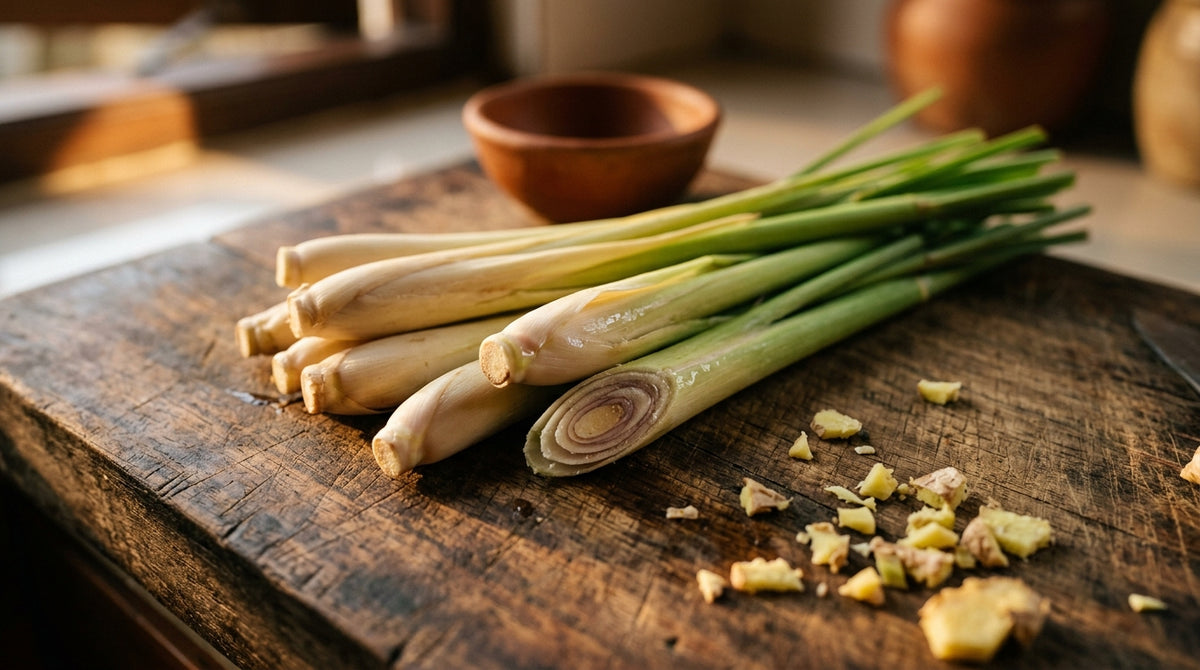
The Verbraucherzentrale Bayern (2023) confirms citral as the substance responsible for the aroma and clearly assigns lemongrass to Asian cuisine and to tea preparation. However, only the lower, soft part of the stalk is edible, roughly the first ten centimetres above the root. The woody upper stalks are cooked along with the dish but removed before serving because they are too fibrous to chew. Anyone buying lemongrass as a spice therefore usually gets exactly this aromatic stalk base, fresh, dried or finely ground.

Where does the lemony aroma of lemongrass come from?
The unmistakable lemon aroma comes almost entirely from citral, a mixture of the two substances geranial and neral. In their analysis, Figueiredo et al. (2008) identified 23 compounds in the essential oil, of which citral dominated with 73.3 per cent (geranial 42.2 per cent, neral 31.5 per cent). As a minor component they found beta-myrcene at 7.5 per cent. This makes lemongrass one of the few spices whose character can be traced back to a single main substance.
Exactly how high the citral content turns out depends on origin, harvest time and processing. A literature review from 2024 cites a range of 24.9 to 48.0 per cent for geranial and 10.5 to 35.1 per cent for neral. The Sri Lankan study by De Silva et al. (2020), with 41.21 per cent geranial and 31.13 per cent neral, sits in the upper, aromatically valuable range. Citral is approved as a food flavouring substance in the EU (FL No. 05.020, Regulation (EC) No 1334/2008) and holds GRAS status in the USA (FEMA 2303). That explains why lemongrass is so widespread in foods, teas and drinks.
Our way at MrCOLOMBO
We source our lemongrass directly from Sri Lanka, where the plant grows particularly rich in citral in the warm island climate. You can read more about our direct imports in our overview of spices from Sri Lanka.
Why is lemongrass from Sri Lanka worth it?
Sri Lanka has a documented lemongrass history that hardly any other source tells. According to the Department of Export Agriculture (DEA Sri Lanka), J.F. Jovit brought the variety "Kochin Sera" from South India to the Bandarawela farm in 1905. To this day, the local Sinhala name is "sera". The island is therefore not a random place of cultivation but part of the traditional Sri Lankan herb economy, in which lemongrass has been cultivated for over a century.
The island also plays a role economically. Sri Lanka exports lemongrass as oleoresin and essential oil, as the Export Development Board (EDB, 2024) confirms. The country's total spice exports in 2024 amounted to around 461.8 million US dollars. For lemongrass oil, Tridge (Dec. 2025) reports Sri Lankan export prices between 29.22 and 49.21 US dollars per kilogram with annual growth of 18.7 per cent. According to Global Market Insights (2024), the world market for lemongrass oil grew to 56.3 million US dollars and is expected to keep growing at 9.7 per cent per year. Anyone buying Sri Lankan quality benefits from a country of origin with a long cultivation tradition rather than from anonymous mass-produced goods.

How is lemongrass grown and harvested?
Lemongrass is a robust grass that allows several harvests per year in the tropics. The right harvest time is decisive for quality. De Silva et al. (2020) determined a maximum oil yield for Sri Lankan plants after around 56 days of growth. The oil content differs markedly depending on the part of the plant: the leaves contain about 0.91 per cent essential oil, the stems 0.7 per cent and the roots only 0.2 per cent. These figures explain why the stalk base is the aromatic heart.
Viewed globally, the Asia-Pacific region dominates production with over 70 per cent of world output (Tridge, 2025). India leads the market: according to the National Horticulture Board (NHB, 2024), 300 to 350 tonnes of oil are extracted there every year on around 3,000 hectares, with a yield of 80 to 100 kilograms per hectare. Sri Lanka, India and Vietnam form the top 3 producers. For kitchen quality, however, what counts is less the quantity than the care taken in harvesting and drying, because grass cut too late or dried poorly loses part of its volatile aroma compounds.
Fresh, dried or ground - which is better?
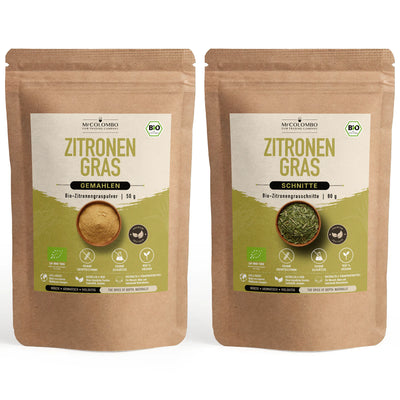
The most frequent question in cooking communities such as r/AskCulinary is: fresh, dried or as a paste? The answer depends on the dish. Fresh lemongrass delivers the fullest, liveliest aroma because the volatile citral compounds are still intact. Dried grass keeps considerably longer and is ideal for teas and long-simmering curries. Ground powder is the easiest to measure out, but loses its aroma faster because of its large surface area. The BZFE (2026) recommends storing ground spices airtight for a maximum of one year.
| Form | Aroma intensity | Shelf life | Best use |
|---|---|---|---|
| Fresh (stalks) | Very high | 1-2 weeks (refrigerator) | Curries, soups, marinades |
| Dried | High | up to 1 year | Tea, long braised dishes |
| Ground | Medium | max. 1 year | Spice blends, quick seasoning |
Quality deserves a second look. ÖKO-TEST found up to 15 different pesticides in a single spice, and eight conventional products failed with a "poor" rating. According to Stiftung Warentest, organic spices are not automatically free of contamination either. Direct import with a traceable supply chain is therefore a genuine quality argument, as we explain in detail in our article on the benefits of organic spices.
Shopping checklist
Does the grass smell intensely of lemon? A weak smell indicates loss of aroma through overly long or improper storage.
Is the origin traceable? Specific details such as Sri Lanka or direct import are a quality signal compared with anonymous goods.
Is there an organic or Fairtrade seal? The BZFE (2026) recommends certified goods because they are less often contaminated with pesticides.
Is the packaging airtight and protected from light? Oxygen and light break down citral; correct spice storage preserves the aroma.
How do you use lemongrass properly?
In the kitchen, lemongrass only releases its aroma once the cell walls break open. The Verbraucherzentrale Bayern (2023) therefore recommends bruising the stalks before cooking, for example with the back of a knife or a meat mallet. Classics include lemongrass coconut soup and the Thai tom yum soup, in which lemongrass forms the typical aroma trio together with galangal and kaffir lime leaves. The most-watched lemongrass recipe worldwide, Hot Thai Kitchen's "Tom Yum Goong", reached over three million YouTube views and shows that fresh stalks are considerably more aromatic than frozen ones.
Lemongrass goes superbly with coconut milk, ginger, garlic, chilli and lime. In Sri Lankan and South Indian curries it harmonises with turmeric and curry leaves, which is why it fits well into an authentic Sri Lanka curry. Beyond the kitchen, lemongrass is enjoying two trends: lemongrass tea as a wellness drink, for which sliced stalks simmer for around ten minutes (Utopia.de), and lemongrass syrup as a cocktail base (two stalks, one cup each of water and sugar, simmer for ten minutes). Hardly any other Asian spice is this versatile.

Freshly bruised lemongrass from Sri Lanka immediately smells of lemon and blossom. You simply do not get this lively aroma with anonymous mass-produced goods.
MrCOLOMBO experience report
What do science and the authorities say about lemongrass?
Lemongrass is being intensively researched: Shah et al. (2011) list 17 documented pharmacological activities, and Tibenda et al. (2022) confirm in Frontiers in Pharmacology its centuries-old use on three continents. What matters for consumers, however, is the legal classification: in the EU there is not a single authorised health claim for lemongrass. Around 2,000 botanical health claims have been stuck in the EFSA assessment backlog for over 13 years (Drouet et al., 2025). Statements such as "works against" or "heals" are therefore legally inadmissible and not scientifically substantiated.
On the safety side, there are clear reference values. The JECFA database (WHO/FAO) gives an ADI value for citral of 0 to 0.5 milligrams per kilogram of body weight per day. The EFSA FEEDAP Panel (2023) assessed lemongrass oil as a feed additive with "no concern for consumers". At the same time, WebMD (2024) urges caution: for many applications there is "no good scientific evidence", and during pregnancy lemongrass is "likely unsafe". As a kitchen spice in usual quantities, lemongrass is considered safe, but restraint is advised with concentrated essential oil.
Important
This article is for information purposes and does not replace medical advice. Lemongrass has no authorised health claims in the EU. According to the BfR (2008), undiluted essential oils can trigger breathing problems in infants, and larger quantities are not advisable during pregnancy (WebMD, 2024). If you have health-related questions, consult your doctor or pharmacist.
Is lemongrass from Sri Lanka worth it?
Lemongrass is a versatile spice whose character is based around 72 per cent on the aroma compound citral (De Silva et al., 2020). With its cultivation tradition of over a hundred years since 1905 and its citral-rich island climate, Sri Lanka offers an origin that hardly any competitor puts in the spotlight. For the kitchen: fresh is the most aromatic, dried keeps the longest, ground is the most practical. Anyone who values clean quality looks for traceable origin and organic certification. You will find a selection from our direct-import range in our spice range.