




Asian spices for beginners can be boiled down to eight classics: turmeric, ginger, coriander seeds, cumin, star anise, Sichuan pepper, lemongrass and galangal. With this basic kit you can cook Indian, Thai and Chinese without getting lost in a shelf full of little single packets. In 2023 the EU imported around 339,800 tonnes of spices, and ginger imports have risen by 112 per cent since 2013 (Eurostat, 2024) - Asian flavours have long since arrived in German kitchens.
At MrCOLOMBO we import some of these spices directly from Sri Lanka, including turmeric from the Jaffna region and lemongrass from smallholder farmers we know personally. In this beginner's guide we explain not only which eight spices you should buy first, but also how to dose them, how to recognise good quality and which scientific facts lie behind the aroma. That way you make an informed decision when shopping instead of guessing.
Short answer
Which Asian spices does a beginner really need? Eight are enough: turmeric and ginger as the most versatile all-rounders, coriander seeds and cumin as the basic duo for Indian cooking, star anise and Sichuan pepper for Chinese, lemongrass and galangal for Thai. According to market analyses, these cover the most important Asian flavour profiles (Mintel, 2023), which show the greatest potential among new product launches.
At a glance
Which Asian spices should a beginner buy first?
The most sensible order is based on versatility, not exoticism. Start with turmeric and ginger: both work in savoury dishes, in drinks and in almost every Asian cuisine. Next come coriander seeds and cumin, the classic duo of Indian cooking, which you also need in Middle Eastern and Mexican dishes. Only after that are the more specialised aromas worthwhile: star anise and Sichuan pepper for China, lemongrass and galangal for Thailand. This prioritisation is completely missing from most overview articles, yet it saves beginners money and prevents a drawer chaos of rarely used packets.
Market researchers regard Asian flavour profiles as the segment with the greatest growth potential in the German food market - 97 per cent of consumers in Germany use spices every day (Mintel, 2023). The German Nutrition Society (Deutsche Gesellschaft für Ernährung) expressly recommends herbs and spices as a salt substitute, because they deliver flavour without eating into the recommended maximum of 6 grams of salt per day (DGE, 2023). So anyone who cooks Asian food seasons not only more aromatically but often more mindfully too.

Turmeric: the most versatile spice in the Asian beginner's kitchen
Turmeric (Curcuma longa) is the most versatile of the eight spices and the reason why curry powder glows yellow. Its main active compound, curcumin, makes up around 3 to 5 per cent of the powder depending on quality. Turmeric is known above all for its poor bioavailability: in a classic study, taking 20 milligrams of piperine from black pepper at the same time increased the curcumin concentration in the blood by 2000 per cent (Shoba et al., 1998). A more recent pharmacokinetic investigation, however, puts this effect into perspective and found no measurable piperine advantage with modern formulations (Kroon et al., 2025).
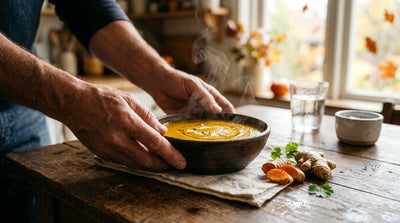
In practice, half a teaspoon of turmeric powder per dish is enough, for example for our golden milk recipe or for a Vietnamese turmeric and ginger rice. The upper limit matters: the German Federal Institute for Risk Assessment gives an acceptable daily intake of 3 milligrams of curcumin per kilogram of body weight, i.e. around 200 milligrams for 70 kilograms, and warns against more than 7 grams of turmeric powder per day (BfR, 2021). Our turmeric root comes from northern Sri Lanka around Jaffna, where the warm climate and the red soils produce a strong colour. If you prefer the organic seal, you will find the full selection in our turmeric collection.
What makes ginger the indispensable beginner's spice?
Ginger (Zingiber officinale) is the most searched-for Asian spice after turmeric and shares with it the botanical family of the ginger plants. Its heat comes from the gingerols, pungent-tasting compounds that partly convert into milder shogaols during drying. That is precisely why fresh ginger tastes different from dried. Stiftung Warentest found that freshly pressed ginger shots contain around ten times more gingerols than dried products (Stiftung Warentest, 2021). In scientific investigations, ginger has been studied in amounts of 1 to 3 grams per day for its effect on nausea, for example during pregnancy (Nikkhah Bodagh et al., 2019). For the kitchen the rule is: a thumb-sized piece freshly grated or half a teaspoon ground per dish.
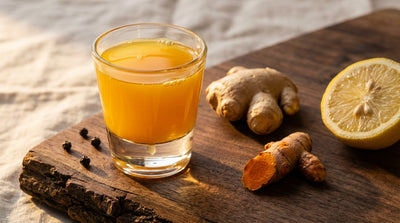
Ginger is the bridge between savoury and sweet cooking. It seasons wok vegetables and curries just as well as tea and baked goods, and together with turmeric it forms a classic pair that you can recreate in our ginger-turmeric shot recipe. In Ayurveda, ginger has been regarded for centuries as a warming, digestion-stimulating spice. An honest note belongs here: anyone taking blood-thinning medication should discuss larger amounts of ginger with their doctor, because ginger can affect blood clotting.
Our way at MrCOLOMBO
We import turmeric and lemongrass directly from smallholder farmers in Sri Lanka, without intermediaries. That way we know every stage of the supply chain personally, from the field in the Central Province to the mill. Read more in our overview of spices from Sri Lanka.
Why are coriander seeds and cumin the most important spice duo?
Coriander seeds and cumin are the foundation of Indian cooking and appear together in almost every curry blend. Coriander seeds (Coriandrum sativum) taste warm and slightly citrusy, which is due to the high linalool content, which makes up 60 to 80 per cent of the essential oil depending on the variety (Laribi et al., 2023). Important for beginners: the seeds have nothing to do with the polarising taste of fresh coriander leaves; they are milder and nuttier. Cumin (Cuminum cyminum) brings the earthy, slightly smoky note that many people associate with Indian food. Its main aroma compound, cuminaldehyde, has been studied for inflammation-modulating properties (Koohsari et al., 2020). India exported cumin alone worth 898 million US dollars (Spices Board of India, 2025).
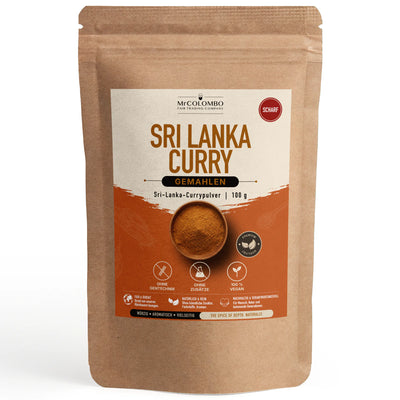
In practice, you first toast both spices briefly in a dry pan until they release their fragrance; this activates the essential oils. Then you grind them or add them whole to the hot fat. A tried-and-tested dosage is one teaspoon of whole coriander seeds and one teaspoon of cumin for a lentil dal for four people. Do not confuse cumin with black cumin (Nigella sativa): they are completely different plants with a different active compound profile. If you do not want to buy the duo separately, you will find the balanced combination ready-made in our Sri Lanka curry powder, which is roasted according to a family recipe and already contains both spices.

What lies behind the intense aroma of star anise?
Star anise (Illicium verum) is the star-shaped classic from southern China and a fixed component of Chinese five-spice powder. Its liquorice-like, slightly sweet aroma comes predominantly from trans-anethole, which makes up more than 80 per cent of the essential oil (Zou et al., 2023). One study identified a total of 201 compounds in star anise. The plant is famous as the source of shikimic acid, which serves as the chemical precursor for the flu medicine oseltamivir (Tamiflu) (Zou et al., 2023). For the kitchen, intensity is the decisive factor: one to two whole stars are enough for an entire braising pot; more quickly makes the dish bitter. Whole stars keep for two to three years when stored airtight, dark and cool.
Important
Real star anise (Illicium verum) is safe, but the visually similar Japanese star anise (Illicium anisatum) is poisonous. So buy star anise only from trustworthy retailers and not as undeclared imported goods of unknown origin.
Star anise is an excellent way into Chinese cooking, because it gives depth to braised dishes and broths, for example a Vietnamese pho soup. Combine it sparingly with ginger and cinnamon and you get a warm, festive aroma. Speaking of cinnamon: if you want to understand the difference between real Ceylon cinnamon and coumarin-rich cassia cinnamon, you will find the basics in our article on organic spices and their advantages. Star anise itself is harmless in normal household quantities, since you only use tiny amounts of the intense spice anyway.
Why does Sichuan pepper tingle on the tongue?
Sichuan pepper (Zanthoxylum simulans) is botanically not a pepper at all but the dried husk of a citrus plant, and it produces a unique tingling and numbing sensation on the lips. Responsible for this is the active compound hydroxy-alpha-sanshool, which inhibits certain potassium channels in the nerve cells (Bautista et al., 2008). This mechanism is fundamentally different from the heat of chilli, which is based on capsaicin. Search interest in Sichuan pepper recently rose by 22 per cent year on year, driven by viral videos of the so-called numbing effect. For beginners, this spice is the most exciting boundary-crosser of the eight, because it delivers a taste experience that no other spice imitates.
In the kitchen the rule is: dose extremely sparingly. A quarter of a teaspoon is enough for an entire dish. A classic application is Sichuan pepper oil, for which you infuse two tablespoons of the husks in oil at a maximum of 100 to 110 degrees, because at higher heat the sanshool breaks down and loses its effect (America's Test Kitchen). When buying, look for bright reddish-brown husks without black seeds; that is the most important quality feature. As we do not import Sichuan pepper ourselves, it is not part of our range, which you can find in our spice range. If you are looking for classic black pepper for comparison, you will find it in our pepper collection.
Lemongrass and galangal: the aroma pair of Thai cooking
Lemongrass (Cymbopogon citratus) and galangal (Alpinia galanga) are the aroma pair of Thai cooking and the basis of classics such as the coconut soup tom kha gai. Lemongrass delivers the fresh, citrusy note that comes from the high citral content of its essential oil, which reaches around 89 per cent in some varieties (Adukwu et al., 2016). With the fresh stalk you use only the lower 10 to 12 centimetres; dried cuts you add whole and remove before serving. Galangal looks like ginger but tastes more resinous, almost like pine, and its main active compound, galangin, is being studied for antioxidant properties (Aw-Hassan et al., 2021). In China, galangal has been rooted in cooking and tradition for around 2000 years.
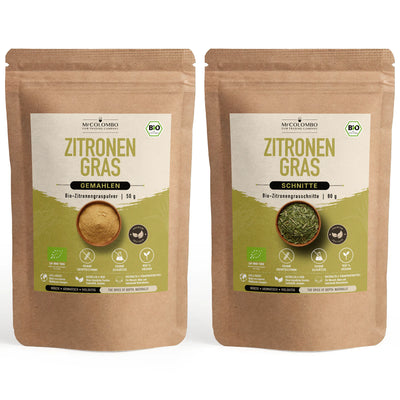
Our lemongrass comes from organic cultivation in Sri Lanka and, both as coarse cuts for soups and tea and as a fine powder for seasoning, goes into our lemongrass collection. Dried lemongrass is more practical for beginners than fresh, because it keeps for a long time and can be dosed precisely. Galangal is not part of our range, but it is available in any well-stocked Asian grocery. Both spices bring the South East Asian aromas into your kitchen that trend analyses are tipping as the next big flavour after matcha (Mintel, 2023). In the Western history of reception, Hildegard of Bingen already valued galangal and called it the spice of life.

What should you look for when buying Asian spices?
With Asian spices, quality is not a luxury but a safety issue. In a laboratory test of 19 turmeric powders, 16 failed with the grade "poor"; mineral oil components were found in all samples and, in one organic product, even the banned ethylene oxide (ÖkoTest, 2022). Inspectors repeatedly find germs, mould toxins and pesticides above the limits in imported spices (BZfE). The consequence for beginners: prefer organic goods with traceable origin instead of buying cheap mass-produced goods with no indication of origin.
Checklist for buying spices
Is the origin stated? A specific growing region is a good sign; vague details such as just a continent are a bad one.
Organic seal present? According to tests, organic spices contain pesticide residues considerably less often.
Whole instead of ground? Whole spices keep longer and are harder to adulterate than powder.
Stored correctly? Airtight, dark and cool; use ground spices within one year (BZfE).
As a beginner, buy small quantities of fresh goods rather than large stocks that lose their aroma. Whole spices such as coriander seeds, cumin or star anise retain their essential oils considerably longer than ground ones and can be freshly ground as needed. We explain in detail how to store your spices optimally in our article on storing spices properly. That way your basic kit stays aromatic for a long time and you need to restock less often.
These eight Asian spices are your ideal beginner's basic kit
Turmeric, ginger, coriander seeds, cumin, star anise, Sichuan pepper, lemongrass and galangal are the ideal starting line-up for Asian cooking. Buy them in this order, look for organic quality and traceable origin, and dose the intense ones such as star anise and Sichuan pepper sparingly. That way you can cook Indian, Thai and Chinese without wasting money on rarely used specialities. The German Nutrition Society expressly recommends spices as a salt substitute (DGE, 2023) - these eight Asian classics fulfil exactly this function. If you want to start with a ready-made, balanced mix, our Sri Lanka curry recipe offers a practical way in that combines several of these spices at once.
Note
This article is for information purposes and does not replace medical advice. If you have health questions or are taking medication, consult your doctor or pharmacist.