

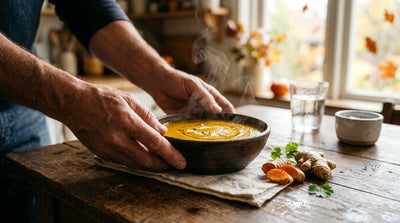

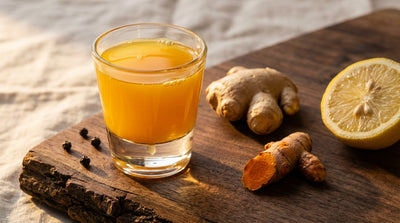


Turmeric and ginger give autumn soups warmth, colour and a pleasant heat, because their active compounds curcumin and gingerol strongly shape flavour and appearance. The curcumin content of turmeric varies between 2.3 and 10.9 per cent depending on the variety (Sanwal et al.), and combined with black pepper, absorption in the body rises markedly according to Shoba et al. (1998, Planta Medica). This article presents four soup recipes with pumpkin, red lentils, lemongrass and carrots, along with the state of research on their effects and realistic dosage recommendations.
MrCOLOMBO imports turmeric and ginger directly from smallholder cooperatives in Sri Lanka, where both roots are traditionally grown. This origin also shapes the recipes in this article: they rely on fresh, untreated spices rather than anonymous bulk goods from the supermarket shelf.
Short answer
Which spices are suitable for warming autumn soups? Turmeric and ginger are among the most popular spices for autumn soups, because their active compounds curcumin and gingerol provide warmth, colour and heat. The curcumin content varies between 2.3 and 10.9 per cent depending on the variety (Sanwal et al.); combined with black pepper, absorption in the body improves markedly according to Shoba et al. (1998).
At a glance
Which spices make autumn soups warming and comforting?
Turmeric (Curcuma longa) and ginger (Zingiber officinale) shape warming autumn soups above all through their active compounds curcumin and gingerol, which markedly influence flavour and colour. Depending on the variety, turmeric provides between 2.3 and 10.9 per cent curcumin (Sanwal et al.); fresh, unpeeled ginger peel contains around 75.25 mg of 6-gingerol per 100 g fresh weight according to chromatographic analysis (Ghasemzadeh et al., PMC5343986). This value becomes noticeably more concentrated on drying: according to an analysis of Australian samples, dried ginger powder provides roughly 8 to 10 mg of gingerol derivatives per gram (ScienceDirect, Food Research International). Botanically, both roots belong to the ginger family (Zingiberaceae) and in Sri Lanka they are traditionally harvested fresh, dried or ground into powder, depending on what they are to be used for.
In the Ayurvedic tradition, turmeric counts among the heating, "pungent" spices, and ginger has been used there for thousands of years to balance the Vata dosha (Ayurveda Journal). The use of ginger in India and China is archaeologically documented for around 5,000 years; in medieval Europe the root was regarded as a luxury good of comparable value to a sheep (PlantDEA Blog). This long tradition explains why both roots are now such a natural part of autumn in so many kitchens around the world, from soup to tea.
During drying and heating, part of the pungent gingerol is additionally converted into shogaol, a compound with an even more intense heat (NCBI Bookshelf, NBK92775). Structurally, gingerol belongs to the same group of compounds as capsaicin from chilli and piperine from black pepper; all three create a sensation of warmth in the mouth in different ways (NCBI Bookshelf, NBK92775). This explains why dried ginger in the cooking pot often tastes hotter than the fresh root in a salad. Stiftung Warentest gives turmeric a sober assessment: "spice yes, superfood no" (test.de, 2023). The root enriches autumn soups in flavour, but is no substitute for a balanced diet. Spiced soups are by no means a new trend: the Nuremberg Bratwurst soup, documented since 1721, shows that ginger, pepper and nutmeg were already used in soups in historical Germany as expensive, status-laden seasonings, while regional recipes such as the Thuringian sauerkraut soup relied more on caraway as an everyday spice (Historisch Kochen). For the four recipes in this article, one thing matters above all: turmeric and ginger provide warmth, colour and a pleasant heat that goes well with pumpkin, lentils and carrots.

Why should you combine turmeric in soup with black pepper?
Black pepper markedly increases the absorption of curcumin in the body, because its active compound piperine slows its breakdown in the liver and intestine. In the much-cited study by Shoba et al. (1998, Planta Medica), the curcumin serum concentration rose significantly when combined with piperine, although the effect lasted only about one to two hours and has not been independently replicated since. A newer measurement method using LC-MS/MS quantitatively confirmed the effect of black pepper on curcumin bioavailability in human urine (PMC10724617), which methodologically underpins the original findings. For autumn soups this means: a pinch of black pepper in addition to turmeric is more than a mere matter of taste; it influences how much curcumin the body absorbs at all.
Curcumin is generally considered poorly bioavailable, because the body metabolises and excretes it quickly (PMC9319031). A recent review by Zhang et al. (2024, Antioxidants) summarises various formulation strategies with which researchers try to get around this natural hurdle, for instance through special carrier substances, phospholipid complexes or nanoparticles. Such concentrated extracts differ clearly from the spice in the cooking pot: the German Federal Office of Consumer Protection and Food Safety (BVL) classifies high-purity curcumin extract with at least 90 per cent curcuminoids as the food colouring E 100; outside food supplements it is considered a novel food. This bioavailability problem is now also fuelling a growing market: the global curcumin extract market is estimated at around 135.3 million US dollars for 2026 (Grand View Research), and many suppliers advertise precisely the formulation strategies that Zhang et al. describe in their review. In the kitchen, the same basic idea can be put into practice more simply: process turmeric together with black pepper and a little fat such as coconut milk. Our article on the quality of black pepper shows more about the quality of the pepper.
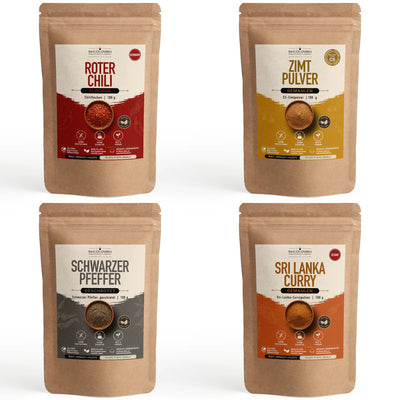
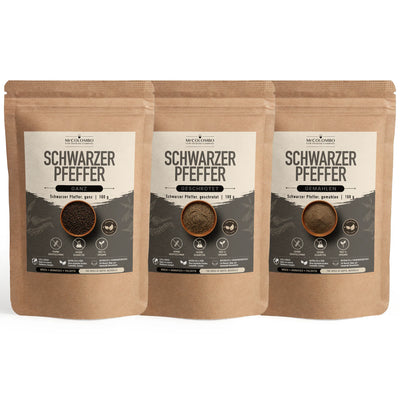
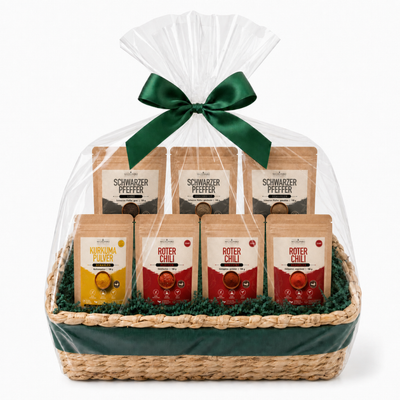
For our autumn soups we prefer to use freshly ground black pepper from the highlands of Sri Lanka, because the essential oils stay fresh when ground. The complete pepper selection shows further grinds for the kitchen and the soup pot.
What do studies show about the effects of ginger in cold weather and when you feel a cold coming on?
Several studies have investigated a possible influence of ginger on joint complaints and the perception of cold, even if the results are mixed. In the randomised study by Altman and Marcussen (2001, Arthritis & Rheumatism) with 261 patients with knee osteoarthritis, 63 per cent of the ginger group reported a reduction in pain compared with 50 per cent in the placebo group (p=0.048), a statistically robust but moderate difference. A meta-analysis by Bartels et al. (2015, Osteoarthritis and Cartilage) confirmed a small but statistically relevant effect across several pooled studies (SMD -0.30, CI -0.50 to -0.09, p=0.005). Both papers examine exclusively extracts in defined doses, not the amount of ginger that typically ends up in a portion of soup. In the Ayurvedic tradition, ginger is regarded as a warming spice that has long been used there for joint complaints (Ayurveda Journal), a body of experiential knowledge that Western research, with the studies mentioned, has so far retraced only in part and with limited evidence.
These figures show an observed association, not proof of a healing effect, and precisely here lies an important distinction. In 2017 the European food safety authority EFSA officially assessed the health claim "curcumin and normal joint function" and did not authorise it due to insufficient scientific evidence. That is not a flaw but a signal of trust: it shows how strictly health claims about spices are controlled before they may be advertised. For the soup pot this simply means: turmeric and ginger are traditionally valued spices with studied active compounds, but no substitute for medical advice. Our article on the effects of turmeric provides more background.
Where do the turmeric and ginger for the MrCOLOMBO autumn soups come from?
Sri Lanka has been regarded as the "Spice Island" for centuries and, according to the Sri Lanka Export Development Board (EDB), is among Asia's significant spice exporters, with spices that, according to the EDB, are characterised by particularly high concentrations of essential oil, oleoresin and active compounds. The tropical climate with high humidity and fertile soils favours both turmeric and ginger, which are both grown in the central and northern provinces of the island. For autumn soups with turmeric and ginger this means: the roots come from a region where their cultivation is deeply rooted in agricultural tradition, not from industrial mass production. Historically, turmeric was part of the spice trade along the Silk Road for centuries: in the 13th century Marco Polo documented this trade and helped the nickname "Indian gold" for the golden-yellow root to spread in Europe (Hartkorn Gewürzmühle Blog). This centuries-old trading history still shapes today how closely Sri Lanka as a growing region is linked to the international spice trade.
The Department of Export Agriculture Sri Lanka provides concrete figures for the year 2019: 13,785 tonnes of ginger were harvested on 1,838 hectares, concentrated in Kurunegala, Kandy and Gampaha. These regions lie in the warm, humid highlands and lowlands of the island, where smallholders often still harvest the roots by hand. By comparison: the far larger exporter India shipped around 17.34 lakh tonnes of spices in 2025/26 according to Spices Board India, of which turmeric accounted for about 7 per cent and ginger together with pepper around 3 per cent of the export value, so the Sri Lankan quantities remain much more small-scale and more widely spread across individual smallholder cooperatives. Our overview of spices from Sri Lanka shows more about the growing regions and spice traditions. It is precisely in these growing regions that the farms are located from which MrCOLOMBO sources turmeric and ginger directly.
Our approach at MrCOLOMBO
We buy turmeric and ginger directly from smallholder cooperatives in Sri Lanka, with no intermediaries in the supply chain. That shortens the path from field to spice jar and creates a price basis from which the producer families on the ground genuinely benefit.
What should you look for when buying turmeric and ginger?
The quality of turmeric powder varies greatly, as an Öko-Test laboratory showed: 16 of 19 turmeric powders tested failed because they were contaminated with mineral oil components (MOSH), in some cases at over 10 mg per kg, and only a single product received the grade "very good". Such residues often stem from packaging, transport or processing and cannot be recognised from the label. The curcumin content itself also varies greatly depending on the variety: a study by Sanwal et al. found between 2.3 per cent in the variety "Hahim" and 10.9 per cent in the variety "Edapalayam", an almost fivefold difference through the choice of variety alone.
A recent pesticide test by foodwatch (May 2026) sharpens the picture: residues of banned pesticides were detected in 70 per cent of 64 spice samples tested from Germany, France, the Netherlands and Austria. Direct import with short, traceable supply chains reduces this risk, because fewer intermediate stations create opportunities for mixing or adulteration. The Verbraucherzentrale (German consumer advice centre), too, points to the EFSA ADI value and the lack of authorisation of health-related claims for turmeric preparations in its assessment of common turmeric myths. When buying, it is worth looking at the declaration of origin and the colour of the powder: a strong, rich orange-yellow without admixtures is a first indication of quality, even if only a laboratory test provides real certainty.
Our turmeric powder from Jaffna is ground without additives and comes from a single region of origin rather than anonymous bulk goods. The entire turmeric selection shows further processed forms for soups and other dishes.

Which 4 autumn soup recipes with turmeric and ginger are suitable for the cold season?
The following four recipes show how turmeric and ginger can be used in different ways in autumn soups, from creamy and mild to spicy and hot. Pumpkin naturally provides plenty of provitamin A: according to USDA FoodData Central, 100 g of pumpkin flesh contains around 426 micrograms of retinol equivalent, while red lentils, with 23 to 24 g of protein and 17 g of fibre per 100 g (dried), bring a considerably more filling base. All quantities are calculated for 4 servings and can easily be doubled or halved. If you use fresh turmeric, you can roughly double the amount, because dried powder tastes more concentrated than the fresh root.
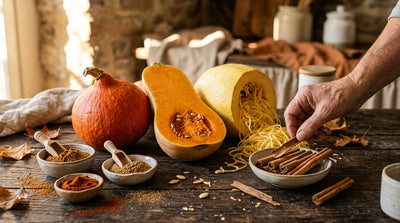
Pumpkin, turmeric and ginger soup with coconut milk
Hokkaido pumpkin naturally brings a slight sweetness that combines superbly with the heat of ginger and the earthiness of turmeric. The coconut milk makes the soup creamy, entirely without additional cream.
| Ingredient | Quantity (4 servings) |
|---|---|
| Hokkaido pumpkin | 800 g |
| Onion | 1 piece |
| Garlic cloves | 2 pieces |
| Fresh ginger | 20 g |
| Turmeric (powder) | 1 tsp |
| Coconut milk | 400 ml |
| Vegetable stock | 600 ml |
| Oil for frying | 2 tbsp |
Preparation
Prepare the pumpkin Wash the Hokkaido, remove the seeds and cut into cubes; the skin can be cooked along with it.
Sweat Finely chop the onion, garlic and ginger and sweat in oil until translucent.
Stir in the turmeric Briefly toast the turmeric powder with them, then add the pumpkin.
Deglaze and simmer Top up with stock and coconut milk and simmer for 20 minutes until the pumpkin is soft.
Blend and season Blend until smooth and season with salt and pepper.
Red lentil soup with turmeric, ginger and black pepper
Red lentils provide plant protein and are deliberately combined here with black pepper in order to make use of the piperine effect described in section 2 (Shoba et al., 1998). The lentils break down by themselves during cooking, giving a velvety consistency entirely without a hand blender.
| Ingredient | Quantity (4 servings) |
|---|---|
| Red lentils | 250 g |
| Onion | 1 piece |
| Garlic cloves | 2 pieces |
| Fresh ginger | 15 g |
| Turmeric (powder) | 1 tsp |
| Black pepper, ground | 1/2 tsp |
| Chopped tomatoes (tinned) | 400 g |
| Vegetable stock | 800 ml |
Preparation
Rinse the lentils Rinse the red lentils under cold water until the water stays clear.
Toast the spices Briefly fry the onion, garlic, ginger, turmeric and pepper in oil.
Add the lentils Add the lentils and tomatoes and stir in briefly.
Simmer Pour in the stock and simmer for 15 to 20 minutes until the lentils are soft.
Season Season with salt, pepper and a squeeze of lemon.

Asian turmeric and ginger soup with lemongrass and rice noodles
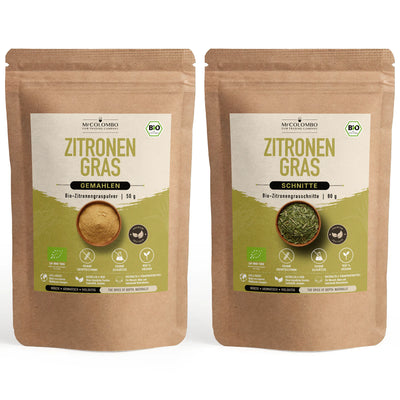
Lemongrass gives this soup a fresh, slightly lemony note, typical of South-East Asian cuisine. In Sri Lanka the plant is traditionally used fresh or dried; find out more in our article lemongrass as a spice. The entire lemongrass collection is also available as a powder, practical for quick soups.
| Ingredient | Quantity (4 servings) |
|---|---|
| Vegetable stock | 800 ml |
| Lemongrass (fresh, or 1 tsp powder) | 2 stalks |
| Fresh ginger | 20 g |
| Turmeric (powder) | 1 tsp |
| Coconut milk | 300 ml |
| Rice noodles | 150 g |
| Lime juice | 2 tbsp |
Preparation
Infuse the stock Bruise the lemongrass or stir in the powder, and leave to infuse with the ginger and turmeric for 10 minutes.
Add the coconut milk Stir in the coconut milk and bring briefly to the boil.
Prepare the noodles Soak or cook the rice noodles separately according to the packet instructions.
Bring together Divide the noodles between bowls and pour the hot soup over them.
Season Season with lime juice and garnish with coriander as desired.
Carrot and ginger soup with turmeric and cumin, vegan
Carrots bring natural sweetness and plenty of beta-carotene, which gives the soup its vivid orange colour. Cumin complements turmeric and ginger with an earthy, warm note that is especially welcome on cool autumn days.
| Ingredient | Quantity (4 servings) |
|---|---|
| Carrots | 600 g |
| Onion | 1 piece |
| Fresh ginger | 20 g |
| Turmeric (powder) | 1 tsp |
| Cumin, ground | 1/2 tsp |
| Vegetable stock | 700 ml |
| Coconut milk (optional) | 200 ml |
Preparation
Prepare the vegetables Peel the carrots and cut into slices, dice the onion.
Sweat Briefly toast the onion, ginger, turmeric and cumin in oil.
Add the carrots Add the carrots and sweat briefly.
Simmer Pour in the stock and simmer for 20 minutes until the carrots are soft.
Blend Blend until smooth, refine with coconut milk if desired and season.
How much turmeric and ginger can the body tolerate per day?
For curcumin, the European authority has set a clear reference value: according to the BfR, an acceptable daily intake (ADI) of 3 mg per kg body weight applies, which at 70 kg body weight comes to around 210 mg of curcumin per day. For tetrahydrocurcuminoids, a further-processed form of curcumin, EFSA has authorised an amount of up to 140 mg per day as a novel food (PMC8693248). How low the actual blood concentration remains even with high oral doses is shown by a dose-response evaluation of clinical studies: 2, 4 and 8 g of curcumin daily over three months produced blood levels of only 0.51, 0.63 and 1.77 micromoles (Examine.com, data aggregation). These values refer to concentrated extracts, not to the spice in the cooking pot.
By comparison: a teaspoon of turmeric powder contains, roughly estimated, 15 to 60 mg of curcumin depending on the curcumin content of the variety, so one to two teaspoons per soup pot for four servings remain well below the ADI value. For ginger, a systematic review by Viljoen et al. (2014, Nutrition Journal) with 1,278 pregnant women shows that daily amounts under 1,500 mg were the most thoroughly studied for efficacy, considerably more than is contained in a normal portion of soup. Kitchen-typical amounts of 15 to 20 g of fresh ginger per pot are therefore clearly within the range regarded as unproblematic.
Important
Anyone taking blood thinners or suffering from gallbladder disease should consult a doctor or pharmacist before consuming larger amounts of turmeric. This article is no substitute for medical advice.
Warming autumn soups with turmeric and ginger: flavour meets tradition
Turmeric and ginger make autumn soups not only warmer in flavour but also more interesting to prepare, from creamy pumpkin soup to spicy lentil soup with black pepper. The state of research on both spices is promising but not conclusive, and precisely that makes an honest approach to the facts important: turmeric and ginger are traditionally valued kitchen spices with studied active compounds, not a substitute for medical treatment. According to Grand View Research, the global market for curcumin extracts will grow to around 199.7 million US dollars by 2030, a sign of growing interest in the active compounds, but this changes nothing about the sober assessment by Stiftung Warentest: spice yes, superfood no. Those who pay attention to origin and quality, for example through direct import from Sri Lanka rather than anonymous bulk goods, at the same time reduce the risk of residues such as mineral oil or pesticides. If you would like to try the effect of turmeric in an even more concentrated form, our ginger-turmeric shot is a fitting addition to the four soup recipes.