




B lack pepper is the most widely used spice in the world - yet there is a world of difference between a dusty supermarket powder and freshly ground Ceylon peppercorns. According to a coordinated EU investigation (EU JRC, 2021), 17 per cent of all pepper samples tested were suspected of adulteration, frequently bulked out with papaya seeds or pepper husks. At the same time, the Öko-Test of March 2025 shows that not a single conventional product achieved the rating "good" - all five test winners were organic pepper. Anyone who chooses black pepper consciously not only tastes more, but also avoids contaminants such as mineral oil residues (MOSH/MOAH) and pesticides.
Judging black pepper by quality can be reduced to six criteria: piperine content (ideally above 5 per cent), origin, peppercorn size, purity, form of processing and storage. As a direct importer from Sri Lanka, we know the entire supply chain personally - from cultivation in the Central Province to delivery in Germany. In this guide, we combine scientific data with our practical experience so that you make the right choice at your next purchase.
At a glance
What makes good black pepper?
The quality of black pepper can be pinned down to six measurable criteria: piperine content, essential oil content, peppercorn size, purity, moisture content and freedom from contaminants. The most important single value is the piperine content - it determines pungency and depth of flavour. According to a study of 160 Vietnamese samples, piperine content ranges between 3.1 and 6.5 per cent (Park et al., 2020). Ceylon pepper from Sri Lanka, by contrast, reaches over 7 per cent (Newerli-Guz & Śmiechowska, 2022), making it one of the most piperine-rich varieties in the world. On the international spice market, which according to IMARC Group (2024) amounts to around USD 4.5 billion, safety and purity standards determine quality grading alongside flavour.
The International Pepper Community (IPC) in Jakarta defines three quality grades for black pepper, based on moisture (a maximum of 13 per cent), proportion of foreign matter and microbiological load. In India, the Spice Board additionally distinguishes between Malabar Garbled (MG-1), with a minimum peppercorn size of 3.25 mm, and the premium grade Tellicherry TGEB with a peppercorn diameter of at least 4.25 mm (Spice Board India). For consumers in Germany, this means: peppercorn size alone is already a visible mark of quality. Large, even peppercorns with a matt to slightly glossy surface indicate careful harvesting and processing. An intense, aromatic scent when crushed between the fingers confirms a high content of essential oils.

Which pepper varieties are there and how do they differ?
Black pepper (Piper nigrum) originally comes from the Malabar Coast in southern India, but is now grown in tropical regions worldwide. Vietnam dominates the market with over 52 per cent of world production and an export value of USD 1.66 billion in 2025 (VHB Group, 2026). The five most important varieties differ markedly in flavour, pungency and aroma profile - depending on terroir, climate and processing.
The five most important pepper varieties at a glance
Malabar pepper from Kerala (India) is regarded as the classic, with a robust, woody pungency and a minimum peppercorn size of 3.25 mm under the MG-1 standard. Tellicherry pepper is not a separate crop but the best 10 per cent of the Malabar harvest - only peppercorns over 4.25 mm are classified as Tellicherry, which guarantees more even ripening and more complexity in flavour (Serious Eats). Lampong pepper from Sumatra (Indonesia) is rather hot and direct, with less aromatic depth. Kampot pepper from Cambodia was granted EU protected geographical indication (GI) status in 2016, which tripled the price per kilo from USD 4.50 to 14.50 (FAO).
Ceylon pepper - the front runner for piperine content
Ceylon pepper from Sri Lanka deserves special attention: with a piperine content of over 7 per cent, it measurably outperforms most of its competitors. Sri Lanka grows pepper on around 42,989 hectares, often as an intercrop in coconut and tea plantations in the districts of Matale, Kandy and Kegalle (Dept. of Export Agriculture Sri Lanka). The annual yield in 2023 was over 30,000 tonnes - a record. At MrCOLOMBO, we know every stage of this supply chain personally: from the smallholder farmers in the Central Province, who train their pepper vines up living support trees, to gentle drying in the sun. Despite a world market share of only 2 per cent, Ceylon pepper commands a premium price that is justified by its demonstrably higher quality.
| Variety | Origin | Piperine content | Flavour profile |
|---|---|---|---|
| Ceylon | Sri Lanka | >7 % | Complex, fruity-warm, long-lasting |
| Tellicherry | India (Kerala) | 5-7 % | Multi-layered, woody, nutty |
| Malabar | India (Kerala) | 5-7 % | Robust, woody, earthy |
| Kampot | Cambodia | 4-6 % | Floral, citrusy, mild |
| Vietnam | Vietnam | 3.1-6.5 % | Hot, direct, little complexity |
Why is piperine content so decisive?
Piperine is the alkaloid that gives black pepper its characteristic pungency - and at the same time the most objective quality marker. In an analysis of Polish market samples, piperine values varied between 3.92 and 9.23 per cent (Newerli-Guz & Śmiechowska, 2022). This enormous difference shows: not all pepper is the same. Piperine content depends directly on the degree of ripeness at harvest, the terroir and the processing. NIR spectroscopy now enables rapid analysis in just 2 minutes, compared with 20 minutes for the traditional HPLC method (Park et al., 2020) - an advance that should become more accessible to smaller importers in future, too.
Besides pungency, piperine also influences the absorption of other nutrients in the body. In a much-cited study, combining 2 g of curcumin with 20 mg of piperine increased the bioavailability of curcumin by 2,000 per cent (Shoba et al., 1998). The absorption of coenzyme Q10 also rose by around 30 per cent with the addition of piperine (Badmaev et al., 2000). These findings make pepper the ideal companion to Turmeric - and explain why the Ayurvedic combination Trikatu (black pepper, long pepper, ginger) has been used in South-East Asia for millennia (Johri & Zutshi, 1992). For the kitchen, this means: a piperine-rich pepper such as Ceylon pepper not only offers more flavour, but according to studies can also better support the bioavailability of other nutrients than a cheap mass-market product.

Which contaminants can be found in black pepper?
Black pepper can contain a range of contaminants that arise during harvesting, drying or storage. The German Federal Office of Consumer Protection and Food Safety (BVL, 2020) classified pepper as conspicuous for lead, aluminium, nickel, chromium and thallium. In a recent US study, 40.5 per cent of spice samples exceeded the New York limit for lead - arsenic, cadmium and lead were detectable in over 90 per cent of all samples (Huff et al., 2025). Mechanical high-temperature drying can exacerbate the problem: contact with metal parts in the dryer measurably increased iron and chromium levels in Brazilian samples (Vieira et al., 2022).
Mineral oil residues are of particular concern. Stiftung Warentest (2016) found MOSH in all 20 pepper products tested and MOAH - which is considered potentially carcinogenic - in four products. The Öko-Test of March 2025 confirmed the problem: the conventional product from Hartkorn failed with the rating "unsatisfactory", mainly because of MOAH contamination. Mycotoxins also pose a risk, especially with goods from warm, humid storage environments. An investigation of Indian market samples found that 76.1 per cent were aflatoxin-positive and 78.5 per cent were OTA-positive (Jeswal & Kumar, 2015). The 23-year analysis of the EU rapid alert system RASFF also shows: 96.3 per cent of all black pepper notifications concern salmonella, with India the most frequently reported country of origin (Eissa et al., 2024). That is why at MrCOLOMBO we rely on short, transparent supply chains directly from Sri Lanka - our partner farms in the Central Province dry the pepper gently in the sun, without contact with metal parts, and store it in controlled environments before it reaches us in Germany.
Important
This article is for information purposes and does not replace medical advice. If you have health-related questions, please consult your doctor or pharmacist. The contaminant levels mentioned refer to specific studies and cannot be applied to all products.
Whole peppercorns or ground pepper - which is better?
Anyone who has ever crushed a fresh peppercorn between their fingers and noticed the intense, almost floral fragrance knows the difference immediately. The recommendation is clear: whole peppercorns are superior to ground pepper in every respect. The aroma of a freshly cracked peppercorn dissipates within 30 minutes (America's Test Kitchen) - ground pepper in a jar loses its essential aroma compounds after just 30 days. Whole peppercorns, on the other hand, stay aromatic for 2 to 3 years when stored correctly. The reason lies in the essential oils: black pepper contains α-pinene, β-pinene, limonene and β-caryophyllene, the composition of which varies greatly depending on origin (Dosoky et al., 2019). Grinding breaks open the cell structures and these volatile compounds escape into the air immediately.
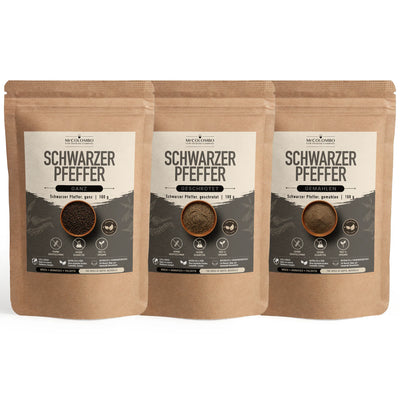
Whole peppercorns also perform better when it comes to contaminants. Stiftung Warentest (2016) found that ground pepper tended to show higher contaminant levels than whole peppercorns - presumably because mineral oil residues from packaging and machinery are transferred during the grinding process. In addition, the polyphenols are also better preserved in whole peppercorns: the total polyphenol content of black pepper is between 9.75 and 32.13 mg GAE per gram, with an antioxidant capacity of over 80 per cent radical scavenging activity (Zhang et al., 2021). Ground pepper is also easier to adulterate: papaya seeds, pepper husks or starch can be mixed in without difficulty, whereas foreign matter stands out immediately among whole peppercorns. So anyone investing in good spice quality should buy only whole peppercorns and grind them fresh in a mill. That is why at MrCOLOMBO we supply only whole peppercorns - grinding happens in your kitchen.
Practical tip
Store whole peppercorns protected from light and airtight at room temperature. Avoid places right next to the cooker - heat and steam accelerate the loss of aroma. Find out more in our guide on storing spices properly.

What should you look for when buying black pepper?
Germany is the largest pepper importer in Europe: 26,400 tonnes a year, equivalent to 30 per cent of all EU pepper imports (CBI, 2024). At the same time, Germany is the EU leader for organic spices with 6,900 tonnes - 55 per cent of the entire EU organic spice market. Demand for high-quality, transparent products is growing, which is also reflected in the test results: in the 2025 Öko-Test, only organic products achieved the rating "good" - including dm Bio, Sonnentor, Alnatura and K-Bio. Not a single conventional pepper was convincing.
Five criteria for buying pepper consciously
For a well-founded purchasing decision, five criteria are recommended: first, organic certification - it rules out synthetic pesticides and demonstrably correlates with lower contaminant levels. Second, whole peppercorns instead of powder, as they contain fewer contaminants and retain their aroma for up to 3 years (Stiftung Warentest, 2016). Third, a specific indication of origin - "pepper from Vietnam" is more informative than "black pepper". Fourth, transparency in the supply chain: direct importers such as MrCOLOMBO can personally confirm the growing conditions in Sri Lanka and guarantee short transport routes. Fifth, price as an indicator: the Stiftung Warentest test winner (Lebensbaum Bio) cost €6 per 100 g - well above the discounter price, but also markedly better in flavour and purity. Given that pepper prices have doubled since 2023, which according to the German Spice Industry Association (Fachverband der Gewürzindustrie) is caused by climate change and shrinking growing areas in Vietnam, you should be particularly wary of conspicuously cheap offers.
An additional mark of quality is resistance to adulteration. The EU-coordinated investigation (EU JRC, 2021) identified papaya seeds as the most common adulterant in pepper samples. Modern analytical methods such as IR spectrometry can now detect 27 different types of adulteration (McGrath et al., 2025). For consumers, there is a simple home test: real peppercorns sink in water, while papaya seeds float. As a general rule: anyone who buys from a transparent organic spice retailer considerably minimises the risk of adulteration.
Black pepper - recognising quality and choosing consciously
The quality of black pepper is no coincidence, but the result of origin, variety, processing and storage. With a piperine content of over 7 per cent, strict organic standards and transparent supply chains directly from Sri Lanka, Ceylon pepper offers a measurably superior alternative to anonymous mass-market goods. Anyone who chooses whole peppercorns from a trustworthy supplier and grinds them fresh tastes the difference immediately - and at the same time avoids contaminants that are regularly detected in cheap ready-ground products.
If you would like to learn more about the world of spices, read our overview of Spices from Sri Lanka or find out why Ceylon cinnamon differs from cassia cinnamon.