

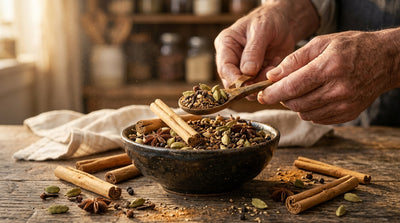


Sustainable spice cultivation means producing pepper, cinnamon and turmeric in such a way that the soil is more fertile after the harvest than before it. Instead of monoculture, the plants grow in the shade of support trees; instead of synthetic fertilisers, compost and green manure do the work; instead of chains of middlemen, there is a direct contract with the growing operation. It is precisely this combination that the term regenerative agriculture describes.
The global spice sector accounts for around 0.06 per cent of the world's food crop production and in doing so causes 41.4 to 64.8 million tonnes of CO2 equivalents per year, which corresponds to 0.33 per cent of agricultural greenhouse gas emissions (Bolliger, Itten and Stucki, 2026). The quantity in the spoon is tiny; the effort per kilogram of end product is anything but. At MrCOLOMBO we import directly from Sri Lanka and see the other side of this calculation on the ground every year. Cinnamon from the central region, pepper from the highlands and turmeric from Jaffna grow there predominantly in mixed cultivation systems that come closer to a forest garden than to a field. Between the cinnamon shrubs stand jackfruit and coconut trees, turmeric rhizomes sprout in the undergrowth, and to this day the bark is peeled by hand. Machines fail at this work. From the peeled quill to the jar in Germany, we know every station of this chain personally. This structure determines whether cultivation builds up soil or uses it up.
Short answer
What is sustainable spice cultivation? A cultivation system that builds up soil fertility instead of consuming it, preserves biodiversity on the land and pays producer families in a way they can plan around. In practice, this usually means agroforestry: spice plants grow between crop trees and shade trees. According to Bolliger, Itten and Stucki (2026), switching to organic cultivation saves 4.8 kilograms of CO2 equivalents per kilogram of end product for cloves, 5.6 for cinnamon and 26.3 for vanilla. For turmeric and ginger, however, this advantage is reversed.
At a glance
What does sustainable spice cultivation mean in concrete terms?
Sustainable spice cultivation rests on three measurable pillars. The first is soil building, the second is biodiversity on the land, the third is a producer price that a family can plan with. The EU organic seal covers only part of this. According to the German Environment Agency (Umweltbundesamt), it requires that chemical-synthetic fertilisers, chemical-synthetic plant protection and genetic engineering be forgone, but it expressly contains no social standards. Regenerative agriculture starts one level higher and asks what the farming gives back to the system. It is measured by humus content, water retention capacity, shading and pollinator diversity. For spices this difference is particularly tangible, because pepper, cardamom and cinnamon are by nature understorey plants. They originate from multi-layered tropical forests and deliver their best quality in precisely such structures. Open monocultures, by contrast, force additional irrigation and fertilisation, because nothing shades the soil any more. Anyone who replaces agroforestry with row cropping trades structure for inputs. The yield rises in the short term, the effort permanently.
The market is moving in this direction, though more slowly than the debate would suggest. With organic sales of 18.23 billion euros in 2025, Germany is the largest organic market in Europe (BÖLW), and the federal government's Organic Strategy 2030 aims for 30 per cent of farmland under organic cultivation (BMLEH). Across the EU, the share of organic farmland stood at 10.8 per cent in 2023 (Eurostat). By 2030 it is to rise to 25 per cent under the Green Deal, accompanied by a halving of pesticide use. These targets, however, primarily concern land within Europe. Spices are almost entirely imported goods from tropical regions, to which European land targets do not apply. Anyone looking for sustainable spices on the shelf therefore has to look at the cultivation practice in the country of origin. What matters there is the cultivation system, the processing and the question of who keeps which share of the price in the end. A seal on a German shelf reflects only a fraction of this. No German land target improves a cinnamon garden in Matale.

How large is the CO2 footprint of spices really?
Spices are regarded as climatically insignificant because the quantities consumed are tiny. Per kilogram of end product, the calculation looks different. Bolliger, Itten and Stucki (2026) put the emissions of the global spice sector at 41.4 to 64.8 million tonnes of CO2 equivalents per year. The sector thus accounts for 0.33 per cent of agricultural greenhouse gas emissions, even though it makes up only around 0.06 per cent of global food crop production. The reason lies in processing, because spices lose up to three quarters of their weight during drying, so that behind every kilogram sold stand several kilograms of fresh produce and the land needed to grow it. Add fossil-fuelled dryers, irradiation, fumigation and air freight, and it quickly adds up. Organic cultivation lowers emissions for most spices, but not equally strongly everywhere. For cloves the saving is 4.8, for cinnamon 5.6 and for vanilla 26.3 kilograms of CO2 equivalents per kilogram. For cinnamon that means, concretely, 6.8 instead of 12.3 kilograms. For turmeric and ginger, conventional cultivation performs better in the same study, so a blanket "organic is always more climate-friendly" does not hold.
The biggest levers sit in cultivation and drying, while transport is regularly overestimated. Sun drying on concrete terraces or in simple solar tunnels, as is customary in Sri Lanka for cinnamon and pepper, manages without fossil energy. The produce is spread out in the morning, turned several times and brought in again in the evening so that the night moisture does not creep back into the bark. Sea freight pushes the transport share down to a fraction of what air freight causes, because a container holds many times the quantity for the same volume. Agroforestry systems also actively sequester carbon rather than merely avoiding emissions. For consumers, an uncomfortable truth follows from this. The country of origin alone says little; what matters is the combination of cultivation system, drying method and transport route. It is precisely these three pieces of information that are missing on most spice packaging in the supermarket. Anyone who asks for them gets a concrete answer from a serious supplier and silence from interchangeable mass-market goods.
Our way at MrCOLOMBO
Our spices are sun-dried in Sri Lanka, shipped by sea freight and only filled in small batches once in Germany. Why direct import without middlemen matters to us is explained in detail under Benefits of organic spices.
Why is agroforestry considered the heart of regenerative cultivation?
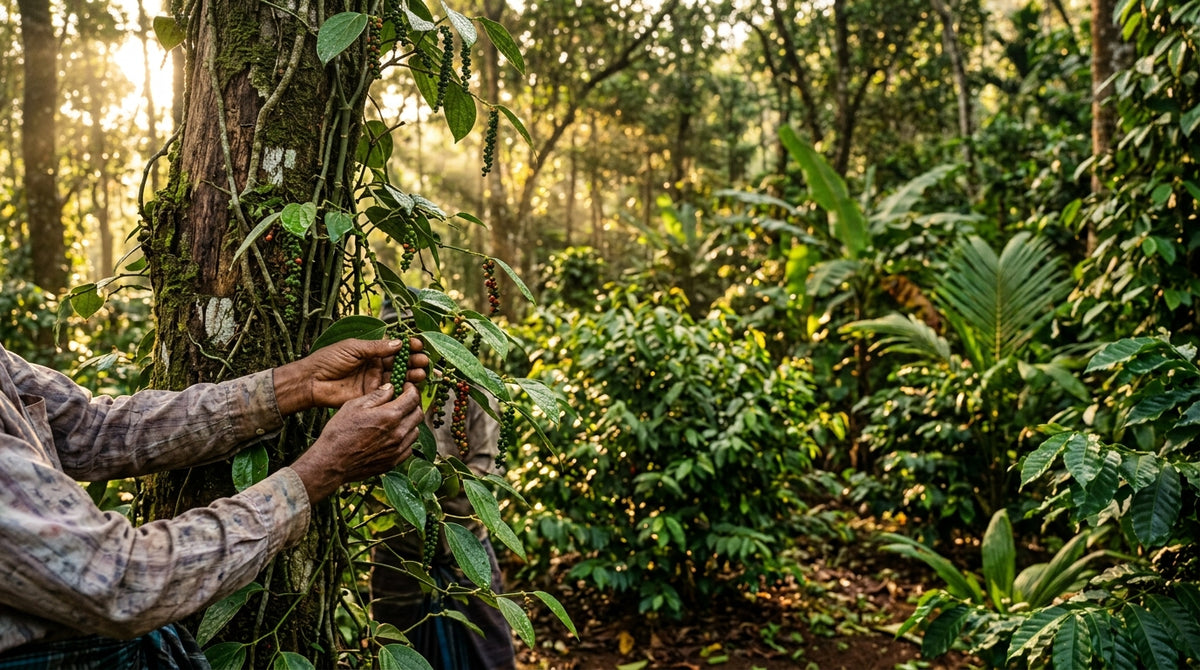
Agroforestry combines trees and crops on the same land and thus forms the counterpart to the cleared monoculture. For spices, this system looks less like a romantic ideal than like the botanically obvious solution. Black pepper (Piper nigrum) is a climbing plant and needs a living support tree on which it grows several metres high. Kunhamu and colleagues (2018) examined 22-year-old support trees in pepper cultivation systems in Kerala and found substantial biomass stocks, sequestered carbon and a nutrient cycle closed via leaf litter. Biomass was highest for Grevillea robusta at 365.7 tonnes per hectare. The soil remains shaded, erosion after heavy rain falls markedly, and water demand drops noticeably compared with open land. Albrecht and Kandji (2003) arrive at a similar picture in their review of tropical agroforestry systems, with significantly higher soil carbon values than in comparable monocultures. In these systems the support tree is no mere accessory. It provides shade, foliage and support, and thus carries a good part of the harvest.
Biodiversity benefits measurably too. A survey of ten Sri Lankan home gardens in the village of Pitekele found 219 plant species from 181 genera and 73 families, on average 64 species per garden (Mongabay, 2018). According to a 2009 FAO report, such home gardens make up around 15 per cent of the land area and around 33 per cent of the forested area of Sri Lanka. They therefore shape the landscape of an entire country. Globally, according to the same Mongabay analysis, agroforestry sequesters around 0.73 gigatonnes of carbon per year, a figure for which, however, no primary study is named there. As early as 2003, the FAO analysed in a working paper how smallholder agroforestry projects can combine emission reduction and income security, but pointed to the high transaction costs. For individual family farms, access to climate finance has remained difficult to this day. A farm with two hectares can hardly manage the documentation required for a carbon project, even if its land sequesters more per hectare than many a certified section of forest.
In practical terms, this means that pepper vines climb up jackfruit, coconut or Gliricidia trees, while turmeric and ginger grow in the undergrowth. Each storey uses a different layer of light, and the farm harvests several products spread across the year instead of a single crop. This spread is also economically decisive. If the world market price for pepper falls, fruit, coconut or cinnamon carry the family through the year. The quality in the jar also depends on the processing. The piperine that gives black pepper its heat sits mainly in the outer fruit skin, which turns dark and wrinkled during drying. The volatile aromatic oils survive slow sun drying far better than harsh hot air. Anyone who has once smelled freshly harvested pepper next to months-old commercial goods in the jar will not forget the difference in a hurry. How strongly cultivation system and processing show in the finished peppercorn is described under Recognising pepper quality. All of our black pepper comes from such mixed highland gardens.
How sustainably is cultivation in Sri Lanka actually carried out?
When it comes to cinnamon, Sri Lanka is unrivalled. Around 90 per cent of the true cinnamon traded worldwide comes from the island, grown on about 31,000 hectares, with almost 400,000 people employed directly and indirectly (Sri Lanka Export Development Board). Counting the households behind them, Suriyagoda and colleagues (2021) arrive in their review at over 350,000 families who make a living from cinnamon. Cinnamomum verum, formerly also listed as Cinnamomum zeylanicum, is accordingly genuinely Sri Lankan. The typical cinnamon farm works a few hectares as a family unit and has little in common with a plantation in the industrial sense. This small-scale structure is both an advantage and a risk for the sustainability debate. It preserves diversity but makes certification harder, because audit costs per farm are barely affordable. The state manages organic exports through the National Organic Control Unit at the Sri Lanka Export Development Board. The national cinnamon research station in Palolpitiya has been under the newly created Department of Cinnamon Development since January 2024.

The historical starting point makes clear why agroforestry there is more than a marketing term. Between 1990 and 2005, Sri Lanka lost over 35 per cent of its primary forest, and the total forest area shrank by almost 18 per cent (Mongabay, 2006). Spice gardens in the agroforestry system are today among the few land-use types that combine tree cover and agricultural income. Particularly well documented are the Kandyan home gardens in Kandy, Matale, Kegalle, Badulla, Kurunegala, Nuwara Eliya and Rathnapura, which Pushpakumara and colleagues (2017) describe as a centuries-old, culturally rooted agroforestry system. Anyone standing among these gardens in the highlands often only recognises the boundary with the forest by the fence. That is precisely what distinguishes a home garden that has grown over time from a plantation that has been laid out. In exports, the country deliberately focuses on organic and supplies certified organic pepper, cardamom, cloves, nutmeg, cinnamon, ginger and vanilla in growing quantities. Demand from Europe is noticeably driving this conversion. You can find more about the individual regions under Spices from Sri Lanka.
For the kitchen, origin is both a question of taste and a question of safety. True Ceylon cinnamon and the cheaper cassia cinnamon are botanically different species with markedly different coumarin content. The German Federal Institute for Risk Assessment issued an opinion on this as early as 2012 and confirmed a tolerable daily intake of 0.1 milligrams of coumarin per kilogram of body weight. The main aroma compound in both species is cinnamaldehyde, but Ceylon bark also brings fine citrus and vanilla-like notes, while cassia tastes flatter and sharper. The difference is already visible in the stick. Ceylon cinnamon consists of several wafer-thin layers of bark rolled into one another and breaks between the fingers; cassia forms a single thick, hard tube. Anyone who buys ground cinnamon without a species declaration in the supermarket usually gets cassia from large-scale cultivation in South East Asia. We have written up the complete comparison of both species under Ceylon cinnamon versus cassia cinnamon. We source our Ceylon cinnamon from family farms in the central region.
What does regenerative agriculture change in the soil?
The soil is the real yardstick for sustainability, because this is where farming mistakes accumulate over the years. A comparative study in semi-arid Karnataka in India found higher bacterial diversity on regeneratively farmed arable land than on conventionally farmed land and on fallow land. What was studied there was arable farming in general, not spice cultivation. Microbial diversity governs nutrient turnover and aggregate stability, and thus the soil's ability to store water instead of letting it run off. This is exactly what decides, in the monsoon months, whether a slope keeps its topsoil. Feliziani, Bordoni and Gabbianelli (2025), in a review in the journal Antioxidants, link regenerative cultivation, soil health, soil microbiome and nutrient density of the harvest in a common model. For pepper cultivation, researchers have analysed the physicochemical soil parameters of South Indian growing areas and found a clear connection between cultivation practice and soil fertility. For spice gardens, a simple consequence follows from this. Anyone who leaves leaf litter lying and forgoes deep tillage works with the microbiome instead of disturbing it anew every year.
A healthy spice garden smells of forest floor, not of dust. Anyone who reaches into the top ten centimetres during a plantation visit and finds dark, crumbly earth is seeing the result of decades of leaf litter and shade.
MrCOLOMBO experience report
Organic cultivation is not automatically the loser on yield, as is often assumed. Choudhary and Rahi (2018) studied the organic cultivation of the high-yielding turmeric cultivars Palam Pitamber and Palam Lalima in the Indian Himalayan region. The rhizome yield rose to about three times that of conventional cultivation, profitability to three to four times and resource efficiency to two to three times. Such figures are site-dependent and cannot be transferred wholesale to every spice and every region. But they refute the assumption that sustainability in spice cultivation must fundamentally be bought with a loss of yield. With perennial crops such as cinnamon and pepper, soil building in any case pays off only over decades, because the same plant stands on the same site for 20 years and longer. A cinnamon shrub that grows on the same plot for three decades answers every farming mistake with thinner shoots and weaker aroma. What the soil loses in that time, no fertiliser brings back.
Which certifications guarantee sustainable spice cultivation?
No single seal covers all three pillars, and this is exactly where most of the misunderstandings on the shelf arise. The EU organic seal regulates cultivation practice but, according to the German Environment Agency, contains no social standards. Fairtrade regulates price and premium but makes no stipulations on agroforestry structure. The Fairtrade premium is paid in addition to the selling price, and the smallholder organisation decides jointly on its use, for example for health care, community projects or its own processing. Certification is carried out by FLOCERT in accordance with ISO 17065. Organic farming associations go beyond the EU standard. At Naturland, among other things, an upper limit of 112 kilograms of total nitrogen per hectare and year applies, partial conversions of a farm are not permitted, and around 114,000 farmers worldwide are certified. Anyone who wants to see all three pillars covered therefore inevitably combines several forms of proof. That is not a failure of the seals. Each of them answers exactly the question it was once built for, and not a single one beyond it.
| Criterion | EU organic | Fairtrade | Rainforest Alliance / UEBT |
|---|---|---|---|
| Ban on synthetic pesticides | Yes | No | Partly |
| Social and wage standards | No | Yes | Yes |
| Requirements on tree cover and biodiversity | Limited | Limited | Yes |
| Minimum price or premium | No | Yes | Premium possible |
| Traceability back to the farm | Via control body number | Via cooperative | Via supply chain verification |
Which programme applies specifically to herbs and spices?
Specifically for herbs and spices, the Rainforest Alliance and the Union for Ethical BioTrade have been running a joint certification programme since 2024, which combines the UEBT standard at farm level with traceability of the supply chain and covers, among others, pepper, chilli and vanilla. The industry's Sustainable Spices Initiative aims to achieve at least 25 per cent sustainable sourcing in its three most important product categories by 2025, and 50 per cent by 2030. The target is thus more narrowly defined than it first sounds, because it expressly does not apply to the entire range. Even in the optimistic scenario, a large part of world trade remains outside any sustainability check until 2030. For small direct importers, the practicable route therefore rarely leads via yet another seal. It leads via traceable single origin with laboratory analysis of every batch. An audit costs a family farm with two hectares about as much as a large operation with two hundred, and that is exactly where certification fails at the small scale.
Why does the EU Deforestation Regulation not apply to spices?
The EU Deforestation Regulation adopted in 2023 (Regulation (EU) 2023/1115) allows certain commodities onto the European market only if no forest was cleared for them after 31 December 2020. Its Annex I lists seven commodities: cattle, cocoa, coffee, oil palm, soya, rubber and wood. Spices are not on it. Pepper, cinnamon, turmeric and cardamom are therefore subject to no geolocation-based proof requirement, even though they come from the same tropical regions as coffee and cocoa. For large and medium-sized companies, the regulation applies from 30 December 2026, for small and micro enterprises from 30 June 2027, after the amending Regulation (EU) 2025/2650 postponed its application once again. Anyone wishing to prove deforestation-free origin for spices therefore cannot rely on European law and instead needs the assurance of the producing farm as well as a supply chain that can be traced backwards. For spices, freedom from deforestation thus remains a voluntary commitment for the time being. Whether it is honoured depends solely on the importer.
Important
An organic seal says nothing about how producers are paid; a Fairtrade seal says nothing about pesticide use. Anyone who wants both needs both pieces of information or a documented direct trading relationship with batch analysis.
How do you recognise sustainably grown spices when shopping?
A look at the packaging is rarely enough, yet the residue data show why the question of origin is worth asking. In May 2026, Foodwatch had a total of 64 samples of rice, spices and tea from Germany, France, the Netherlands and Austria tested and found residues of pesticides banned in the EU in around 70 per cent of the samples, i.e. 45 of 64. Paprika powder, chilli and cumin were the most affected. In 2022, ÖKO-TEST examined nineteen turmeric powders, including ten organic products, and found elevated mineral oil levels in 16 of 19, and in one organic turmeric additionally the banned fumigant ethylene oxide. In 2020, in a test of 34 kitchen herbs, Stiftung Warentest classified five products as heavily to very heavily contaminated with pyrrolizidine alkaloids. For three of them, the testers advised against consumption. In the ÖKO-TEST comparison, in the end only a single organic product received the top mark. A seal alone therefore does not replace laboratory analysis, and origin and batch say more than any logo.
Checklist for shopping
Is the specific region stated on the pack? "Central region Sri Lanka" is a declaration of origin; "EU and non-EU agriculture" is not.
Is the botanical species named? Cinnamomum verum instead of just "cinnamon", Piper nigrum instead of just "pepper" shows that the retailer knows the goods.
Is there an organic control body number? The format DE-ÖKO-000 can be verified; a green leaf in the logo cannot.
Is the harvest year or the batch stated? Anyone who declares batches can assign laboratory analyses and, in case of doubt, trace them back.
Is the cultivation system described? Agroforestry, mixed cultivation or home garden are concrete details; "close to nature" is an empty word.
Does the price match the promise? Hand-peeled Ceylon cinnamon from smallholder cultivation cannot cost the same as machine-processed cassia mass-market goods.

In everyday life, a simple rule of thumb helps. The more processing steps lie between field and jar, the less can be said about the cultivation practice. Whole spices have the advantage here, because species, size and processing quality can be judged directly on the whole peppercorn or the whole stick, whereas ground goods conceal this. A good peppercorn vintage feels heavy and immediately smells resinous when crushed; old goods stay mute. With cinnamon sticks, the wall thickness reveals the species; with ground turmeric, the colour says something about age and storage. This check takes seconds and is more honest than any advertising claim on the front of the pack. Anyone who buys whole peppercorns and cinnamon sticks and grinds them themselves therefore controls not only the aroma but also the origin. Our entire range from Sri Lanka is sorted by single origin rather than by blends, and we name the growing region for every product.
Is sustainable spice cultivation worthwhile for producers and the kitchen?
Sustainable spice cultivation is not an exercise in going without; in most cases it is the older and more robust form of cultivation: spices in the agroforestry system, sun drying, sea freight and direct contracts with the producer families. The figures support this from both sides. Organic cultivation lowers emissions for cinnamon by 5.6 and for vanilla by 26.3 kilograms of CO2 equivalents per kilogram, but not for turmeric and ginger (Bolliger, Itten and Stucki, 2026). Agroforestry sequesters around 0.73 gigatonnes of carbon worldwide every year, and in the organic turmeric trial by Choudhary and Rahi (2018) profitability rose to three to four times. At the same time, the residue tests by Foodwatch and ÖKO-TEST show how much is still amiss in the mass market. For the kitchen, a simple rule remains. Ask about origin, buy whole spices, grind them yourself. Anyone who keeps that up for three months will shop differently afterwards anyway. How strongly origin makes itself felt in the jar is shown by the comparison under Ceylon cinnamon versus cassia cinnamon.