



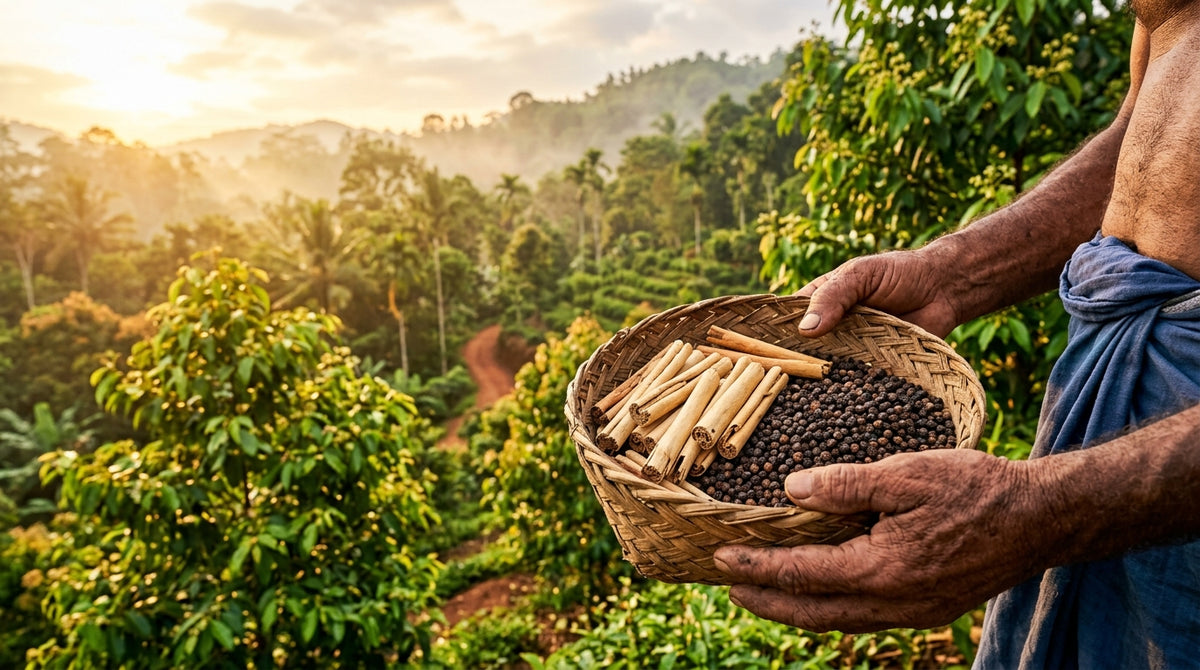
Between the spice plantation in Sri Lanka and the bag on the German supermarket shelf, conventional trade involves five to seven intermediate stages: from the smallholder via the collection point, exporter, importer and wholesaler to the retailer. Along this long journey, a spice loses freshness, traceability and value. The farmer at origin receives less than 7 per cent of the eventual final price (Heray Spice Survey, 2022), while every further stage adds its own margin.
At MrCOLOMBO, we import premium spices directly from smallholder farmers in Sri Lanka. From the turmeric field in Jaffna to dispatch in Germany, we know every stage of the supply chain personally. This article shows how a global spice supply chain really works, why so much quality and money is lost along the way, and how you can tell when shopping whether your spice has travelled a short or a long road.
Short answer
What happens between the plantation and the bag? In the classic spice trade, every single grain passes through five to seven hands. Each stage takes a margin, and the farmer at origin keeps less than 7 per cent of the final price (Heray Spice Survey, 2022). The longer the chain, the higher the risk of aroma loss, adulteration and residues. An EU investigation found deficiencies in quality, safety or authenticity in 66.3 per cent of 104 cinnamon samples (JRC, 2025).
At a glance
How many stages does a spice pass through from plantation to bag?
A conventionally traded spice changes hands five to seven times between harvest and the shop shelf. It starts with the smallholder, who harvests and dries. Then come a local collector, a regional buyer, a processor or exporter, an importer in Europe, the wholesaler and finally the retailer. Each of these stages demands a trading margin, stores the goods in the meantime and often blends them with lots of other origins. This is precisely how traceability is lost: in the end, it is almost impossible to say which field a spice came from. Scientists therefore describe spice supply chains as highly fragmented and characterised by numerous intermediaries, which leads to inefficiencies and low returns for producers (Kumar et al., 2023).
The journey also takes longer than most consumers assume. Several months, sometimes more than a year, often pass between harvest and supermarket shelf, because at every stage the goods wait until there is a sufficient quantity for resale. In Germany, this market is large: retail sales of spices stood at around 446.87 million euros in 2025, and 97 per cent of all households use spices (Statista, 2025). Despite this significance, the origin almost always remains invisible to customers. The bag rarely states more than a country of origin, often just the vague note "from various countries". Anyone wanting to know which plantation their pepper comes from will find practically no answer in conventional trade.

| Stage | Task | Estimated share of value |
|---|---|---|
| Smallholder | Cultivation, harvest, drying | < 7 % |
| Collector / local trader | Buying up, bundling | approx. 5 % |
| Processor / exporter | Cleaning, grinding, shipping | approx. 8 % |
| Importer / logistics | Import, customs, transport | approx. 15 % |
| Wholesaler | Storage, distribution | approx. 20 % |
| Retailer / brand | Packaging, marketing, sales | approx. 45 % |
This breakdown explains why a long trade route is not only a logistical but also an economic question. Anyone who looks for a short, traceable supply chain when shopping is at the same time deciding how much of their money actually reaches the producer. We describe in detail what such a short route looks like in practice in our article on the direct import of spices versus wholesale.
Why were spices the foundation of the world economy?
The spice supply chain is not a modern phenomenon but one of humanity's oldest trading structures. More than 4,000 years ago, caravans were already carrying cinnamon, pepper and cardamom along sections of what later became the Silk Road, which connected Asia with Europe over a length of around 6,400 kilometres (Pastaweb, 2024). In the Middle Ages, pepper was so valuable that at times it was weighed against gold, and Venice built its wealth on an almost complete spice monopoly. This early supply chain worked on the same principle as today: numerous intermediaries made the goods more expensive at every stage, while the producers at the other end of the world saw only a fraction of the final price. The trade in flavours thus shaped entire economies.
The breaking of this monopoly triggered the first wave of globalisation. When the sea route to India opened up, the price of pepper in Lisbon fell around 1505 to just a fifth of the Venice price (Periodics, 2024). Portugal achieved profit margins of around 500 per cent on the direct import of pepper (Tagesanzeiger, 2024). In 1602, Dutch merchants founded the Dutch East India Company (VOC), which is regarded as the world's first joint-stock company and was created exclusively for the spice trade. The lesson of this history is astonishingly topical: whoever bypasses the intermediaries and buys directly at the source changes the entire distribution of value in a supply chain. It is exactly this principle that lies behind today's growing trend towards direct import.
Why does the farmer get so little of the spice price?
The core of the problem lies in the number of hands a spice passes through. A survey of 300 producers in Afghanistan, India and Sri Lanka found that farmers receive on average less than 7 per cent of the retail price (Heray Spice Survey, 2022). In concrete terms: of 10 euros that a customer pays for a bag of spice, often less than 70 cents reach the farmer at origin. The large remainder is spread across collectors, processors, importers and the trade. Direct-trade models, by contrast, pay many times that: studies show that fair direct relationships can pay producers up to five times the usual farm-gate price (SRA, 2024). The difference determines whether a farming family can live from its harvest.
The more stages there are between field and bag, the less remains for the hands that actually planted and harvested the spice.
MrCOLOMBO experience report
The German market also shows how value creation concentrates at the top of the chain. The entire spice market in Germany is estimated at around 900 million euros; the market leader Fuchs alone generated sales of 660.9 million euros in 2024, an increase of 4.8 per cent (Lebensmittelpraxis, 2025). At the same time, fair trade is growing: Fairtrade Germany reached a volume of 3.14 billion euros in 2025 and paid out 42 million euros in premiums to producers (Lebensmittelpraxis, 2025). These figures demonstrate that consumers are increasingly willing to pay for transparency and fair producer prices. Anyone who consciously opts for short supply chains when shopping shifts, to some extent, where the money in this chain ends up.

What does the long transport route do to spice quality?
Every additional stage and every month of storage costs a spice aroma. The greatest loss is often caused by grinding itself: during industrial grinding, the material can heat up to 42 to 95 degrees Celsius, causing a considerable proportion of the volatile aromatic oils to evaporate (PMC, 2016). This is exactly why freshly ground pepper tastes more intense than a powder that was processed months ago and has been stored ever since. Whole spices stay aromatic considerably longer: Hartkorn gives a shelf life of up to four years for whole spices, but only six to twelve months for powders (Hartkorn, 2024). Gentle processes such as cryogenic grinding under cold conditions can measurably reduce this loss of aroma, but are rare in the mass market.
Anyone who wants to preserve aroma therefore pays attention to two things: a short route between harvest and packaging, and correct storage at home. Light, heat and oxygen destroy volatile aromas and colour pigments, which is why spices should be stored in a cool, dark and airtight place (Hartkorn, 2024). The moment of grinding also counts: as soon as a spice is crushed, it releases its essential oils, which then quickly dissipate. We have collected practical tips on this in our article on storing spices properly, and we explain why gentle processes make such a difference in our article on the cryogenic grinding of spices. A short supply chain is a genuine quality advantage here, because the spice is packaged fresher and passes through fewer intermediate warehouses.
Which spices are adulterated most often?
The longer and more opaque a supply chain, the easier it is to stretch or swap goods. In September 2025, the Joint Research Centre of the EU Commission examined 104 cinnamon samples from ten EU countries: 66.3 per cent did not meet all standards for quality, safety or authenticity, and around 9 per cent of the samples declared as Ceylon actually contained cheaper cassia cinnamon (JRC, 2025). The picture is similar for turmeric: a research review found that around 20 per cent of commercial turmeric products worldwide were adulterated, frequently with synthetic curcumin or dyes (Pharmaceutical Biology, 2025). In chilli and paprika powder, banned dyes such as Sudan red keep turning up (Verbraucherzentrale, 2024). The real difference between the types of cinnamon is therefore worth a closer look.
We show in detail how to distinguish true Ceylon cinnamon from the cheaper cassia variety in our comparison Ceylon cinnamon versus cassia cinnamon. Besides adulteration, residue contamination is also a supply chain issue. A Foodwatch analysis from 2026 found pesticides banned across the EU in 43 of 64 products tested, which corresponds to 67 per cent of the sample (Foodwatch, 2026). In addition, the Federal Office of Consumer Protection and Food Safety recorded more than 5,300 RASFF rapid alerts in 2024, a new record, with herbs and spices among the largest individual categories due to pesticide residues (BVL, 2025). These figures show that authenticity and purity can hardly be guaranteed without a traceable origin.
Important
Adulterated or residue-contaminated spices often cannot be recognised with the naked eye. Look for clear statements of origin, organic certification and a supplier who discloses their supply chain. This article is for information purposes and does not replace advice on food law.

How does direct import protect quality and smallholder farmers?
Direct import shortens the supply chain to a few traceable steps: from the producer via processing to dispatch, without the usual intermediaries. Sri Lanka is particularly suitable for this because the country has a long tradition and clear standards of origin. True Ceylon cinnamon covers around 85 to 90 per cent of the global market for this variety (Tridge, 2021), and according to the International Finance Corporation its production supports around 70,000 smallholder farmers and 350,000 workers in Sri Lanka (IFC, 2024). Since 2022, Ceylon cinnamon has also carried a protected geographical indication (GI) from the EU, which legally safeguards its origin. Growing regions such as the Central Province, Matale, Kandy or the north around Jaffna stand for clearly defined qualities.
Our approach at MrCOLOMBO
We buy our spices directly from smallholder farmers and cooperatives in Sri Lanka instead of sourcing them via anonymous collection markets. As a result, we know which region every lot comes from and can pay fair prices directly at origin. You can read more about the growing areas in our overview of spices from Sri Lanka.
For your shopping, this means: a short supply chain is not only an ethical but also a flavour decision. Anyone who chooses single-origin spices with a clear indication of region gets more freshly processed goods and at the same time supports the people who grow them. The growing interest in origin is reflected in the market: the global organic spice market stood at 1.6 billion US dollars in 2024 and is expected to grow to 4.3 billion by 2034, an annual increase of 10.6 per cent (Allied Market Research, 2024). "Where does it come from?" has become a standard question for many consumers. If you would like to try our spices, you will find the full range in the collection of all spices or specifically under true Ceylon cinnamon.
Checklist for shopping with a short supply chain
Is a specific region stated on the packaging? A precise indication of origin (e.g. central region of Sri Lanka) points to few intermediate stages.
Is there an organic or GI certificate? Certifications secure origin and reduce the risk of residues and adulteration.
Whole spice or powder? Whole spices keep their aroma for up to four years, powders often only six to twelve months.
Does the supplier disclose their supply chain? Anyone who names farmers, region and processing usually has the shorter route.
Is it worth looking at the supply chain?
The spice supply chain determines three things at once: the freshness in the jar, the authenticity of the contents and the income of the people at origin. In conventional trade with five to seven stages, the spice loses aroma, the farmer keeps less than 7 per cent, and the risk of adulteration rises, as the 66.3 per cent of deficient cinnamon samples in the EU investigation show (JRC, 2025). A short, transparent route turns this logic around. Anyone who pays attention to clear origin, certificates and direct import buys fresher, safer and fairer. Our golden milk recipe shows which countries of origin come together in a single cup.