





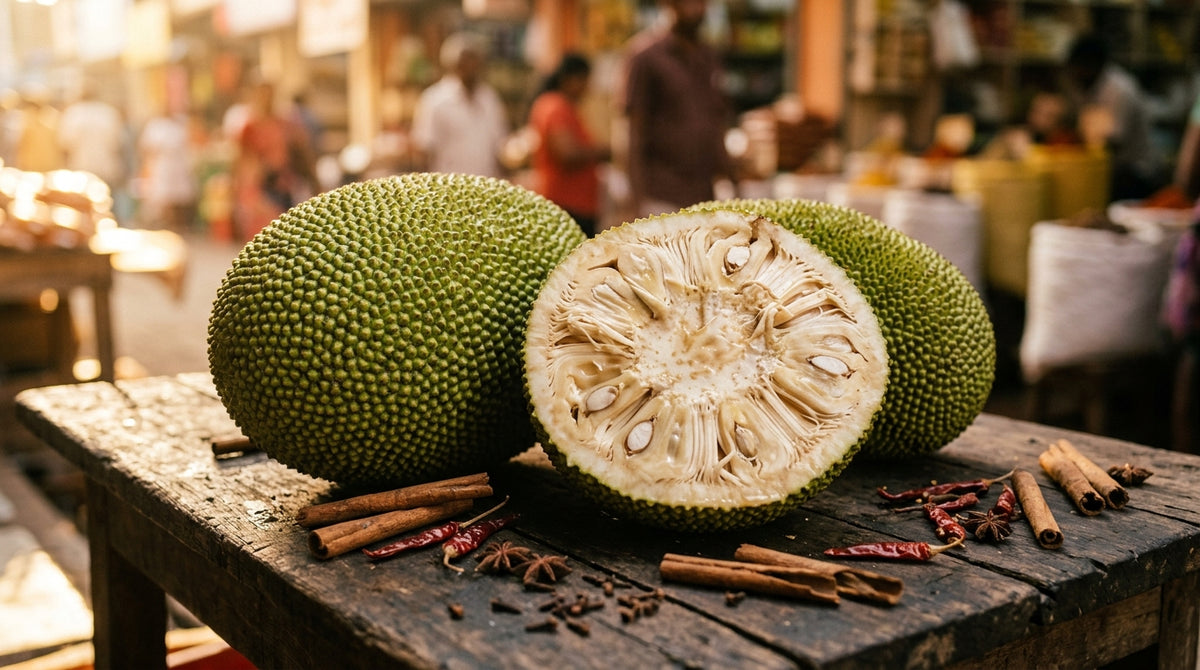
Jackfruit is regarded as the plant-based meat substitute with the meatiest texture - yet it provides hardly any protein. Harvested unripe, the largest tree fruit in the world falls apart into fibrous strands that look and bite like pulled pork. With only around 1.7 g of protein per 100 g (USDA FoodData Central, 2024), however, it is a texture substitute, not a source of protein.
That makes jackfruit an honest ingredient: it wins you over with its fibrous structure and versatility, not with its nutritional values. Its home is South Asia - and in Sri Lanka, from where MrCOLOMBO imports its spices directly, it has been part of everyday cooking under the name polos for more than 2,000 years. This article puts nutritional values, origin, climate footprint and preparation into a fact-based perspective.
Short answer
Is jackfruit a complete meat substitute? Jackfruit replaces meat in texture, not in nutritional value. Unripe jackfruit provides only 0.5 to 1.9 g of protein per 100 g (Ahmad et al., 2025) and is therefore classified by the Dutch Nutrition Centre, too, as unsuitable as a sole meat substitute. If you rely on protein, combine it with pulses, tofu or seitan.
At a glance
What is jackfruit and why is it regarded as a meat substitute?
Jackfruit (Artocarpus heterophyllus) is the largest tree-grown fruit in the world: individual specimens weigh 3.5 to 10 kg, in exceptional cases up to 25 kg (Tripathy, 2024). What matters for its use as a meat substitute is the time of harvest. When ripe, jackfruit is sweet and aromatic, but for savoury dishes it is harvested unripe - then the flesh is neutral in flavour and fibrous in structure. It is precisely these fibres that fall apart into strands when cooked, strands that are visually almost indistinguishable from shredded braised meat. That is why jackfruit has established itself as a base for pulled-pork imitations, tacos and gyros.
The term meat substitute needs to be understood precisely here. Jackfruit mimics the consistency of meat, but provides neither its protein nor its iron content in comparable amounts. In a review, the Dutch Nutrition Centre explicitly classifies unripe jackfruit as unsuitable as a sole meat substitute (Ahmad et al., 2025). If you use it in the kitchen as a fibrous main ingredient and get your protein from other sources, you are playing to its strengths.

How much protein does jackfruit really have?
Fresh, raw jackfruit contains around 95 kcal, 1.72 g of protein, 23.25 g of carbohydrates and 1.6 g of fibre per 100 g (USDA FoodData Central, 2024). This is the central point of honesty: a chicken breast, with around 23 g of protein per 100 g, provides roughly thirteen times as much. If you buy tinned jackfruit, you should also know that the protein content there is even lower - according to WebMD (2026), tinned jackfruit with 0.6 g of protein per 100 g contains around 78 per cent less than the fresh fruit. Jackfruit is thus a low-calorie provider of texture, not a carrier of protein.
| Per 100 g | Protein | Calories | Fibre |
|---|---|---|---|
| Jackfruit (unripe, fresh) | 1.7 g | 95 kcal | 2.5 g |
| Jackfruit (tinned) | 0.6 g | 164 kcal | 1.6 g |
| Chicken breast | 23.0 g | 110 kcal | 0 g |
| Beef (lean) | 21.0 g | 143 kcal | 0 g |
| Tofu | 8.0 g | 76 kcal | 0.3 g |
| Seitan | 25.0 g | 106 kcal | 0.6 g |
A look at the seeds is interesting: cooked jackfruit seeds contain 21.66 per cent protein and 14.26 per cent fibre (Kamdem Bemmo et al., 2023) - in other words, the highest nutrient density of the entire fruit. In Sri Lanka they are traditionally eaten along with the flesh, roasted or in curry. So if you really want to make nutrient-rich use of jackfruit, don't throw the seeds away. What remains important: these figures are nutritional values, not health promises - the nutritional benefit always depends on the overall diet.
Our approach at MrCOLOMBO
We don't import fresh jackfruit, but we do import the finely ground jackfruit powder from Jaffna in the north of Sri Lanka - harvested shortly before ripening, gently dried. How that fits into Sri Lankan cooking is something we show in our spices from Sri Lanka.
Where does jackfruit come from and what role does Sri Lanka play?
Jackfruit originates from the Western Ghats of India and has been cultivated throughout South Asia for more than 2,000 years. In Sri Lanka the unripe fruit is called polos, the ripe one kos - and it is deeply rooted in the cuisine. Traditionally it secured the food supply in the months before the rice harvest: a single tree can feed a family throughout the season (Kolamba, 2024). Harvesting takes place mainly around Avurudu, the Sinhalese and Tamil New Year in April, when dishes such as kos mallung and polos curry come to the table.
Economically, the fruit is gaining importance for Sri Lanka. In 2024 the country exported around 4.17 million kilograms of jackfruit worth 11.1 million US dollars (Tridge, 2024). The main buyers were the Maldives with 2.4 million kilograms, followed by Qatar, the United Kingdom and Switzerland. The crop suits the country: the tree is naturally drought- and pest-resistant and grows in mixed cultivation systems without intensive irrigation. For a direct importer like us, who knows every stage of the supply chain personally, this robustness is a quality argument - it allows cultivation without intensive pesticide use.

How climate-friendly is jackfruit compared with meat?
The climate footprint is the strongest argument for jackfruit. A life cycle assessment by The Jackfruit Company puts the greenhouse gas emissions of jackfruit at around 6 per cent of the figure for beef - in other words, 94 per cent less. Compared with chicken it is also 60 per cent lower and compared with pork 87 per cent lower. For comparison: according to global estimates, livestock farming causes around 14.5 per cent of man-made greenhouse gas emissions (Myblueplanet). If you replace beef with jackfruit, you therefore reduce the footprint of that meal drastically.
| Product | CO2 relative to beef | Climate-friendly |
|---|---|---|
| Beef | 100 % | No |
| Pork | approx. 46 % | No |
| Chicken | approx. 15 % | No |
| Jackfruit | approx. 6 % | Yes |
Honesty demands some perspective here too, though. Because of the transport distance, imported jackfruit has a larger footprint than home-grown alternatives such as tofu, tempeh or lupins (Myblueplanet). Its ecological advantage arises in comparison with meat, not in comparison with regional soya. Added to that is a problem of utilisation: only 25 to 35 per cent of the fruit is edible as flesh, 65 to 75 per cent counts as waste (Pathak et al., 2022). Research is working on obtaining flour, pectin and even bioplastics from the peel and seeds - which would further improve the overall balance.
How do you prepare jackfruit as a meat substitute?
The most important practical tip decides between success and failure: when buying tinned, always choose jackfruit in brine or water, never in syrup - otherwise the dish will turn out sweet instead of savoury. The pieces are drained well and patted dry, then shredded with two forks. Next, sear them over a high heat in the pan until the edges caramelise - only then does the meaty roasted structure develop. A study on optimal processing found that a cooking time of around 45 minutes achieves the best rating for appearance, flavour and acceptance (Samutsri and Thimthuad, 2025).
Checklist for perfect pulled jackfruit
Brine instead of syrup? Only buy tins with water or brine, otherwise it turns out sweet.
Drained and dried well? Moisture prevents browning - patting dry is a must.
Seared over a high heat? Only caramelised edges give the meaty texture.
Seasoned generously? Jackfruit is neutral in flavour and gratefully soaks up marinade.
Because jackfruit has hardly any flavour of its own, it lives on seasoning. In a European context it works as a BBQ pulled burger, as gyros with gyros seasoning or Mexican-style as a taco filling. It becomes authentic with Sri Lankan polos curry: baby jackfruit slowly braised in two stages of coconut milk, with curry leaves, tamarind and a stick of Ceylon cinnamon. This very cinnamon is the natural bridge to Sri Lankan cuisine - find out more in our Sri Lanka curry recipe and in the coconut sambal recipe.
An authentic polos curry needs the right seasoning base. A roasted Jaffna curry blend gives the typical dark, earthy note that characterises jackfruit in Sinhalese cooking. If you would like to add the cinnamon stick separately, you will find genuine Ceylon cinnamon with us. Which cinnamon is suitable for this is something we explain in detail in our comparison of Ceylon cinnamon and cassia cinnamon.

Is jackfruit well tolerated by everyone?
For most people jackfruit is well tolerated, but one group should be careful: people with a birch pollen allergy. A jackfruit allergen shows cross-reactivity with the birch pollen protein Bet v 1 - in one investigation, all five birch pollen allergy sufferers tested reacted with oral allergy symptoms (Bolhaar et al., 2004). So if you react to birch pollen, you may feel a tingling or itching in the mouth when eating raw jackfruit. Heating usually breaks down the allergen, which is why cooked jackfruit is often better tolerated. WebMD (2026) also advises caution for people with a latex allergy and people with kidney disease because of the potassium content.
Important
This article is for information purposes and does not replace medical advice. If you have allergies, kidney disease or health questions, please consult your doctor or pharmacist.
The research also includes a note from diabetology - though not on the fruit itself, but on green jackfruit flour. In a randomised controlled trial with 40 participants, an effect on the HbA1c value was observed when 30 g of rice or wheat per day was replaced with jackfruit flour (Rao et al., 2021). Such observations are the subject of ongoing research and not a promise of healing. For the kitchen, the takeaway is this: jackfruit is a normal food that is harmless in usual quantities - with the exception mentioned for allergy sufferers.
Fresh, tinned or powder - which jackfruit should you buy?
In Germany, jackfruit has long ceased to be a niche product: it is stocked in organic shops, chemists and many supermarkets - mostly tinned in brine. That fits the market trend, because the production of meat substitute products reached around 126,500 tonnes in 2024, an increase of 4 per cent on the previous year (Destatis, 2025). Per head, 1.5 kg was produced. Fresh unripe jackfruit is hard to get hold of in this country and highly perishable - for the pulled version, the tin is therefore the most practical choice. Look for organic quality and the words young, green or unripe on the label.
Jackfruit is no miracle ingredient and no protein wonder. It is an honest, fibrous ingredient that carries a dish when you season it properly - just as it has in Sri Lanka for centuries.
MrCOLOMBO experience report
A growing alternative is jackfruit powder. It can be stored for a long time, measured out and used in doughs, smoothies or as a binding agent, for example - without the water ballast of the tin. Our powder comes from Jaffna in the north of Sri Lanka and is harvested shortly before ripening. If you would like to discover the whole Sri Lankan range, you will find it in our jackfruit collection. More about origin and quality criteria can be found in our article on the benefits of organic spices.
Is jackfruit worth it as a meat substitute?
Jackfruit is worth it as a texture substitute and a climate win, not as a source of protein. With around 1.7 g of protein per 100 g it provides hardly any protein (USDA, 2024), but compared with beef it saves up to 94 per cent CO2. If you know that and season it generously - ideally with genuine spices from Sri Lanka - you get a versatile, honest ingredient with a cultural history going back thousands of years. Combined with pulses or tofu, it becomes a complete meal. Our spices from Sri Lanka lead you deeper into Sri Lankan cooking.