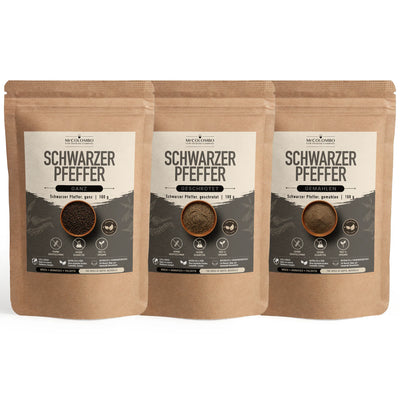





Four jars stand side by side on the shelf: black corns, white spheres, green berries, red pearls. Next to them a jar labelled Tellicherry, twice as expensive as the rest. Are four different plants growing there, and what exactly are you paying for with Tellicherry?
Black, white, green and red pepper all come from the same plant, the climbing shrub Piper nigrum from the Piperaceae family. Colour is determined solely by when the berries are harvested and how they are processed afterwards. The content of the pungent compound piperine varies between 2 and 9 per cent depending on origin and growing conditions (Stojanović-Radić et al., 2019). Tellicherry is not a variety but a trade grade. Under the trade standards of the International Pepper Community, Tellicherry Garbled Special Extra Bold comprises only those corns that are retained on a 4.75-millimetre sieve. Kampot pepper, in turn, has carried an EU protected geographical indication since 18 February 2016, the first Cambodian product to do so. And Sichuan pepper or pink berries are, botanically speaking, not pepper at all. The harvest figures show how big the market behind all this is. Worldwide, a total of 812,673 tonnes of pepper were harvested in 2022, a good third of it in Vietnam (FAO data for 2022, analysed by World Population Review).
Short answer
What really sets the pepper varieties apart? Black, white, green and red are ripening stages and forms of processing of a single plant (Piper nigrum). Names such as Tellicherry or Malabar denote trade grades by corn size, while Kampot and Sarawak stand for origins. The piperine content lies between 2 and 9 per cent depending on origin and growing conditions (Stojanović-Radić et al., 2019), and it is precisely this that determines pungency and depth of aroma.
At a glance
Why do black, white, green and red pepper come from the same plant?
Piper nigrum is a perennial climbing shrub that twines up support trees to a height of up to four metres in the humid tropics. Green pepper is picked unripe and immediately blanched, freeze-dried or pickled in brine so that the chlorophyll is preserved. Black pepper comes from the same unripe harvest but goes into the sun unblanched. In the process, polyphenols oxidise while chlorophyll and vitamin C in the fruit skin break down, and it is exactly this chain of reactions that makes the skin shrivel and darken. Gu and colleagues (2018) demonstrated in Molecules that both enzymatic and non-enzymatic browning pathways are involved. White pepper, by contrast, is harvested fully ripe and soaked in water for one to two weeks until the flesh comes away and only the pale core remains. Red pepper is the rarest variant, namely fully ripe berries that are either gently dried straight away or preserved in brine. Orav and colleagues (2004) measured in the Journal of Agricultural and Food Chemistry a smaller quantity of oil after one year of storage, together with a rising proportion of oxygenated compounds.

| Colour | Harvest time | Processing | Typical use |
|---|---|---|---|
| Black | unripe | unblanched, sun-dried | All-rounder, meat, sauces, marinades |
| White | fully ripe | soaked, fruit skin removed | light sauces, fish, Asian wok dishes |
| Green | unripe | blanched, freeze-dried or in brine | pepper sauce, terrines, poultry |
| Red | fully ripe | gently dried or in brine | fruity, only on the finished plate |
What is piperine and why does pepper taste hot?
The pungency of pepper is due to the alkaloid piperine, not to capsaicin as in chilli. Piperine binds to the TRPV1 receptor in the lining of the mouth, which actually registers heat, which is why the brain processes a warmth signal rather than a taste signal. The Oxford food scientist Charles Spence (2024) cites in the International Journal of Gastronomy and Food Science precisely this combination of pungency and volatile aroma as the reason for the epithet king of spices. The piperine content lies between 2 and 9 per cent depending on origin and growing conditions (Stojanović-Radić et al., 2019). Piperine became known above all through Shoba et al. (1998) in Planta Medica, where 20 milligrams of piperine increased the bioavailability of 2 grams of curcumin by 2,000 per cent. However, after two dropouts only eight male volunteers were evaluated after a single dose, and three of the six authors worked for the manufacturer of the piperine preparation. A later study using 5 milligrams of piperine found merely a doubling instead of a twentyfold increase (Anand et al., 2007, cited in BfR, 2021). You can read more in our article on the effects of turmeric.
Important
The German Federal Institute for Risk Assessment considers a maximum of 2 milligrams of isolated or enriched piperine per day to be acceptable for adults weighing 70 kilograms, taken as a bolus, for instance from a capsule (BfR, 2021). How often this is exceeded is shown by a 2024 investigation by the CVUA Stuttgart of 86 curcumin-containing food supplements: of the samples with declared isolated piperine, 39 per cent were above 10 milligrams per day, and the peak value reached 72 milligrams. This value applies to isolated piperine, not to pepper as a spice in the kitchen. This article is for information purposes and does not replace medical advice.
What makes Tellicherry pepper special?
Tellicherry denotes the highest trade grade for black pepper and not a botanical variety. Under the trade standards of the International Pepper Community (Pepper Quality and Grades), Tellicherry Garbled Special Extra Bold, TGSEB for short, consists only of corns that are retained on a 4.75-millimetre sieve. Added to this is a bulk density of at least 550 grams per litre. The lion's share of Indian pepper, by contrast, is traded as Malabar Garbled 1, MG1 for short, while the large-calibre premium grades make up only a fraction of each harvest. Large corns develop when the berries are allowed to stay on the vine longer and mature without yet becoming fully ripe, and when the plant sets fewer spikes. More time on the vine means more essential oil stored in the corn, and that is exactly what you taste in the result. Tellicherry seems less bluntly hot, but fruitier and more complex in the finish. The name goes back to the port city of Thalassery in Kerala, through which this pepper was historically shipped. So anyone who buys Tellicherry is paying for the sorting by corn size and the higher aroma density per corn, not for a different plant.
Which pepper origins should you know?
With pepper, alongside corn size it is origin that determines the aroma profile, because soil, altitude and processing tradition leave measurable traces. Kampot pepper from the Cambodian provinces of Kampot and Kep received EU protected status as a protected geographical indication on 18 February 2016, the first product from the country to do so (European Commission, eAmbrosia register). The cultivation history behind it is chequered. Under the French protectorate, production rose from 1,350 to 3,500 tonnes between 1899 and 1902 and then settled at around 2,000 tonnes a year, before civil war and the Khmer Rouge brought cultivation almost completely to a halt (La Plantation, Kampot). Sarawak pepper from the Malaysian part of Borneo goes back to Chinese immigrants who brought cultivation with them at the end of the 18th century and from the 1840s onwards expanded it into a network of family farms (One Tribe, The King of Spice). Vietnam leads the world market today with 272,235 tonnes, ahead of Brazil with 128,331 tonnes and Indonesia with 81,962 tonnes (FAO data for 2022).
Whether a declaration of origin for pepper can be verified in the laboratory remains an open question. Zeiner and colleagues (2023) did cleanly separate black, white, green and cayenne pepper in Foods by their mineral profile, but an assignment to the country of cultivation explicitly did not succeed. The element contents within a single country of origin vary too widely for that, and in any case all the samples examined came from India. For shoppers, this means that, for the time being, a declaration of origin on the jar documents traceability and does not replace laboratory analysis. Anyone looking for a particular aroma profile is therefore better guided by the growing region, the trade grade and the processing than by the country name alone. That only becomes verifiable through specific details on the packaging, such as the harvest year, the batch number or the control body number of an organic certificate. If all of this is missing and only a country of origin without a region appears on the label, the origin remains a claim without evidence.
What distinguishes Ceylon pepper from Sri Lanka?
Sri Lanka hardly ever appears in the usual lists of varieties, even though the island supplies around 5.7 per cent of world production with 44,090 tonnes and is the fifth-largest exporter after Vietnam, Brazil, Indonesia and India. From January to November 2018 alone, 12.47 million kilograms of pepper left the country (Sri Lanka Export Development Board). The same authority puts the piperine content of Ceylon pepper at two to six times higher than in produce from other growing countries. This figure, however, comes from the state export promotion agency and not from a published comparative measurement, so it should be read with caution. What remains plausible is the reason behind it: the way it is grown. In the Sri Lankan highlands around Matale and Kandy, pepper vines grow in the shade of larger trees, in mixed cultivation rather than monoculture, with cooler nights and slower ripening. The Department of Export Agriculture runs its own research centre in Matale, which works on precisely this question of quality. We have also described how strongly origin and processing shape the aroma for other spices, for instance in our overview of spices from Sri Lanka.

Our approach at MrCOLOMBO
We buy our pepper directly from smallholder farmers in the Sri Lankan highlands, without intermediaries, and know every stage of the supply chain personally. It is harvested by hand and dried on mats in the sun. If you want to see the full range, you will find it in our black pepper range.
Which peppers are botanically not pepper at all?
A considerable part of what is sold as pepper does not belong to the genus Piper. Sichuan pepper comes from the prickly ash tree Zanthoxylum and produces its characteristic tingling and numbing sensation, called mala in Chinese, through the compound hydroxy-alpha-sanshool, not through piperine or capsaicin. Pink berries are frequently and wrongly sold as red pepper, although true red pepper is the fully ripe, gently dried berry of Piper nigrum. Pink berries are the fruits of the Brazilian pepper tree Schinus terebinthifolius and belong to the Anacardiaceae family, i.e. the same plant family as cashew and mango, which is why people with a cashew or mango allergy should be careful. Mixed pepper combines black, white, green and usually pink corns, thereby putting four components of different hardness into one mill, which leads to uneven grinding. Long pepper, on the other hand, as Piper longum, does genuinely belong to the pepper genus. It is a component of the Ayurvedic blend Trikatu, which combines black pepper, long pepper and dried ginger in a ratio of 1:1:1 and forms the basis of numerous traditional formulations (Stojanović-Radić et al., 2019).
| Name | Botanically true pepper | Pungent compound |
|---|---|---|
| Black pepper (Piper nigrum) | Yes | Piperine |
| Long pepper (Piper longum) | Yes | Piperine |
| Sichuan pepper (Zanthoxylum) | No | Hydroxy-alpha-sanshool |
| Pink berries (Schinus) | No | essential oils, hardly any pungency |
How do you recognise good pepper when buying?
Pepper is among the most heavily contaminated spices on the German market, which is why the question of variety is only half the battle when shopping. The German Federal Office of Consumer Protection and Food Safety reported in 2020 on the investigations of 2017: in 7.5 per cent of black pepper samples the maximum pesticide levels were exceeded, and on top of that came elevated levels of lead, aluminium, nickel, chromium and thallium compared with other foods. Back in 2016, Stiftung Warentest rated only 7 of 20 products as good, while 5 failed with a poor rating. Whole corns consistently performed better than pre-ground produce. In its 03/2025 issue, Öko-Test tested 21 brands of whole peppercorns, 9 conventional and 12 in organic quality, for mineral oil components, pesticides and mycotoxins. Only 5 products achieved a good rating, all of them organic produce, and one branded product failed with an inadequate rating because of mineral oil components. The editors did not award a top mark. Added to this is a problem you cannot see from the jar. Consumer organisations such as Foodwatch point out that expensive spices are stretched with cheap fillers, and with ground produce nobody can tell any more what has been ground in with it.
Shopping checklist
Whole corns instead of powder? Whole produce performed significantly better at Stiftung Warentest (2016) and cannot be stretched with flakes.
Origin stated with a region? A country alone says little; a growing region such as Matale, Malabar or Kampot indicates traceability.
Organic certification present? At Öko-Test 03/2025, only organic products achieved a good rating.
Corns uniformly large and heavy? Trade grades such as TGSEB or MG1 refer to sieving and bulk density; uneven corns point to unsieved produce.
Does the corn smell when crushed? Fresh pepper immediately releases a resinous, citrus-like aroma; old corns only smell dusty.
A high price is no guarantee of quality with pepper. In a tasting by the Swiss consumer programme SRF Kassensturz in 2015, a French spice expert assessed eight black peppers. Of all things, the cheapest product performed best, a discounter's own brand, with 7.7 out of 10 points, while more expensive organic produce came in behind it. At Stiftung Warentest (2016) too, it was the contaminant load that was decisive and not the price bracket. A well-known branded product stood out there with record levels of mineral oil components of the MOSH and MOAH groups. So when you are standing in front of the shelf, growing region, trade grade and test result tell you more about quality than the price tag. For the export of Indian pepper to the USA, the ASTA cleanliness specifications on insect infestation, animal contamination and mould additionally apply, and failure to meet them leads to rejection at the border (Spices Board India). If you want to go deeper, you will find the details in our article on the quality of black pepper.
How do you store and grind pepper properly?
Pepper does not lose its aroma slowly but in bursts. Under the influence of light, piperine rearranges into its isomers isopiperine, chavicine and isochavicine, which taste considerably less hot, depending on light intensity and duration (Kozukue et al., 2007). Whether this alone explains the loss of pungency in old powder is disputed in the specialist literature. If you store whole corns in a dark, dry and airtight place, they remain usable for years. Harold McGee (2004) also describes how freshly ground pepper releases considerably more volatile aroma compounds than pre-ground produce. The grinding technique counts too. Liu and colleagues (2018) showed in the Journal of Food Science and Technology that cryogenic grinding preserves piperine, essential oil and fatty acids better than other methods, and that even in chilled storage, moisture, piperine and monoterpenes drop measurably after six months. Details can be found in our article on the cryogenic grinding of spices. It pays to be sceptical about the mill itself, because in the 2016 K-Tipp test only 4 of 18 models achieved a good rating. All the details on correct storage are in our guide to storing spices.
Which variety belongs in which dish?
White pepper is the choice for light sauces such as béchamel or beurre blanc and for Asian wok dishes, because it leaves no dark specks. For the classic French sauce au poivre vert, green peppercorns are only lightly crushed rather than ground, then sweated with shallots, deglazed with cognac and reduced with cream. Red Kampot pepper deliberately does not go into the pot but is freshly ground only on the finished plate, because its fruity notes are sensitive to heat. In South Indian cooking, whole Tellicherry pepper for a rasam is briefly toasted in a dry pan and only then ground, so that the essential oils open up before cooking. And anyone wanting to reduce salt will find an obvious substitute in pepper: the German Nutrition Society gives a guideline value of up to 6 grams of table salt per day and advises seasoning with spices and herbs instead.

When we rub a freshly dried corn between our fingers in the highlands around Matale, it smells resinous and citrus-like, with a hint of pine wood. The same produce a year later as powder smells above all dusty. That is why the whole corn is at the heart of what we do, and grinding is best done only shortly before the meal.
MrCOLOMBO experience report
Which pepper variety is the best?
There is no single best pepper variety, and that is the most honest answer. Black pepper remains the all-rounder with the broadest spectrum of aroma, white belongs in light sauces, green in pepper sauce, red on the finished plate. Trade grades such as Tellicherry with a sieve size of 4.75 millimetres and above say something about sorting and aroma density, declarations of origin such as Kampot or Ceylon about growing conditions. All four colours come from the same plant, and the piperine content, at 2 to 9 per cent, remains the real lever for pungency and depth of aroma (Stojanović-Radić et al., 2019). How often quality falls short is shown by Öko-Test 03/2025, where only 5 of 21 tested brands achieved a good rating. More important than any choice of variety is, in the end, the question of freshness: whole corns instead of powder, stored in the dark, ground only shortly before the meal and from a source with traceable origin. We rely on highland pepper from Sri Lanka, grown in the shade and with slow ripening. If you want to reorganise your spice rack from scratch, you will find the overview in our full range.