



Turmeric and curcumin - two terms that are constantly mixed up. In chemists' shops, curcumin capsules sit next to turmeric powder. Influencers swear by curcumin as a miracle remedy. And anyone who googles "buy turmeric" is shown food supplements, even though they are looking for a spice.
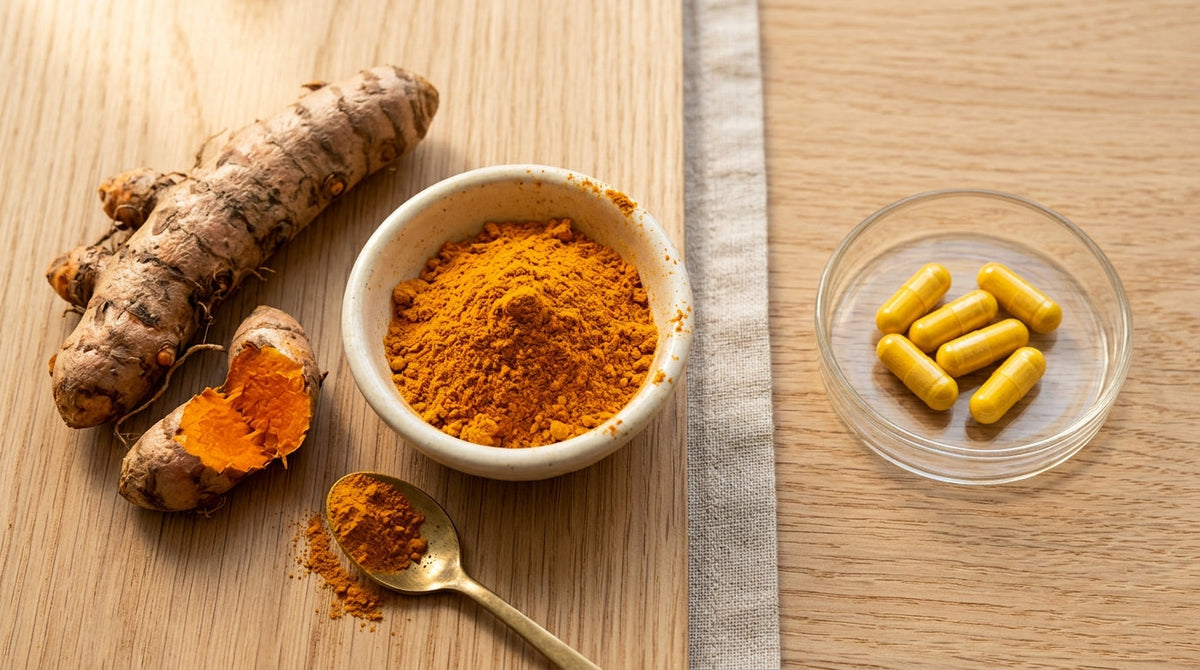
The difference is clear: turmeric (Curcuma longa) is the whole spice, with hundreds of constituents. Curcumin is just one of them and makes up 2-5% of the powder (Hewlings & Kalman, 2017). One teaspoon of turmeric provides around 90 mg of curcuminoids, plus essential oils, minerals and fibre that are completely absent from a curcumin extract. To date, the EFSA has not authorised any health claim for curcumin (EU Register, 2026). We import organic turmeric directly from smallholder farmers in Sri Lanka and explain the difference - honestly and without exaggerated promises.
At a glance
What is the difference between turmeric and curcumin?
Turmeric (Curcuma longa) is a tropical plant from the ginger family. The rhizome is dried and ground into powder. This bright orange powder contains hundreds of constituents: curcuminoids, essential oils such as ar-turmerone, fibre and minerals. Curcumin is a single polyphenol and makes up only 2-5% of the powder (Hewlings & Kalman, Foods 6(10):92, 2017).
Under the umbrella term curcuminoids, science groups together three related compounds: curcumin itself (approx. 77% of the curcuminoids), demethoxycurcumin (approx. 17%) and bisdemethoxycurcumin (approx. 6%) (Prasad et al., Biotechnology Advances, 2014). When a manufacturer writes "curcumin extract 95%" on its capsules, it usually means the sum of all three curcuminoids - not pure curcumin alone. This distinction sounds technical, but it is relevant for anyone comparing labels.
| Turmeric | Curcumin | |
|---|---|---|
| What is it? | Plant / spice | Single constituent |
| Composition | Hundreds of constituents | Isolated polyphenol |
| Curcumin content | 2-5% | 95% (in extracts) |
| Use | Cooking, drinks, colouring | Food supplements |
Why is turmeric more than just curcumin?
Turmeric powder contains 3-6% essential oils (Li et al., 2011) - ar-turmerone, alpha-turmerone and beta-turmerone. With conventional grinding, up to 30% of these oils are lost to frictional heat (Singh & Goswami, 1999). That is why, for our organic turmeric, we rely on cryogenic grinding.
The essential oils give turmeric its characteristic scent and are responsible for its full aroma. Anyone who has ever cut open a fresh turmeric root knows the intense, earthy smell - that is the turmerones. In a curcumin extract they are completely absent, because they are removed during extraction. In the turmeric fields of Sri Lanka's Central Province, in the region around Matale and Kandy, you can smell the freshly harvested rhizomes from several metres away. Our partner farms there grow turmeric under tropical conditions at 25-30 degrees Celsius and high humidity - ideal conditions for a high content of essential oils and curcuminoids.
Curcumin is authorised in the EU as a food colouring under E100. If you see E100 on an ingredients list, that is isolated curcumin - not turmeric. This distinction matters: anyone who spots a ready meal in the supermarket with "turmeric extract" in the ingredients list is getting curcumin as a colouring - not the full plant matrix with all its components.
How well can the body absorb curcumin?
Curcumin is broken down quickly in the body and is insoluble in water (Anand et al., 2007). That means: even if you swallow a high dose of curcumin, only a fraction of it reaches the bloodstream. The majority is metabolised in the liver and gut before it can take effect. In turmeric powder, curcumin is embedded in the natural plant matrix - together with fats and essential oils. This matrix embedding may favour absorption, although the exact mechanisms are still the subject of research.
Turmeric and pepper in the kitchen
In South Asian cuisine, turmeric and pepper have been combined for centuries - long before there were any studies on the subject. Read more in our pepper article.
Fat as an absorption aid
Curcumin is fat-soluble. In golden milk, turmeric, fat and pepper come together naturally. Frying turmeric in oil or ghee is a traditional first step in Sri Lankan cooking. Coconut oil or fresh coconut milk are the classic sources of fat here, found in almost every Sri Lankan curry.

Which is better: turmeric powder or curcumin capsules?
Turmeric powder provides the entire plant matrix: approx. 90-150 mg of curcuminoids per teaspoon. Curcumin capsules typically provide 500-1,500 mg - 5 to 15 times as much.
Important
To date, the EFSA has not authorised any health claim for curcumin (EU Register, as of 2026). The EFSA re-evaluation of curcumin as the food additive E 100 dates from 2010 and states an ADI of 3 mg/kg body weight per day. This value is not a dosage recommendation for food supplements or turmeric powder.
Whether curcumin supplements make sense for you is something to discuss with a medical professional. We sell turmeric as a spice - deliberately. A good organic turmeric is an excellent food.
Turmeric in modern research
Since the 1990s, scientific research into curcumin has increased massively. PubMed lists over 12,000 studies on "curcumin" (as of 2025). That sounds impressive - but it does not automatically mean that all the promises are kept. Many studies were carried out in vitro (in a test tube) or on animals. Clinical studies in humans that demonstrate a measurable benefit are considerably rarer and often show inconsistent results.
That is not because curcumin is ineffective. It is down to poor bioavailability and methodological challenges in study design. Researchers worldwide are working on improved curcumin formulations: nanoparticles, liposomal curcumin, curcumin-phospholipid complexes. One study on micellar curcumin showed significantly higher bioavailability compared with native curcumin powder (Schiborr et al., Molecular Nutrition & Food Research, 2014). However, the long-term safety and efficacy of such formulations has not yet been conclusively demonstrated - most studies have small numbers of participants and short observation periods.
What does that mean for everyday life? Turmeric as a spice in normal kitchen quantities is safe, well researched in terms of its food safety and delivers aromatic enjoyment. Curcumin as a food supplement is a different product - with different dosages, different risk profiles and open questions about its long-term effects. The EFSA also makes this distinction explicit in its assessment.
What "rich in curcumin" means on products
In recent years, more and more products have carried the statement "rich in curcumin" or "with high-dose curcumin extract". These statements are permissible as long as they do not constitute unauthorised health claims. You should be wary of wording such as "has an anti-inflammatory effect", "helps with joint problems" or "strengthens the immune system" - these claims have not been authorised for curcumin by the EFSA. Anyone who sees such promises should ask critical questions.
For turmeric as a food - our spice - these restrictions apply. We do not name any health effects that are not covered by authorised claims. What we can say: good organic turmeric tastes intense, colours a bright yellow and is a central element of Ayurvedic cooking. You can find out more about the spices of Sri Lanka and their culinary tradition in our overview of spices from Sri Lanka.
How do you recognise good turmeric powder?
The curcumin content varies by growing region between 2 and 5% of the dry matter (Hewlings & Kalman, 2017). Sri Lankan turmeric from the Central Province is typically at the upper end of this range, which is due to the optimal soil conditions and the tropical climate. Four factors determine quality:
Organic certification is particularly relevant for turmeric, because conventional cultivation frequently goes hand in hand with pesticide contamination. Cryogenic grinding at temperatures of around -196 degrees Celsius preserves the essential oils, a considerable proportion of which is lost to frictional heat with conventional grinding (Singh & Goswami, 1999). Origin and traceability protect against adulteration - a real problem in the turmeric trade. And finally: good powder has a bright golden-yellow to orange colour. A dull, brownish yellow points to old, inferior or adulterated goods.
Adulteration: a real problem
Lead-based colourants (lead chromate) have been detected in turmeric from Bangladesh and India (Forsyth et al., 2019). Other adulterants: starch, chalk, synthetic curcumin. Organic certification and a transparent supply chain minimise the risk. Read more in our article Recognising spice quality.

How do you use turmeric correctly in the kitchen?
Turmeric only develops its full aroma when prepared properly. If you follow a few basic rules, you will get considerably more out of the spice.
Fat first: fry turmeric in oil or ghee. Fat-soluble curcuminoids dissolve better. You can see the principle in the Sri Lanka curry recipe.
Combine with pepper: in terms of taste, the combination works.
Dosage: 1 heaped tsp (approx. 3 g) for 4 portions of curry. 1/2 tsp for golden milk.
Caution: turmeric turns everything yellow. Use a separate board. UV radiation breaks down curcumin.
Storage: store turmeric in an airtight container, in a dark, dry place. UV radiation and moisture break down the curcuminoids. Freshly ground turmeric noticeably loses aroma and colour after six months.
Do not overdo it: beyond a certain amount it turns bitter. One tsp per dish is a good guideline.
Practical tip from Sri Lanka
In Sri Lankan cooking, turmeric is traditionally used together with coconut oil or coconut milk and black pepper.
Using turmeric correctly in recipes
The most important rule of thumb: always add turmeric early in the cooking process, ideally with a little fat. This gives the curcumin time to develop and to combine with the other flavours. In golden milk, turmeric is first heated as a paste in oil or ghee - a step many people skip, but one that is crucial for the aroma. In curries, turmeric goes in after the onions have been fried and before the liquid is added.
If you want to use turmeric in cold applications - for example in smoothies or muesli - you should combine it with a fat such as coconut oil or yoghurt. The same applies here: the fat-soluble curcuminoids need fat as a carrier. A turmeric smoothie without any fat at all gives off considerably less aroma than a version with a teaspoon of coconut oil. This is not rocket science - it is basic chemistry, which you will confirm for yourself on your first attempt.

Understanding turmeric and curcumin
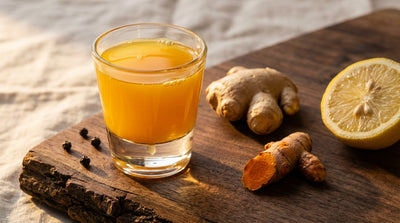
Turmeric is the spice, curcumin is one part of it. Get a good organic turmeric powder into your kitchen. Cook curries with it, make yourself a golden milk or a turmeric shot.
The choice between turmeric as a spice and curcumin as a food supplement is not an either-or question. They are simply different things with different purposes. Turmeric in the kitchen is an aromatic staple with a long tradition. Curcumin in capsules is a concentrated extract whose long-term effects are still being intensively researched. Both have their place - in their respective contexts.
Turmeric plays a central role in Ayurvedic cooking, where it is traditionally combined with ginger, cinnamon and cardamom. Find out more in our article on Ayurveda spices.
What you can do today: open your turmeric powder, rub a little of it between your fingers and smell it. Fresh, good turmeric smells intensely earthy, almost floral. If you can barely smell anything, the powder is too old or of inferior quality. We have summarised more on how to recognise high-quality spices in our article on recognising spice quality. And if you would like to get to know Sri Lanka's turmeric cultivation and the smallholder farmers behind it, you will find more in our article on the direct import of spices.