




A yurveda is a system of medicine from India that is more than 3,000 years old and regards diet, body care and lifestyle as a single whole. In Ayurvedic cooking, spices play the central role: turmeric, ginger, Ceylon cinnamon, cardamom and black pepper are used not only for flavour but are deliberately combined according to the individual body type - the so-called dosha. According to a representative survey of 4,065 participants, 9.3 % of Germans have already used Ayurveda at least once, and 30.2 % attribute therapeutic potential to the discipline (Prasad & Tyagi, 2024). The global Ayurveda market is growing at an annual rate of 19.7 % and is expected to reach around 85.8 billion US dollars by 2033 (Grand View Research, 2024).
This article explains the basics of Ayurveda, introduces the most important spices with their active compounds and dosha assignments, and shows you how to use them safely and in compliance with the Health Claims Regulation (HCVO) in your kitchen. From golden milk to classic kitchari - Ayurvedic spice cooking combines a tradition thousands of years old with current nutritional science.
At a glance
What is Ayurveda and where does this teaching come from?
Ayurveda - literally ‘knowledge of life’ - is one of humanity's oldest documented health systems. Its roots reach back to the Rig Veda, a collection of 1,028 hymns that already describes 67 medicinal plants (Jaiswal & Williams, 2016). The Charaka Samhita is regarded as the foundational text, a medical compendium compiled between the 2nd century BC and the 2nd century AD that systematically classifies hundreds of spices according to their properties. Together with the Sushruta Samhita and the Ashtanga Hridaya, it forms the ‘Brhat Trayi’ - the three great pillars of Ayurvedic medicine.
In 2022, the WHO opened a Global Centre for Traditional Medicine in India with an investment of 250 million US dollars (WHO, 2022). In India itself, more than 751,000 registered AYUSH doctors practise Ayurvedic medicine, integrated into more than 26,000 public health centres (Ministry of Ayush, 2026). In Germany, a representative study found that 9.3 % of the population have already used Ayurveda - mainly through wellness offerings (48.3 %) and increasingly as a complement in chronic illnesses (Prasad & Tyagi, 2024).

How does the tridosha principle work in the kitchen?
In Ayurveda, three doshas - Vata, Pitta and Kapha - determine each person's physical and mental constitution. Vata stands for movement and communication, Pitta for metabolism and transformation, Kapha for structure and stability. In Ayurvedic cooking, spices are chosen deliberately to balance a dosha - not to amplify it.
The practical application follows the principle of the six tastes (rasa): sweet, sour, salty, pungent, bitter and astringent. Each taste influences the doshas differently. Pungent spices such as ginger and black pepper balance the sluggish Kapha dosha, for instance, while cooling spices such as coriander and fennel calm an overactive Pitta. The following table shows the most important assignments for everyday cooking.
| Dosha | Quality | Balancing spices |
|---|---|---|
| Vata | Cold, dry, mobile | Ginger, cinnamon, cardamom, fennel, asafoetida |
| Pitta | Hot, oily, intense | Coriander, fennel, turmeric, cumin |
| Kapha | Heavy, cool, stable | Ginger, black pepper, mustard seeds, chilli |
Which spices are indispensable in Ayurvedic cooking?
Turmeric - the golden spice
Turmeric (Curcuma longa) is the heart of Ayurvedic spice cooking. The dried rhizome contains 3-5 % curcumin by dry weight - the plant compound responsible for the intense golden-yellow colour. Curcumin has been examined in more than 13,000 scientific publications on PubMed, making it one of the most thoroughly researched plant compounds in the world (Prasad & Aggarwal, 2011). In Ayurveda, turmeric is considered tridoshic - it balances all three doshas and has traditionally been used for more than 4,000 years in cooking and as an external application. Freshly cut turmeric gives off an earthy, warm scent reminiscent of damp tropical soil and leaves the characteristic golden colour on fingers and chopping board, which in Sri Lanka is regarded as a sign of a high curcumin concentration.
Black pepper - warmth and heat
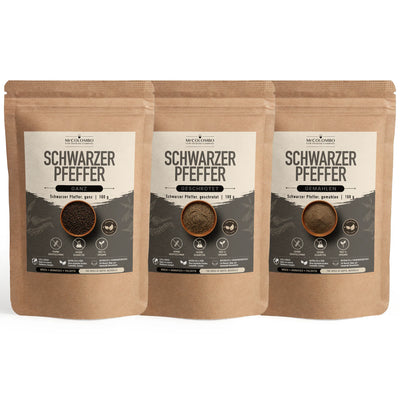
Black pepper (Piper nigrum) is far more than a source of heat in Ayurveda. In the tridosha system, pepper has a particularly Kapha-balancing effect and is added to almost every warm dish in Ayurvedic cooking. If you would like to learn more about the quality characteristics of black pepper, you will find the details in our dedicated guide.
Ceylon cinnamon - the mild variety
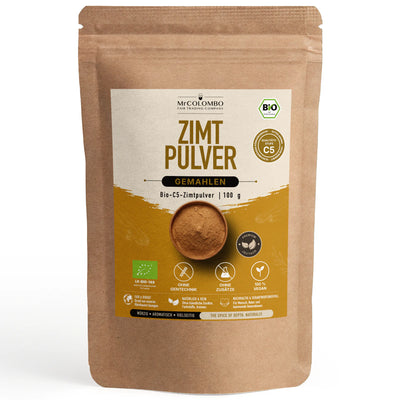
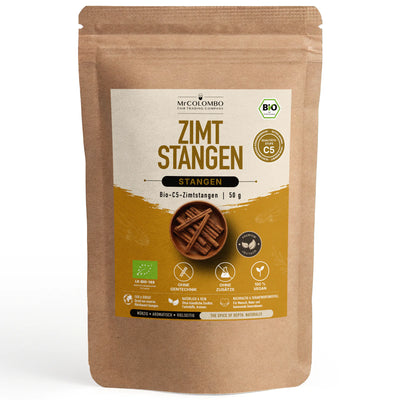
Ceylon cinnamon (Cinnamomum verum) from Sri Lanka differs fundamentally from the cassia cinnamon commonly sold in shops: with only 0.004 % coumarin, it contains around 250 times less of this liver-damaging substance than cassia cinnamon (BfR, 2012). In Ayurveda, cinnamon is classified as warming and is recommended particularly for Vata and Kapha types. Its main active compound, cinnamaldehyde, gives the spice its characteristic aroma. For a detailed side-by-side comparison, we recommend our article Ceylon cinnamon vs. cassia cinnamon.
Cardamom, ginger and fenugreek
Green cardamom (Elettaria cardamomum) contains the essential-oil compound 1,8-cineole and is regarded in Ayurveda as Pitta-cooling. A meta-analysis of 769 participants across 8 randomised controlled trials examined the effects of 3,000 mg of cardamom per day on inflammatory markers (Baraki et al., 2024). Ginger (Zingiber officinale) owes its pungency to 6-gingerol and is prized in Ayurveda as a universal digestive spice. Fenugreek (Trigonella foenum-graecum) contains the alkaloid trigonelline and is used in the Ayurvedic tradition as a spice for dals and curries - a meta-analysis of 19 RCTs with 1,612 participants investigated the relationship between fenugreek and blood sugar parameters (Pourmasoumi et al., 2024). In Ayurvedic spice cooking, all three only unfold their full potential through the tarka method - briefly toasting them in hot ghee, which releases the essential oils and sends an intense, multi-layered scent through the kitchen.
Important
This article is for information purposes only and does not replace medical advice. The studies mentioned describe research findings - not healing promises. If you have health-related questions, consult your doctor or pharmacist.

Why is the origin of Ayurvedic spices so crucial?
Sri Lanka - historically known as Ceylon - has been one of the world's most important spice-growing regions for more than 2,500 years. As early as 1518, Portugal built a fort in Colombo to secure the monopoly on Ceylon cinnamon (Cartwright, 2021). The tropical climate of the Central Province around Matale and Kandy offers ideal conditions for growing cinnamon, cardamom and pepper. Sri Lanka produces 4,000 to 5,000 tonnes of cardamom a year in the LG and LLG quality grades, which are particularly prized for their high essential-oil content (Export Development Board Sri Lanka). The connection between Sri Lanka and Ayurveda runs deep: the country maintains its own independent Ayurvedic tradition, which has developed over centuries in parallel with the Indian school. Anyone who has ever walked through the cinnamon gardens of the Southern Province near Galle knows the sweet, warm scent of freshly peeled bark - a sensory experience that explains why Ceylon cinnamon has been regarded for centuries as the finest cinnamon in the world.
At MrCOLOMBO we import our organic spices directly from smallholder farmers in Sri Lanka and know every stage of the supply chain personally - from the turmeric field in the Central Province to dispatch in Germany. Because with Ayurvedic spices in particular, origin makes the difference: Ceylon cinnamon contains 250 times less coumarin than the commonly sold cassia cinnamon from China, and Ceylon pepper has a particularly high piperine content. If you would like to learn more about the spice diversity of Sri Lanka, you will find the background in our country portrait.
How do you use Ayurvedic spices in everyday life?
Golden milk (haldi doodh) is probably the best-known introduction to Ayurvedic spice cooking. The preparation is simple: a turmeric paste made from turmeric powder, black pepper and a little water is stirred into warm plant-based milk together with Ceylon cinnamon, cardamom and a teaspoon of ghee or coconut oil. The fat component supports the absorption of the fat-soluble curcuminoids. You will find a detailed golden milk recipe with step-by-step instructions on our blog.
Kitchari - a stew of mung beans and basmati rice - is regarded as the staple dish of Ayurvedic cooking. It is prepared with up to twelve spices: cumin, fennel, turmeric, ginger, coriander, garam masala, mustard seeds, asafoetida, black pepper, cardamom, cinnamon and fenugreek. In the Ayurvedic tradition, kitchari is used during Panchakarma treatments as an easily digestible meal that balances all three doshas. Ayurvedic dal made from red lentils with cumin, turmeric and ghee is another everyday staple that is recommended particularly for Vata types. The Ayurvedic principle of tarka applies to all dishes: spices are first briefly toasted in ghee or oil to release their essential oils and increase the bioavailability of the active compounds.
Practical tip
Always toast spices in hot ghee or coconut oil for 30-60 seconds first, before adding any liquid. This tarka method releases the essential oils and improves both flavour and nutrient absorption - a basic principle of Ayurvedic cooking.

What does science say about Ayurvedic spices?
Scientific research into Ayurvedic spices has increased sharply over the past two decades. PubMed lists more than 400 clinical studies on curcumin alone, with doses of between 500 mg and 4,500 mg per day in conditions such as arthritis and inflammatory bowel diseases (Prasad & Aggarwal, 2011). A systematic review in the field of integrative medicine shows that Ayurvedic therapeutic approaches are increasingly being studied as a complement in diabetes and cardiovascular diseases, with the evidence base growing continuously (Payyappallimana et al., 2024). At the same time, Stiftung Warentest urges caution: turmeric is valuable as a kitchen spice, it says, but as a dietary supplement with exaggerated healing promises it should be viewed critically (Stiftung Warentest, 2024).
The European Food Safety Authority (EFSA) has set an ADI (acceptable daily intake) for curcumin of 3 mg per kilogram of body weight - for a person weighing 70 kg, that corresponds to around 210 mg of curcumin per day (EFSA, 2010). The German Federal Institute for Risk Assessment (BfR) warned in 2021 that dietary supplements containing curcumin can exceed this ADI (BfR, 2021). For ashwagandha (Withania somnifera) - another Ayurvedic herb - the BfR issued an explicit warning in 2024: possible liver damage and interactions with medicines, especially in children, pregnant women and people with liver disease (BfR, 2024). The clear recommendation is: use Ayurvedic spices as kitchen spices in usual quantities - and seek medical advice before taking dietary supplements.
What should you look out for when buying Ayurveda spices?
With Ayurvedic spices, quality is not a side issue - it is decisive. A test by ÖKO-TEST (2022) examined 19 turmeric powders in the laboratory: most of the products contained mineral oil residues and pesticides, in some cases ethylene oxide, which is regarded as a suspected carcinogen. Only one of the 19 products tested could be recommended without reservation. In 2025, the Verbraucherzentrale (German consumer advice centre) warned that 60 % of the Ayurvedic dietary supplements tested contained toxic heavy metals such as lead, mercury and arsenic. Organic certification alone does not always protect - what matters are transparent supply chains and independent laboratory analyses.
When buying Ayurvedic spices, it is therefore worth looking at three factors: first, the origin - Ceylon cinnamon from Sri Lanka is clearly superior to cassia cinnamon from China or Indonesia in terms of coumarin content. Second, certification - the EU organic seal and additional laboratory checks for heavy metals and pesticides provide reassurance. Third, the supply chain - direct importers who know their producers personally can guarantee quality better than anonymous wholesalers. The German spice market amounts to around 6.24 billion euros in annual turnover with 94,052 tonnes of domestic consumption (Fachverband der Gewürzindustrie, 2024), and 97 % of Germans use spices regularly - demand for verified quality is growing steadily.
Practical tip
When buying turmeric, look for organic certification and ask the retailer for current laboratory analyses. A curcumin content of 3-5 % by dry weight is a mark of quality - significantly less than that points to inferior raw material.
Ayurvedic spices - tradition meets evidence
Ayurvedic spices combine a tradition documented for more than 3,000 years with growing scientific evidence. Turmeric, black pepper, Ceylon cinnamon, cardamom and ginger are not exotic rarities - they belong in every well-stocked kitchen. Quality is decisive: origin, cultivation and processing determine how much of the valuable constituents actually ends up in the spice. With an understanding of doshas, rasa and the right combinations, these spices can be integrated into everyday life deliberately and mindfully.
If you would like to go deeper, our golden milk guide offers the perfect introduction to Ayurvedic spice cooking - with Ceylon cinnamon, organic turmeric and real black pepper from Sri Lanka.