



R ecognising spice quality - it sounds complicated, but it can be broken down into five measurable features. Premium spices differ from mass-market goods through a higher content of essential oils, more intense pigmentation, transparent origin, proven purity and independent certifications. A meta-analysis by Shayaa et al. (2023) illustrates the problem: 58 per cent of the cinnamon samples and 24 per cent of the oregano samples examined from retail failed to meet international quality criteria. That means: more than every second cinnamon powder on the supermarket shelf is not what it promises to be. According to Statista, the German spice market is growing to a forecast 550 million euros by 2030 - and with it the need for reliable quality criteria. This article gives you the five features that let you tell premium spices from mass-market goods - scientifically substantiated, with concrete measured values and simple home tests for your kitchen.
As a direct importer from Sri Lanka, we know every stage of the supply chain personally - from the turmeric field in the Central Province to dispatch in Germany. This knowledge feeds into each of the five quality indicators we present to you here. Because you do not recognise high-quality spices by their price, but by verifiable facts.
At a glance
Why does aroma decide spice quality?
The aroma of a spice is determined by its essential oils - volatile compounds such as cinnamaldehyde in cinnamon, piperine in pepper or curcumin in turmeric. According to an analysis by Nieto et al. (2020), these oils are the primary quality indicator for spice plants. The Codex Alimentarius (CXS 326-2017) defines a minimum content of 2 ml of essential oil per 100 grams for black pepper - premium pepper from Sri Lanka often reaches double that, while mass-market goods fall below 1 ml. You can check this difference with a simple home test: rub a pinch of spice in the palm of your hand. Premium goods immediately give off an intense, complex scent. Mass-market goods smell weak or one-dimensional.
Processing is also decisive: whole spices retain their essential oils considerably longer than pre-ground goods. According to the reference book “Aroma - Die Kunst des Würzens” (Vierich & Vilgis, 2017), three to five times more volatile aroma compounds are released only when grinding shortly before use. Research by Capuzzo et al. (2023) confirms this too: the essential oil content alone does not fully explain sensory quality - the plant matrix alters the contribution of the main volatiles by up to 47 percentage points. That is why cryogenic grinding is a quality advantage: it preserves heat-sensitive aroma compounds that are destroyed by frictional heat in conventional grinding.
Practical tip
Heat activation test: heat a pinch of spice for 30 seconds in a dry pan over medium heat. Premium spices immediately smell intense and even. Cheap goods burn faster because the oil content is lower.

What does colour reveal about turmeric, cinnamon and chilli?
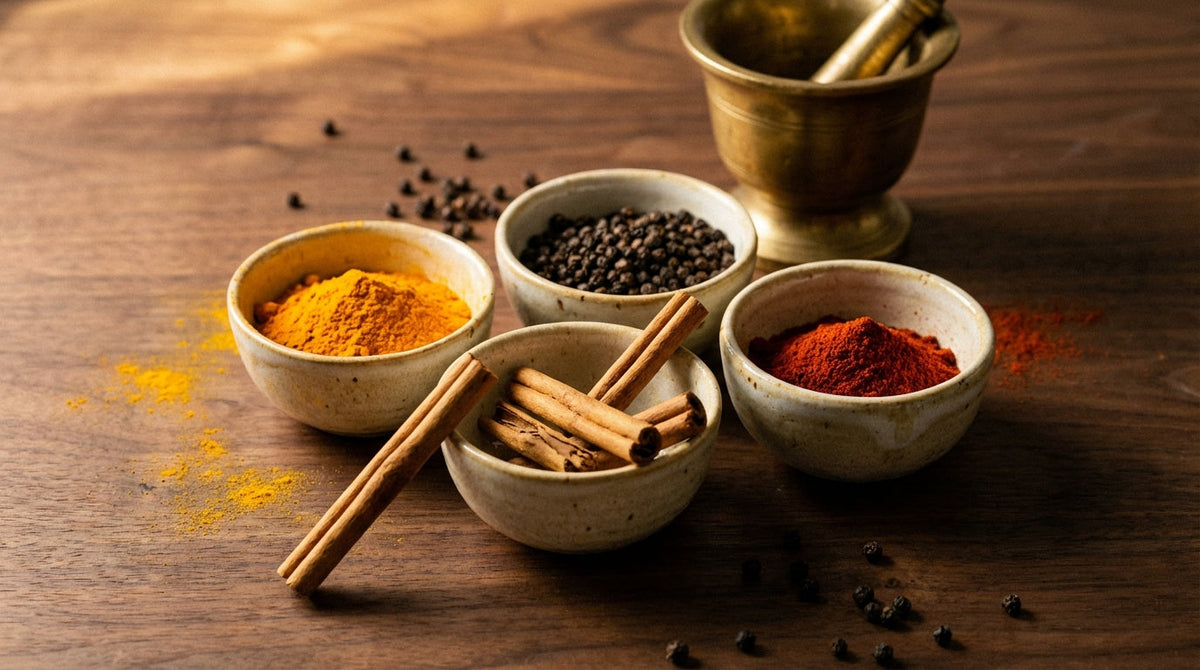
The colour intensity of a spice correlates directly with its content of bioactive pigments. In turmeric, curcumin is the decisive colourant: premium raw root contains 2 to 5 per cent curcuminoids, while mass-market goods frequently fall below 1 per cent (Sharma et al., 2020). A study by Zheng et al. (2018) found that 59 per cent of the turmeric dietary supplements examined did not meet the USP quality criteria - an alarming figure that shows how important measurable quality parameters are. For the home test, a glance is enough: sprinkle a knife tip of turmeric onto white paper. A bright, rich orange-yellow points to a high curcumin content, while pale or brownish powder indicates inferior or aged goods. Our organic turmeric from Sri Lanka comes from the Central Province and, thanks to optimal harvest timing and gentle processing, consistently achieves high curcuminoid values.
With cinnamon, colour is an indirect quality marker. Ceylon cinnamon (Cinnamomum verum) shows a light, honey-brown tone, while cassia cinnamon appears darker and redder. The decisive difference lies in coumarin: according to SLS 81:2021, Ceylon cinnamon contains only 0.02 per cent coumarin, whereas cassia cinnamon contains 0.4 to 0.8 per cent. In a 2024 test of 14 cinnamon powders, Stiftung Warentest confirmed: cassia cinnamon contained 2,300 to 3,500 mg of coumarin per kilogram - many times the value regarded as safe. The same applies to chilli: capsaicinoid contents range from undetectable in bell peppers to 31.84 mg/g dry weight in chiltepín (Jiménez-Sánchez et al., 2025). A bright red colour and even pigmentation are indicators of high chilli quality.
How do you recognise genuine premium origin in spices?
With spices, origin is far more than a marketing promise - it measurably determines the content of active constituents. Sri Lanka has been a centre of the global spice trade since the 14th century, and not without reason: Ceylon cinnamon from the Matale and Galle region has a demonstrably lower coumarin content than cassia varieties from China or Indonesia. According to the Sri Lanka Export Development Board, black pepper from Sri Lanka achieves a two to six times higher piperine content than competing products from other growing regions. The Codex Alimentarius (CXS 326-2017) defines at least 3 per cent piperine as the quality standard - many mass-market peppers fall well short of this value.
A reliable quality feature is the transparency of the supply chain. Premium suppliers name the growing region, the harvesting method and the processing stages. In Sri Lanka, smallholders maintain traditional mixed-cropping systems - cinnamon grows alongside jackfruit and pepper in forest-like structures, which promotes biodiversity and produces measurably different aroma profiles from monoculture plantations. We know the cooperatives in the Central Province personally and can trace every batch back to the field. The German Federal Ministry of Food and Agriculture (BMEL, 2024) stresses: consumers are entitled to transparent origin information - yet stating the spice variety (for instance Ceylon versus cassia cinnamon) is not mandatory in the EU. All the more important, then, to look for the producer's voluntary declarations.
Whole spices versus ground - a quality signal
Whole peppercorns, cinnamon sticks or cardamom pods can be assessed at first glance: uniform size, full shape and an undamaged surface show careful sorting and harvesting. With ground spice, checking is harder - here the visual control is missing, and bulking agents such as starch or mineral fillers cannot be detected with the naked eye. That is why experts and the Reddit community r/cooking unanimously recommend: buy whole spices and grind them only shortly before use. That way you secure maximum aroma intensity and minimise the risk of adulteration.

Why is purity the underestimated quality feature?
Spice fraud is a global problem with concrete figures: according to Shayaa et al. (2023), over 24 per cent of oregano samples from retail are bulked out with cheaper leaves such as olive leaves or myrtle. With cinnamon, 58 per cent of samples fail international quality standards. The American Spice Trade Association (ASTA) has defined purity standards since 1969 that are stricter than the FDA limits - for instance for foreign matter such as insect fragments or dust particles. Premium spices demonstrably meet these standards; mass-market goods often do not.
Alongside adulteration, residues are a decisive criterion. The German Federal Institute for Risk Assessment (BfR, 2019) warns of elevated pyrrolizidine alkaloid levels in dried herbs and spices - particularly in savory, oregano and spice blends. This contamination arises when PA-forming wild herbs are processed along with the harvest. The Öko-Test of March 2025 confirmed the problem with black pepper: of 21 brands tested, only five received the verdict “good” - all five were organic products. Pesticide and mineral oil residues were found above all in conventional goods. The benefits of organic spices are measurable here: the EU Organic Regulation (Regulation 2018/848) governs the requirements for organic production and labelling.
Storage as a quality factor
Even after purchase, correct storage decides whether quality is preserved. Rodriguez-Solana et al. (2021) identified 42 thermolabile aroma molecules in spices that degrade through heat, light and moisture - oxidation and hydrolysis are the main mechanisms. According to ISO 939:2021, the moisture content should be a maximum of 10 to 12 per cent; above that, the risk of mould rises considerably. So store your spices in opaque, airtight containers at room temperature below 20 degrees Celsius. Avoid keeping them above the cooker or by the window - both accelerate aroma loss considerably. As a rule of thumb: whole spices keep for two to three years when stored correctly, ground spices for a maximum of six to twelve months.
Important
This article is for information purposes and does not replace medical advice. If you have health-related questions, please consult your doctor or pharmacist.
Which certifications guarantee genuine spice quality?
Certifications are the fifth and most objective quality indicator - they translate laboratory values into verifiable standards. The EU organic logo under Regulation 2018/848 is the entry-level hurdle: it identifies products that have been produced in accordance with the EU organic rules. But organic alone says nothing about aroma intensity or the content of active constituents. What matters are spice-specific standards such as SLS 81:2021 for Ceylon cinnamon, which stipulates a minimum volatile oil content of 0.5 ml per 100 grams and sets the upper limit for coumarin at 0.02 per cent. The Sri Lanka Export Development Board administers the internationally registered Ceylon Cinnamon certification mark - registered with WIPO, the EU and the USA.
For quality testing in the laboratory, international ISO standards exist: ISO 939:2021 defines the determination of moisture content (a maximum of 10 to 12 per cent depending on the type of spice), ISO 928:1997 the ash content as an indicator of adulteration with mineral fillers. NABL-accredited laboratories of the Spices Board of India additionally test for aflatoxin B1 (EU limit: a maximum of 5 ppb) and salmonella (absence in 25 grams is mandatory in the EU). These laboratory analyses distinguish reputable suppliers from mass-market goods: anyone who can present certificates has nothing to hide. When buying, look for suppliers that communicate their quality criteria for black pepper and other spices transparently.
Measurable quality values compared
| Spice | Feature | Premium | Mass-market |
|---|---|---|---|
| Turmeric | Curcuminoid content | 2-5 % | under 1 % |
| Ceylon cinnamon | Coumarin content | 0.02 % | 0.4-0.8 % (cassia) |
| Black pepper | Piperine content | ≥ 3 % | under 1.5 % |
| Black pepper | Essential oil | ≥ 2 ml/100 g | under 1 ml/100 g |
Practical tip
Five-point quick check when buying spices: (1) Country of origin stated? (2) Spice variety named (e.g. Ceylon cinnamon rather than just “cinnamon”)? (3) Organic certification present? (4) Aroma intense on opening? (5) Colour bright and even? At least four of the five points should be met.
Recognising spice quality - your knowledge in five features
Premium spices can be identified by five concrete features: intense aroma from a high content of essential oils, bright colour as a sign of active pigments, transparent origin with a traceable supply chain, proven purity without adulteration or residues, and independent certifications such as EU organic and spice-specific standards. These criteria are not subjective impressions but measurable values - from the curcumin content in turmeric (2 to 5 per cent for premium) and the piperine content in pepper (at least 3 per cent according to the Codex Alimentarius) to the coumarin limit in Ceylon cinnamon (0.02 per cent according to SLS 81:2021).
The most important thing: you do not need a laboratory to tell good quality from bad. The four home tests - smell, heat, colour and water - give you a reliable initial assessment. For everything beyond that, it is worth looking at certifications and transparent origin declarations. If you would like to dive deeper into the world of spices from Sri Lanka, you will find the right background stories with us.