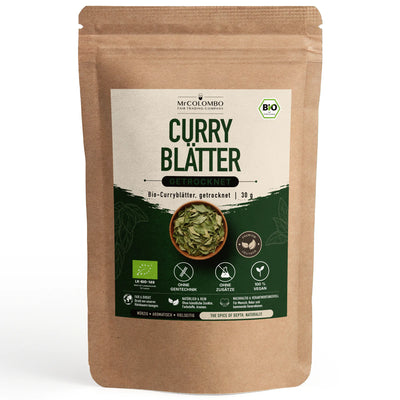




Curry leaves are the aromatic leaves of the curry tree (Murraya koenigii), a member of the rue family from South Asia, and they are not the basis of ready-made curry powder. They are almost always used as whole leaflets: fried for 10 to 15 seconds in hot fat so that the essential oil is released. In a GC-MS analysis of Indian leaves, linalool accounted for 32.83 per cent of this oil (Rajendran et al., 2014). The fat should be 160 to 180 degrees for this; virgin coconut oil already smokes in this range. In Sri Lanka they are called karapincha and stand at the start of almost every curry.
Short answer
How do you use curry leaves properly? Fresh curry leaves go whole and unchopped into hot fat during tempering, before the actual ingredients go into the pan. This technique is called tempering or tadka: the leaves are fried in hot ghee or a heat-stable oil together with mustard seeds before the remaining ingredients are added. In the process, the fat-soluble aroma compounds that make up the characteristic scent pass into the fat. As a subtle accent, one to four individual leaflets are enough for four people; as a supporting base note, a whole sprig with ten to twenty leaflets goes into the pot. Dried leaves need roughly double the amount because they lose a large part of their aroma during drying (Katzer, 2016).
At a glance
On first contact with fresh curry leaves, many people expect the scent of a ready-made spice blend and instead get something citrusy, resinous, slightly grassy. It is precisely this distinctive scent that makes the leaf impossible to replace: bay is more bitter and earthier, lime leaves are sharper and purely citrusy. At MrCOLOMBO we import spices directly from smallholder farmers in Sri Lanka, and on almost every farm we visit, the curry tree stands not in the field but in the home garden next to the kitchen door. This everyday closeness explains why the leaf is not a spice for special occasions in Sri Lankan cuisine but a staple ingredient, like onion and bay leaf for us. There, people usually harvest only what goes into the pot the same day: young, medium-sized leaves from the upper third of the shoot. They smell noticeably more intense than the old, leathery leaves further down the stem, and this difference later decides whether the tempering carries the dish or merely tastes of hot fat.
What are curry leaves, actually?
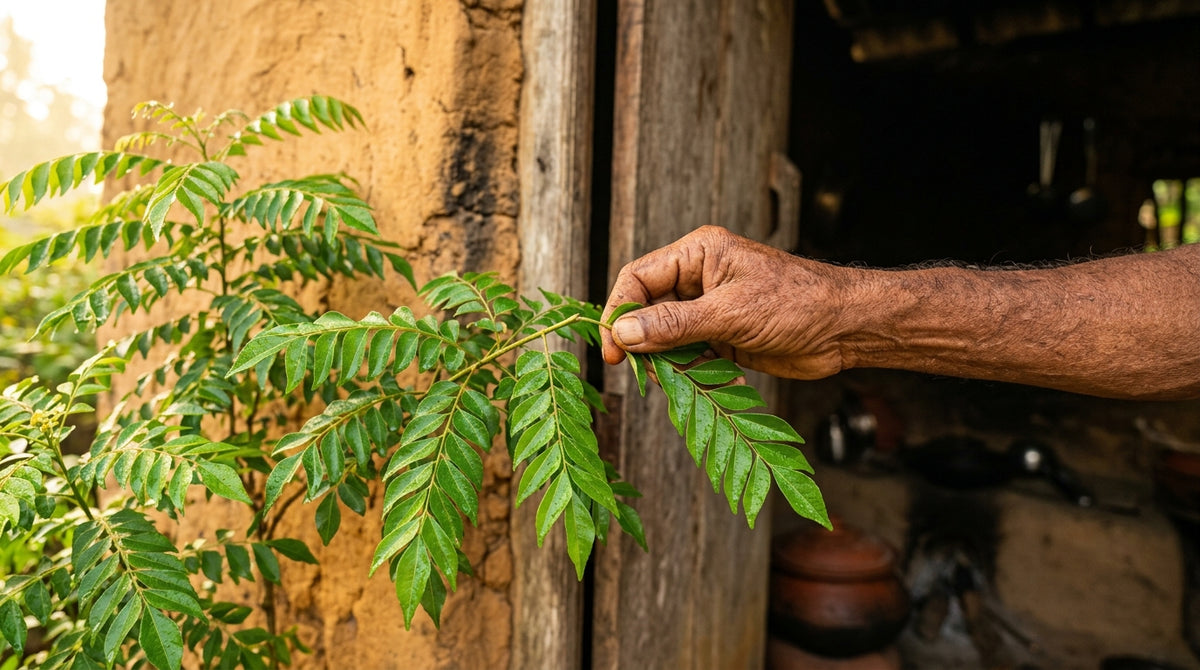
Curry leaves come from the curry tree Murraya koenigii, a small tree or shrub from the rue family (Rutaceae), the botanical relatives of lemon and orange. The Missouri Botanical Garden (2024) gives the usual height as 1.8 to 4.6 metres, while Dilmah Conservation (2024) cites an average height of 5 metres for karapincha in Sri Lanka. What is sold in shops as a single leaf is botanically a leaflet: a complete pinnate leaf carries up to 20 of these small, tapering leaflets on one stalk (Katzer, 2016). The tree bears small, white, fragrant flowers and forms dark purple berries with one to two seeds. The species is distributed across South Asia as far as Thailand and Malaysia; in Sri Lanka, according to Dilmah Conservation, karapincha grows mainly in the moist fringes of the monsoon forests and in home gardens, where leaf and plant are put to dual use. In this climate the tree puts out new growth all year round. Depending on the language, the leaf is called karapincha in Sinhala, karipatta or mitha neem in Hindi and karuveppilai in Tamil (Katzer, 2016).

The most common confusion concerns the name. Curry powder is a blend of ground spices such as coriander, cumin, turmeric and chilli. Industrial blends from the supermarket shelf usually contain not a single curry leaf, whereas roasted Sri Lankan blends often do; there the leaf is included as one ingredient among many. The individual leaf does not taste of curry powder. The English name curry leaf has nothing to do with the spice blend, which only came into being as a ready-made powder in the colonial trade. It goes back to the Dravidian word kari, whose original meaning is disputed in linguistics: older dictionaries translate it as sauce or accompaniment to rice, whereas the Online Etymology Dictionary (Harper, 2026) gives the reading blackened or fried. Ready-made powder and fresh leaf are therefore two different things and not the same thing twice. In many Sri Lankan recipes exactly this happens: roasted curry powder for the body of the dish, curry leaves for the fresh, citrusy top note in the tempering. You can find more about the individual components of such a blend in our overview of spices from Sri Lanka.
Why don't curry leaves taste of curry?
The aroma of the curry leaf does not come from a single lead substance but from a bundle of volatile compounds. In his ingredient guide (2022), food scientist Nik Sharma names at least 22 odour-active substances whose profile swings between citrusy, grassy and burnt-sulphurous. A GC-MS analysis of the essential oil identified 33 compounds that together make up 97.56 per cent of the oil, with linalool as the main component at 32.83 per cent (Rajendran et al., 2014). The two figures do not contradict each other: Sharma counts the substances our nose perceives, the analysis everything that is measurable in the oil. Linalool is the same substance that gives coriander seeds and lavender their floral-citrusy note, which explains the familiar yet hard-to-place aroma. Because these compounds are volatile and fat-soluble, they disappear during long cooking in water and unfold in hot fat. That is exactly why tempering comes at the beginning and not at the end of preparation.
The essential oil content of curry leaves is not a fixed quantity. Gernot Katzer (2016) cites 0.5 to 2.7 per cent as typical figures and points out that the measured value depends heavily on the extraction method as well as on freshness and origin. Comparing two analytical values therefore always means comparing two measurement methods as well. In terms of composition, he distinguishes North Indian plants, in which monoterpenes predominate, from South Indian samples with a preponderance of sesquiterpenes. Location, time of harvest and leaf age have a measurable effect: young, medium-sized leaves from the upper third of the shoot smell more intense than old, leathery leaves from the base of the stem. In practice you notice the difference without a laboratory. Rub a leaf between your fingers. If a clear, resinous-citrusy scent rises immediately, there is enough oil present. If the scent remains weak or smells only of hay, the leaf has either been stored too long or dried at too high a temperature.
What role does karapincha play in Sri Lankan cuisine?
In Sri Lanka the curry leaf is called karapincha, and it is more present there than in almost any other cuisine of the region. Dilmah Conservation (2024) describes the tree as a fixture of Sri Lankan home gardens with dual use in the kitchen and in traditional medicine. This home-garden structure is no coincidence: according to the Sri Lanka Export Development Board (2025), over 70 per cent of the country's spice-growing area comes from smallholdings and home gardens; the country exports around 30,000 tonnes of spices a year and thus ranks ninth worldwide. To be fair, the authority gives no reference year for these three figures, so they describe an order of magnitude and not an annual statistic. In Sri Lankan households, karapincha does not come from a packet anyway, but from the tree outside the door. That shapes the quantities: a whole sprig in the pot is normal, not sparingly counted individual leaves, and a tree in the home garden keeps supplying all year round.
On the farms in the south of Sri Lanka, we hardly saw a kitchen where a sprig of karapincha was not the first thing to go into the hot coconut oil in the morning.
MrCOLOMBO experience report
In culinary terms, the Sri Lankan use of karapincha differs recognisably from the South Indian one. In South India the tempering is either started at the beginning or, depending on the dish, poured over dal, sambar, rasam, upma or chutney at the end. In Sri Lanka, karapincha additionally goes straight into the curry pot, is made into sambol with freshly grated coconut and ground into pastes that colour rice dishes green. A Sri Lankan-style coconut sambol works on the same principle as our coconut sambol recipe, except that finely chopped curry leaves balance the heat of the chilli. Karapincha also belongs in almost every accompanying sauce served with hoppers, the bowl-shaped rice-flour pancakes. For sambol the leaves are finely chopped, for pastes they are ground together with grated coconut and chilli. As a Sri Lankan paste, a whole sprig with ten to twenty leaflets visibly colours the finished rice green. The same number of leaflets, by contrast, remains only a layer of scent on the fat in a South Indian tempering.

How do you use curry leaves properly?
How do you fry curry leaves in a tempering?
Tempering is the one technique you have to master with curry leaves. Heat two to three tablespoons of refined coconut fat or ghee to around 160 to 180 degrees, that is, until a single mustard seed pops immediately. Virgin coconut oil is the wrong choice for this: according to the German Federal Centre for Nutrition (2024), its smoke point is around 177 degrees, so it already smokes in this range. Ghee and refined coconut fat, by contrast, have smoke points clearly above the target range of 160 to 180 degrees. Then the mustard seeds go in, and after a few seconds the whole curry leaves, patted dry. They foam up briefly, curl and after about 10 to 15 seconds smell intense. That is exactly when the onion, garlic or the remaining ingredients are added. It is important to pat the leaves dry, because clinging water makes the fat spit. Roasted curry powder is only added after the tempering, otherwise it burns in the hot fat.
Tempering in four steps
Heat the fat properly? Refined coconut fat or ghee to 160 to 180 degrees, test with a mustard seed. Virgin coconut oil already smokes at this point.
Leave the leaves whole? Do not chop them for tempering; whole leaflets release their oil evenly and do not burn as quickly as small pieces. For sambol and pastes, on the other hand, they are finely chopped or ground.
Keep an eye on the time? 10 to 15 seconds are enough. If the leaves turn dark brown, the aroma becomes bitter.
Keep to the order? First mustard seeds, then curry leaves, then onions, and the powdered spices right at the end.
When it comes to dosing curry leaves, the rule is: less than you think, but regularly. The Utopia guide (2025) gives one to four individual leaflets for a dish for four people as a guideline, whereas in Sri Lankan household recipes a whole sprig with ten to twenty leaflets often ends up in the pot. Both figures are correct because they describe different roles: as a subtle accent or as a supporting base note. For a first attempt, a simple dal with a double tempering works well, once at the start and once as a finish shortly before serving. Our Sri Lanka curry recipe shows the procedure for a complete Sri Lankan dish step by step. The matching base blend is our Sri Lanka Curry Powder made from pan-roasted chilli, coriander, fennel, black pepper, cumin, turmeric, curry leaves, fenugreek and mustard seeds. A good example of the fact that Sri Lankan blends can very well contain the leaf, yet still do not replace the fresh tempering opener.
What is the difference between fresh and dried curry leaves?
Fresh curry leaves are clearly superior in aroma; dried ones, in return, are available and can be stored. The reason lies in the volatility of the aroma compounds: curry leaves rapidly lose most of their scent after drying and should therefore be used as fresh as possible (Katzer, 2016). How much is lost depends on the process: because these aroma compounds are volatile, any additional heat drives them out of the leaf. Goods gently dried in the shade therefore stay green and still smell citrusy, while leaves dried at too high a temperature become dull and hay-like. In the kitchen this means a simple rule of thumb: allow roughly double the amount for dried leaves and leave them a little longer in the hot fat so that the remaining oils are released. Dried leaves are also well suited to a technique from South India in which they are dry-roasted and then ground into a spice powder. This turns weaker raw material into a concentrated seasoning that goes well over rice or yoghurt.
| Criterion | Fresh leaves | Dried leaves |
|---|---|---|
| Aroma intensity | full, citrusy-resinous | markedly reduced, hay-like |
| Dosage in the recipe | reference amount | roughly double the amount |
| Shelf life | around 7 days in the fridge (EDEKA, 2026) | up to 2 years, dry and dark (EDEKA, 2026) |
| Suitable for tempering | Yes | Yes |
| Suitable for sambol and pastes | Yes | No |
For storing fresh leaves, a simple procedure has proved itself in our own kitchen: leave the unwashed leaves on the sprig, wrap them loosely in a dry tea towel and put them in a sealed container in the vegetable drawer. The EDEKA food encyclopaedia (2026) likewise gives about a week for fresh leaves in the fridge. If you get hold of larger quantities, it is best to freeze them unwashed and spread out flat; they can later be put straight from frozen into the hot fat and retain more aroma than dried goods. Dried leaves, on the other hand, belong in an airtight container away from light and the heat of the hob, where, according to EDEKA, they stay fresh for up to two years. Rely on the smell test, not on the printed date: if dried goods smell only of hay instead of citrusy-resinous, the aroma is gone, even if the best-before date is technically still running. We have summarised the general principles of spice storage in our article on storing spices properly.
What constituents are found in curry leaves?
Chemically, the most interesting aspect of curry leaves is the carbazole alkaloids, a group of substances that occurs in this form in only a few plants. Ramsewak et al. (1999) isolated mahanimbine, murrayanol and mahanine from fresh leaves and described an antioxidant activity for mahanimbine at 33.1 micrograms per millilitre. Tachibana et al. (2001) found a radical-scavenging activity of varying strength in the DPPH test for five carbazole alkaloids from curry leaves, including mahanimbine and mahanine, and Ningappa et al. (2008) showed something comparable for polyphenol-rich leaf extracts. For the essential oil, Rajendran et al. (2014) determined an IC50 of 1.79 micrograms per millilitre in the DPPH test. The DPPH test measures nothing more than how quickly a substance scavenges a synthetic radical in a test tube, and it works with isolated extracts in concentrations that are never reached in food. The antioxidant figures cited from Ramsewak et al. (1999) and Rajendran et al. (2014) thus describe laboratory findings on isolated extracts and say nothing about an effect at usual consumption levels.
What is known about blood sugar?
The most frequently cited strand of research concerns blood sugar, and here it is worth taking a close look at the state of the studies. In 1990, Iyer and Mani gave thirty people with non-insulin-dependent diabetes 12 grams of curry leaf powder daily for one month, many times any kitchen quantity and, if only because of the 2.5 grams of dietary fibre it contained, not a pure spice effect; measurements were taken on days 1, 15 and 30. After 15 days a temporarily lower blood glucose value was observed that did not persist until day 30; on serum lipids, lipoproteins and glycosylated proteins the supplementation had no appreciable influence at any of the measurement points. Farooq et al. (2023) gave 45 women with type 2 diabetes an encapsulated aqueous leaf extract for 45 days in two doses of 5 and 10 milligrams per kilogram of body weight and observed lower blood glucose and HbA1c values, though without a described control group. Both studies have small samples; further findings come from animal models and cell cultures. Meaningful, larger clinical studies in humans are lacking so far. Curry leaves are therefore a spice and not a means of treating illnesses.
Important
This article is for information purposes and is no substitute for medical advice. If you have health questions, please consult your doctor or pharmacist. Anyone who takes medication or is prone to intolerances should not regularly consume larger quantities of a spice without seeking advice first.
How do you recognise good curry leaves when buying?
With imported herbs, the declaration of origin is about residue control, not about the look of the label. The EU classified curry leaves from India as high-risk goods as early as 2014: Implementing Regulation (EU) No 885/2014 required a health certificate and had 20 per cent of consignments tested for pesticide residues. That regulation has been superseded, and the classification has since been tightened. Under Annex II of Implementing Regulation (EU) 2019/1793, last amended in January 2026, curry leaves from India are today checked at a rate of 50 per cent. An analysis of 3,741 notifications on herbs and spices in the EU rapid alert system RASFF from the years 2000 to 2022 shows that border rejections accounted for 37.9 per cent of these notifications (Eissa et al., 2024). Curry is among the ten most frequently reported products there, and India, at 23.6 per cent, is the most frequent country of origin. A foodwatch laboratory test from May 2026 found residues of pesticides banned in Europe in 45 of 64 samples of rice, spices and tea. In 2013 the BfR pointed out that herbs and spices are frequently added to foods that are subsequently no longer heated, so that possible contaminations are no longer reduced.
Our approach at MrCOLOMBO
To put the residue question into perspective: we do not stock loose curry leaves; with us the leaf is included as an ingredient in the roasted Jaffna curry blend. We buy exclusively from partner farms in Sri Lanka that we know personally, and we have our goods regularly checked for residues before they go into our warehouse. We show which criteria we apply across our entire directly imported range.

When buying curry leaves, three checkpoints decide the quality. First, the declaration of origin: if it states only a continent or nothing at all, traceability is missing. Second, the smell test, which you can also do through the opened packaging in the shop; if the citrusy-resinous note is completely absent, the goods are old. Third, the colour: fresh leaves are deep green and slightly glossy; dried ones may be duller, but not brownish or brittle grey. As early as 2011, in an Öko-Test investigation of 30 spices, ten each of paprika, oregano and curry samples, a curry declared as organic stood out: the laboratory found seven times more of the herbicide linuron in it than is still tolerated as a trace value in the organic sector. No more recent curry test of this kind exists to date, which is why the finding should be read as a historical note and not as the current state of the market. In any case, an organic label alone does not replace residue control.
When is it worth switching to fresh curry leaves?
Switching to fresh curry leaves is worthwhile as soon as they appear in a recipe more than just once a year. They are not a substitute spice but an ingredient in their own right: in the GC-MS analysis by Rajendran et al. (2014), 33 compounds contributed 97.56 per cent of the essential oil, and this oil dissolves only in hot fat, not in cooking water. The tempering technique itself is quickly learned and needs neither three minutes of time nor any special equipment. Fresh leaves are the first choice, dried ones a usable alternative in double the amount, and both benefit from clean storage. What remains decisive is the quality of the goods, because with a leaf that lies in the fat for only seconds and is then eaten along with the dish, the traceability of the supply chain counts for more than the price per gram. If you want to dive deeper into the island's world of flavours, you will find the right companions in our overview of Sri Lankan spices.