


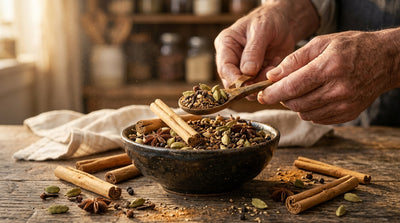
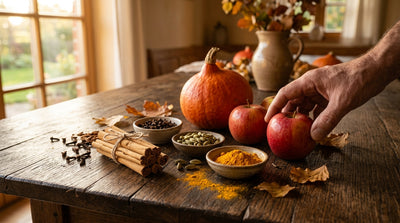
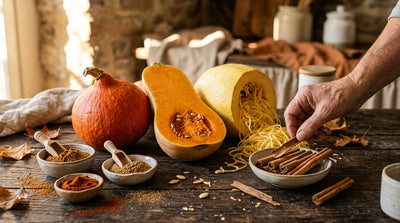
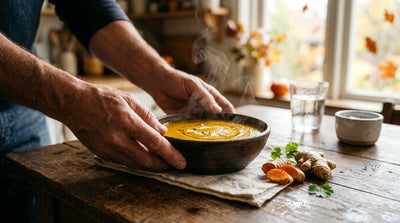

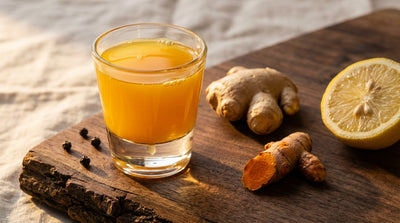

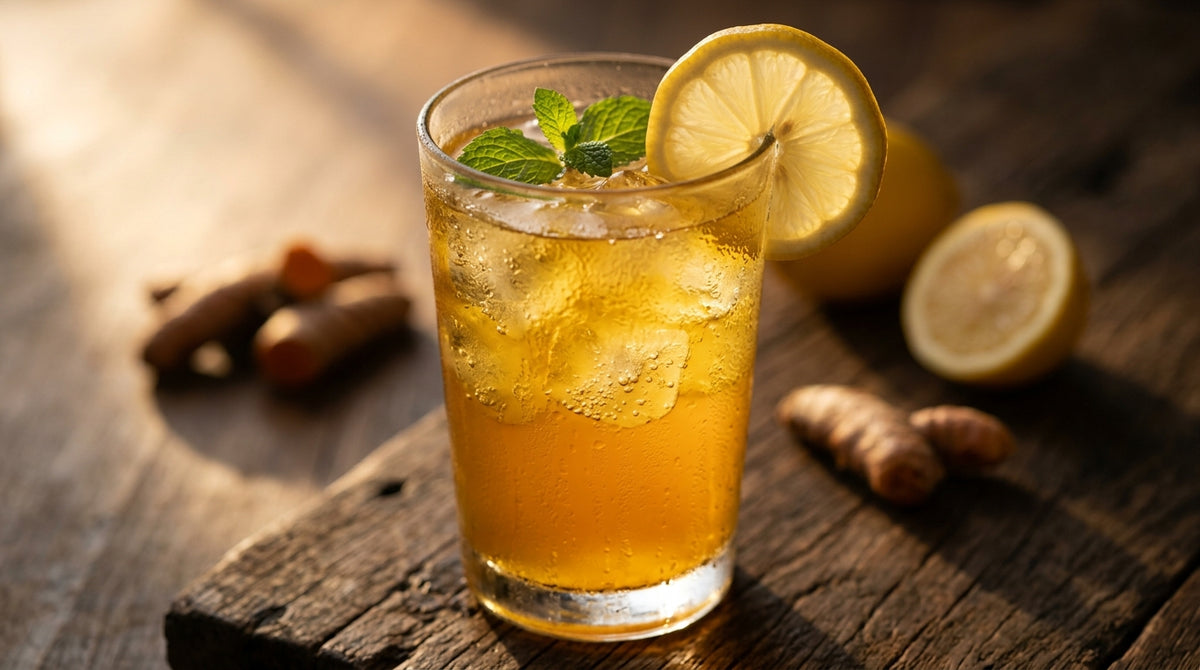
For one litre of turmeric lemonade you need 1 heaped teaspoon of turmeric powder (around 4 grams), 20 grams of freshly grated ginger, the juice of two lemons, 2 tablespoons of honey and a pinch of freshly ground black pepper. Pour 500 millilitres of boiling water over the turmeric and ginger, leave to steep for 15 minutes, strain, stir in the lemon and honey and top up 1:1 with cold sparkling mineral water before serving. The pepper is not a decorative spice: curcumin, the yellow pigment of the turmeric root, is poorly absorbed and rapidly broken down again (Tabanelli et al., 2021), and this is precisely where the combination with piperine comes in. The cold turmeric lemonade and the historic ginger switchel each manage with five ingredients and together need less than 30 minutes of active work at the hob and the grater. The rest is steeping time, and that is exactly what determines the heat and depth of colour in the finished glass.
The ginger switchel follows the same construction principle as the turmeric lemonade, but swaps the lemon for cider vinegar: 1 litre of water, 30 grams of grated ginger, 60 millilitres of unfiltered cider vinegar and 2 to 3 tablespoons of maple syrup or honey, made up cold and left to steep overnight in the fridge. Turmeric lemonade and switchel share the same base of heat, acidity and a small amount of sweetness, and both live off the quality of the root spices. We at MrCOLOMBO import turmeric (Curcuma longa) directly from smallholders in the north of Sri Lanka and black pepper (Piper nigrum) from the highlands around Matale. Botanically, turmeric and ginger belong to the same family, the ginger family (Zingiberaceae), whereas pepper belongs to the pepper family (Piperaceae). From this supply chain we know how strongly harvest timing, drying and grind decide whether a lemonade turns out a luminous golden yellow or tastes dull and musty. A powder that barely smells when opened will give off hardly any aroma in the glass either. That is exactly why the product knowledge belongs alongside the two recipes: the ingredient list and the quality of the raw material cannot be separated.
Short answer
How do you make turmeric lemonade yourself? One heaped teaspoon of turmeric powder, 20 grams of grated ginger and 500 millilitres of boiling water make an infusion that steeps for 15 minutes. After straining, lemon juice, honey and a pinch of black pepper are added, then it is diluted 1:1 with sparkling mineral water. The pepper provides piperine, which in one much-cited single study markedly increased the curcumin concentration in the blood (Shoba et al., 1998). For the EU, the following applies: no health claim is authorised for turmeric and curcumin (EFSA, 2017).
At a glance
How do you make turmeric lemonade yourself, step by step?
The most reliable method for turmeric lemonade is the hot infusion, because heat releases the essential oils and pigments from the powder faster than cold water does. For a good litre of finished drink, put 1 heaped teaspoon of turmeric powder (about 4 grams) and 20 grams of freshly grated ginger into a heatproof jug and pour 500 millilitres of boiling water over both. After 15 minutes of steeping, the infusion is poured through a fine sieve or a straining cloth so that no fibre residue ends up in the glass. The powder does not really dissolve in the process, because curcumin is poorly soluble in water (Stohs et al., 2020); the infusion therefore stays cloudy. Only now are the juice of two lemons (around 80 millilitres), 2 tablespoons of honey and a pinch of freshly ground black pepper added. Honey always goes into the cooled infusion, never into the boiling liquid, because its aroma becomes noticeably flatter above 40 degrees. If you use fresh turmeric root instead of powder, reckon on around 15 grams grated per litre and extend the steeping time to 20 minutes.
Turmeric lemonade step by step
Start the infusion. Put 1 heaped teaspoon of turmeric powder (around 4 grams) and 20 grams of freshly grated ginger into a heatproof jug and pour 500 millilitres of boiling water over them.
Leave to steep for 15 minutes. During this time, pigments and essential oils are released from the powder and the ginger fibres.
Strain. Pour the infusion through a fine sieve or a straining cloth so that no fibre residue ends up in the glass.
Season. Stir the juice of 2 lemons (around 80 millilitres), 2 tablespoons of honey and a pinch of freshly ground black pepper into the cooled infusion.
Dilute and serve. Top up the concentrate 1:1 with cold sparkling mineral water and serve over plenty of ice. Total time around 30 minutes.
Before serving, the turmeric concentrate is topped up roughly 1:1 with cold sparkling mineral water: the strained infusion, with lemon juice and honey, measures around 600 millilitres and with 500 millilitres of sparkling water makes a good litre. This dilution comes from the common commercial recipes and has a practical reason: the undiluted concentrate tastes very dominant because of the ginger and lemon, and it takes up less space in the fridge. If you prefer it milder, go to 1:1.5. It is served over plenty of ice, with a slice of lemon and, if you like, a few leaves of mint. Sealed airtight, the concentrate keeps for two to three days, so a double batch at the weekend is worthwhile. A cold version without cooking works as well: turmeric, ginger, citrus and a teaspoon of olive oil in a high-speed blender, then pass through a cloth. The oil is no accident, but has to do with the fat solubility of curcumin. How the same spice base behaves when warm is shown in our recipe for golden milk.

Why does black pepper belong in every turmeric lemonade?
Curcumin is poorly absorbed, rapidly metabolised and quickly excreted again. A review by Tabanelli et al. (2021) names precisely these three causes for the low curcumin levels in the blood: low absorption, fast metabolism, rapid systemic clearance. Stohs et al. (2020) likewise describe the poor solubility of the free form and its rapid conversion into inactive metabolites. This is exactly where piperine, the pungent compound of black pepper, comes in. In a much-cited investigation by Shoba et al. (1998) in the journal Planta Medica, the relative bioavailability of curcumin with piperine reached twentyfold in eight evaluated male test subjects, but only 1.5-fold in rats. You should be able to put this figure into perspective: it is a single study with eight participants, which has not been independently replicated with this degree of clarity. More recent pharmacokinetic comparisons point in the same direction, even though they use a different bioavailability lever than piperine: a crossover study by Fança-Berthon et al. (2021) measured, for a specially formulated colloidal curcumin preparation compared with standard extract, a roughly 24-fold higher relative bioavailability of total curcuminoids.
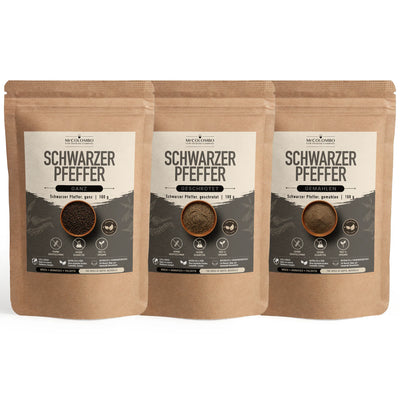
A pinch of freshly ground black pepper per litre of turmeric lemonade is entirely sufficient; in terms of flavour it stays in the background. More is expressly not better, because the German Federal Institute for Risk Assessment recommends a maximum of 2 milligrams per day for isolated piperine (BfR, 2021) and points out that the curcumin content of some food supplements can exceed the health-based acceptable intake. Alongside the pinch of pepper, fat is the second lever: since curcumin is fat-soluble, a teaspoon of coconut or olive oil in the blended version helps, or simply a breakfast containing some fat with the drink. The piperine content stays considerably more stable in freshly ground peppercorns than in years-old ready-ground powder. The BfR recommendation refers expressly to isolated piperine in food supplements, where the usual combinations are 500 milligrams of curcumin plus 5 to 6.7 milligrams of piperine per capsule, and not to pepper as a kitchen spice. A pinch in a litre remains a normal seasoning quantity; a heaped teaspoon of pepper per glass would be something else. You can read more in our article on the quality of black pepper and in the pepper range.
Important
This article is for information purposes and does not replace medical advice. No health claim is authorised for turmeric and curcumin in the EU: in 2017, after evaluating 16 studies, the EFSA rejected the application relating to normal joint function. If you are pregnant, have a gallbladder condition or take medication regularly, talk to your doctor or pharmacist before consuming larger quantities.
What is a switchel and where does the drink come from?
Switchel is a cold refreshing drink made from water, cider vinegar, ginger and a natural sweetener such as molasses, maple syrup or honey. It became popular in the late 17th century in New England; its origin is mostly attributed to the Caribbean (Old Farmer's Almanac, article on the history of switchel). In the 19th century it turned into the "Haymaker's Punch", the standard drink of the hay harvest: farmers took it out to the fields in jugs because it was drunk cold, kept for several days without refrigeration and, with its acidity, kept up the desire to carry on drinking. The vinegar was not a flavour gimmick but a preservative. That such a drink is resurfacing today fits a growing market: the European market for functional beverages stood at around 33 billion US dollars in 2025, with Germany the largest single market at just under 35 per cent (vendor estimate, Mordor Intelligence, 2026). What was a working drink in the fields in the 19th century is today a shelf slot between kombucha and ginger shots.
On the effect of cider vinegar in drinks like switchel, there are studies that should be read with caution. A meta-analysis by Shishehbor et al. (2017) in Diabetes Research and Clinical Practice observed that vinegar consumption dampens the rise in blood glucose and insulin after a meal. A GRADE-assessed meta-analysis by Arjmandfard et al. (2025) found, in people with type 2 diabetes, a fasting blood glucose 1.255 milligrams per decilitre lower for each additional millilitre of cider vinegar per day, evaluated across seven controlled studies with 463 participants. These are observations from study cohorts, not promises for a summer drink that contains 60 millilitres of vinegar per litre and of which perhaps one glass ends up being drunk. To be honest: the switchel is first and foremost a refreshing drink with a long history, and the cider vinegar in it stands first and foremost for acidity and shelf life, not for a proven health effect.
With ginger, too, a sober assessment of the state of research is worthwhile. An overview of meta-analyses by Paudel et al. (2025) summarises that studies on type 2 diabetes examined quantities of 1 to 3 grams of ginger per day, and a meta-analysis by Viljoen et al. (2014) with 12 studies and 1,278 pregnant women examined the effect of ginger on pregnancy-related nausea. A glass of switchel with 30 grams of fresh ginger to the whole litre is a long way from that, especially since with the cold method only part of the pungent compounds passes into the liquid at all. The drink thus remains what it already was in the 19th century: a refreshment for hot days that draws its appeal from heat and acidity and not from a nutritional promise. If you do not like the acidity of cider vinegar, an iced chai latte gives you a mild alternative from the same spice kitchen.
How do you make a ginger switchel properly?
Unlike the turmeric lemonade, the switchel is made up cold. For one litre, coarsely grate 30 grams of fresh ginger, put it in a carafe, top up with 1 litre of cold water and stir in 60 millilitres of unfiltered cider vinegar and 2 to 3 tablespoons of maple syrup or honey. A squeeze of lemon juice rounds off the acidity. The carafe then goes into the fridge for at least 12 hours, preferably overnight. The longer the batch steeps, the hotter it becomes, because the gingerols dissolve slowly. Strain before serving and pour over ice. The choice of ginger matters for the flavour: fresh ginger contains 6-, 8- and 10-gingerol as its lead compounds; with drying and roasting the profile shifts in favour of zingerone (Ajanaku et al., 2022). Dried ginger therefore tastes warmer and less citrusy than fresh. For a fresh, bright switchel you therefore use raw ginger; for the more robust winter version you add half a teaspoon of ginger powder.

Things get interesting with the hybrid of turmeric lemonade and ginger switchel, which hardly any recipe site offers in this form. For it, you stir half a teaspoon of turmeric powder and a pinch of black pepper into the finished switchel, ideally first mixed with two tablespoons of the batch into a lump-free paste. The result is golden yellow, tangy and noticeably less sweet than classic lemonade. Since turmeric powder is not water-soluble, it settles at the bottom after a few hours, which is why you should give the carafe a brief swirl before each pour. A teaspoon of liquid coconut oil, first stirred into a paste with the turmeric powder, keeps the pigments suspended for longer and at the same time works with the fat solubility of curcumin. In Sri Lanka, this very combination of root spice and acidity is not an experiment but everyday life: lime, ginger and turmeric sit side by side there in countless everyday dishes, as our overview of spices from Sri Lanka shows.
When is turmeric lemonade the right choice and when ginger switchel?
Turmeric lemonade and ginger switchel serve different situations. The turmeric lemonade is the milder, sweeter and more colourful drink and is suited to guests, children's portions with less ginger and anyone who does not like vinegar in the glass. The switchel is more tart and keeps longer thanks to the vinegar; with one tablespoon of maple syrup per litre it stays well below the 7.8 grams of sugar per 100 millilitres that Foodwatch (2024) found on average in children's drinks. A practical difference lies in the effort: the lemonade needs heat and 15 minutes of steeping, so it is ready in half an hour including cooling. The switchel needs no hob, but it does need lead time overnight. If you are thirsty on the spur of the moment, you boil. If you plan the evening before, you make it up cold. A third difference concerns the kitchen: turmeric permanently stains plastic, wood and silicone yellow, whereas the switchel leaves no traces and can therefore be made up more casually in any container. In practice, five criteria count: preparation, source of acidity, amount of sweetness, staining and shelf life.
| Criterion | Turmeric lemonade | Ginger switchel |
|---|---|---|
| Preparation | hot infusion, 15 minutes | made up cold, 12 hours |
| Source of acidity | lemon juice | unfiltered cider vinegar |
| Sweetness per litre | 2 tbsp honey | 2-3 tbsp maple syrup |
| Hob needed in the basic recipe | Yes | No |
| Stains hands and containers | Yes | No |
| Shelf life in the fridge | 2-3 days | 5-7 days |
How much sugar do you save compared with shop-bought lemonade?
The strongest reason to make lemonade yourself is control over the sweetness. Stiftung Warentest (2025) tested 29 citrus lemonades and awarded the grade "good" only three times; three products failed with "poor" and contained more than 10 grams of sugar per 100 millilitres, which corresponds to around 17 sugar cubes in a half-litre bottle. In 2024, Foodwatch examined a total of 136 drinks aimed at children and found more than 5 grams of sugar per 100 millilitres in 86 per cent of them, on average 7.8 grams per 100 millilitres. Although, according to the Max Rubner-Institut's 2024 product monitoring, soft drinks contain on average just under 15 per cent less sugar than in the 2018 base year, the starting level was high. The Max Rubner-Institut had already systematically recorded the sugar content of sweetened soft drinks in 2018, thereby laying the data foundation for this reduction strategy. Even after the reduction, an average citrus lemonade is therefore still at a multiple of what a home-made drink needs.
To put the amount of sugar in home-made lemonade into perspective: the joint recommendation of the DGE, DAG and DDG (2018) provides for free sugars to make up less than 10 per cent of energy intake, so at 2,000 kilocalories a day a maximum of 50 grams. Two tablespoons of honey correspond to about 40 grams and thus around 32 grams of sugar, spread over a good litre that is around 3 grams per 100 millilitres in the fully diluted drink. That is well below the average of the children's drinks examined by Foodwatch and can be lowered further by halving the sweetness and using more lemon instead. The same lever works with the switchel: the acetic acid already provides so much flavour definition that one tablespoon of maple syrup per litre is enough for many people. What matters is honesty in the calculation: nutritionally, honey and maple syrup count as free sugars and are treated by the DGE in exactly the same way as table sugar. The advantage of making it yourself lies not in a better type of sugar but simply in the smaller amount.
How do you recognise good turmeric for drinks?
In a drink that consists of only five ingredients, the raw material decides everything. According to the specialist literature on Curcuma longa, the curcumin content of commercial turmeric ranges between 2.1 and 8.6 per cent with an average of around 4.8 per cent; the Indian standard IS 3576 (Bureau of Indian Standards) requires at least 2.0 per cent curcumin in the dry matter. You can see this range in the glass: powder with a high content colours the lemonade a rich gold, weak material stays pale. A second criterion is purity. A laboratory test of 19 turmeric powders found elevated mineral oil components (MOSH) in 16 products, and only a single powder received the top grade (Öko-Test, 2022). For a drink of which you drink litres in summer, that is a relevant difference. So look for an indication of origin with the growing region rather than "EU and non-EU agriculture".

As the main growing areas for turmeric, the Sri Lankan export agriculture authority names the districts of Kurunegala, Gampaha, Kalutara, Kandy, Matale and Ampara, mostly as a mixed crop under coconut palms (Department of Export Agriculture Sri Lanka). Our own produce grows in the north around Jaffna, where a tropical monsoon climate and well-drained, iron-rich soils produce intensely coloured rhizomes. The rhizomes are harvested after eight to ten months, boiled, left to rest for about one day, then dried in the sun over ten to fifteen days and only then ground. It is precisely this boiling before drying that is the step which distributes the colour evenly through the rhizome and later helps determine the shade in the glass. We buy there directly from the family farms without intermediaries. Historically, turmeric came to Europe from the 13th century onwards via the medieval spice routes and initially served there as a cheaper alternative to saffron; in Ayurveda the root has been described for thousands of years under the Sanskrit name Haridra. If you want to go deeper into the product knowledge, you will find the details in our article on turmeric product knowledge and in the turmeric range.
Our approach at MrCOLOMBO
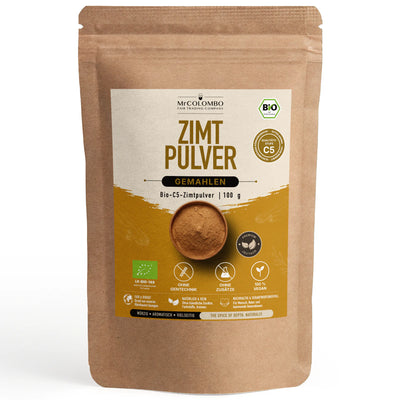
We have been working with the same smallholder cooperative in the Jaffna district for several growing cycles, and the family farms there are certified to the EU organic standard DE-ÖKO-005, the same code that also appears on our packaging. We grind turmeric in small batches and fill it immediately afterwards, because the powder loses its colour intensity with every month of storage. Freshly ground, the produce smells resinous and earthy with a clear bitter note in the finish; after a year on the shelf, all that remains is a flat, slightly musty tone that even double the amount in the infusion can no longer make up for. For drinks we therefore recommend, as a rule, a powder that is no older than six months. If you prefer to work with sticks, you will find the same logic with Ceylon cinnamon.
Checklist for buying
Is a specific growing region stated on the packaging? "Sri Lanka, Jaffna" is a statement; "EU and non-EU agriculture" is not.
How strong is the colour of the powder? A rich orange-yellow indicates a high curcumin content, a pale yellow-brown indicates old or weak produce.
Is a filling or grinding date given? For drinks, the powder should be no older than six months.
Are you buying pepper whole or ground? Whole peppercorns keep the piperine content stable for longer; ground pepper is more convenient and should be used up promptly.
How long does turmeric lemonade keep in the fridge?
Turmeric lemonade keeps for 2 to 3 days in a sealed glass container in the fridge; after that, the lemon and ginger noticeably lose their freshness. Thanks to the cider vinegar, the ginger switchel stays stable for 5 to 7 days, but becomes hotter with every day, because gingerols continue to pass from the ginger into the liquid (Ajanaku et al., 2022). If you have made both drinks in parallel, drink the lemonade first. Both belong in sealed storage, because otherwise they take on fridge odours, and both are given a brief swirl before pouring: turmeric powder is not water-soluble and settles at the bottom, and grated ginger sinks as well. For children's portions, halve the ginger to 10 grams per litre and leave out the pepper, because otherwise the heat dominates. The switchel is in any case less suitable for children, as the cider vinegar comes through clearly in the flavour. If you are making a stock, it is better to double the quantity rather than store the finished infusion for longer.
How do you remove turmeric stains from hands and worktops?
Turmeric stains arise because curcumin is a strong pigment that is fat-soluble and at the same time poorly water-soluble (Stohs et al., 2020), which soaks into porous surfaces and cannot simply be rinsed off there. The turmeric lemonade therefore belongs in glass rather than plastic, you are better off not using wooden boards and silicone spatulas for making it at all, and a stainless steel sieve is superior to a plastic sieve because of its smooth surface. With the switchel without turmeric, the material does not matter. Fresh stains on the worktop or chopping board are easiest to remove as long as they have not dried in: first washing-up liquid, then put the surface in sunlight, because curcumin visibly bleaches under UV radiation. When processing fresh turmeric root, disposable gloves protect your hands, because the discolouration there only washes out after several days. The same principle helps on textiles: wash out before the stain dries, then hang the item in the sun. If you want to avoid discolouration altogether, make up only the ginger and stir the turmeric powder into the glass portion by portion.
A lemonade made from five ingredients cannot be better than the worst of them. With turmeric, that is already decided on the drying yard in Sri Lanka.
MrCOLOMBO experience report
Is the effort worth it for home-made turmeric drinks?
Turmeric lemonade and ginger switchel are made in less than 30 minutes of work and, at around 3 grams of sugar per 100 millilitres, contain considerably less sweetness than the average 7.8 grams per 100 millilitres that Foodwatch found in 2024 in the children's drinks it examined. What they achieve beyond that remains an open research question: no authorised health claim exists for turmeric and curcumin in the EU (EFSA, 2017), and the much-cited piperine study by Shoba et al. (1998) is a single piece of work. What remains certain is the flavour, the control over the ingredients and the possibility of solving the fat and piperine question in practice with a pinch of pepper and a teaspoon of oil. If you want to try both, start with the infusion and make up the switchel the same evening. For winter, the same spice base continues to work warm, and if you are planning the switch from the cold to the hot version, you will find the quantities in our basic recipe for golden milk.