


G enuine cinnamon comes almost exclusively from a single island. Sri Lanka produces around 90 per cent of the Ceylon cinnamon traded worldwide, and that is no coincidence but the result of climate, soils and a craft that has been passed down from generation to generation since the 13th century (Sri Lanka Export Development Board, 2025). Anyone who wants to know why a cinnamon stick from Galle looks and tastes different from the thick bark on the supermarket shelf has to look at where it is made: the plantations of the south-west coast, the hands of the cinnamon peelers and a grading system that classifies every stick by the millimetre.
This article follows the journey of Ceylon cinnamon from the tree to the finished quill: where it grows, how it is cultivated and harvested, how the characteristic multi-layered stick is formed from bark and what the trade grades Alba, Continental, Mexican and Hamburg actually mean. If, on the other hand, you want to know how Ceylon and cassia cinnamon differ in terms of health, you will find that covered in detail in our article on coumarin in cinnamon.
At a glance
Which country does genuine cinnamon come from?
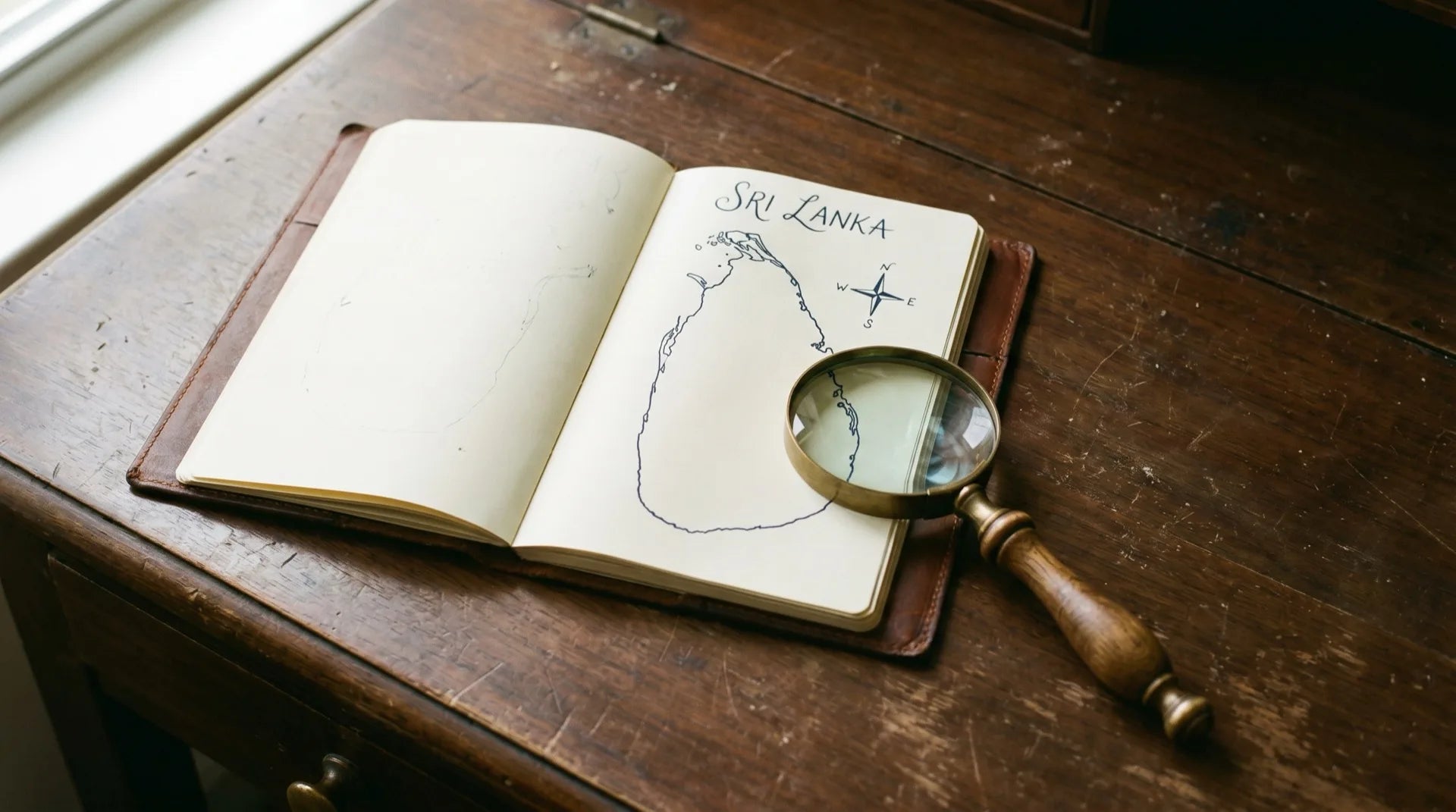
Genuine cinnamon bears the botanical name Cinnamomum verum, which translates simply as "true cinnamon". Its home is Sri Lanka, the island south-east of India that was called Ceylon until 1972 and gave the spice its trade name. Sri Lanka is at once the largest producer and the largest exporter of this species and claims around 90 per cent of the world market for genuine cinnamon (Sri Lanka Export Development Board, 2025).
By far the larger share of what is sold as cinnamon around the world, however, does not come from this plant. Cassia cinnamon comes from related species grown in China, Vietnam and Indonesia, is considerably cheaper and dominates the supermarket shelves. Botanically, sensorially and in cultivation, these are two different worlds, even if both are simply labelled "cinnamon" on the shelf.
Since 2 February 2022, the origin has been legally protected: "Ceylon Cinnamon" has carried an EU protected geographical indication ever since. This means that only cinnamon that genuinely comes from Sri Lanka and meets the defined quality requirements may use the name (IFC/World Bank, 2024). For buyers in Germany, this is a reliable point of reference, because the declaration of origin thereby becomes verifiable.
Where exactly in Sri Lanka does Ceylon cinnamon grow?
The most important growing areas lie on the island's south-west coast, above all in the districts of Galle, Matara and Ratnapura. This region combines two conditions that the cinnamon tree needs: a tropical monsoon climate with high, even humidity and well-drained, sandy to volcanic soils.
The coastal strip in the south-west receives reliable rainfall from the south-west monsoon, while temperatures barely fluctuate throughout the year. It is precisely this consistency that favours the thin, even bark growth that matters when peeling. Cinnamon grows elsewhere in the tropics too, but the combination of climate, soil and inherited craftsmanship cannot simply be transplanted.
In short
Around 90 per cent of genuine Ceylon cinnamon comes from Sri Lanka, mainly from the districts of Galle, Matara and Ratnapura on the south-west coast. There, a tropical monsoon climate and well-drained soils produce the fine, multi-layered bark growth that defines genuine cinnamon.
Economically, cinnamon cultivation matters greatly to the island: the sector supports more than 70,000 smallholders and creates more than 350,000 jobs, the majority of them for women (IFC/World Bank, 2024). Cinnamon is therefore not the plantation product of a few large estates but the livelihood of tens of thousands of family farms. Which other spices play a similar role on the island is something we show in our overview of the spices of Sri Lanka.
Why Ceylon cinnamon attracted colonial powers
That this island of all places supplies the trade name for genuine cinnamon has historical reasons. For centuries, Ceylon was the only significant source of Cinnamomum verum, and this monopoly made the island one of the most coveted destinations of all for the European maritime powers.
In 1505 the Portuguese reached the island and, over the following decades, secured control of large parts of the coastal regions, with the cinnamon trade as the driving motive. In the middle of the 17th century the Dutch East India Company ousted the Portuguese and from 1658 took over colonial rule of the coastal areas; its trading posts, for instance in the fort of Galle, were geared largely towards cinnamon. In 1796 control passed to the British East India Company, and in 1802 Ceylon became a British crown colony.
It was only under Dutch and later British rule that systematic cultivation in plantations emerged, whereas cinnamon had previously been gathered mostly from the wild. The growing areas in the south-west that supply the world market today date back to this period. For the cinnamon peelers and smallholders, it meant centuries of foreign control over a spice that grew on their own island.
The protected name of origin that the EU registered for Ceylon Cinnamon in 2022 reverses this relationship to some extent: it legally ties the name to the country of origin and thus protects the producers against imitation. Anyone buying genuine Ceylon cinnamon today is buying a product whose designation is, for the first time, assigned to the people who make it.
How is Ceylon cinnamon cultivated?
The cinnamon tree is not managed as a tall tree, although by nature it could grow into one. Instead, a technique known in English as coppicing, the equivalent of what is called Niederwaldbetrieb in German, has been used since the 13th century: the trees are cut back close to the ground and then send up several slender shoots.
These shoots grow over a cycle of two to three years until they have reached the right diameter. Only then are they cut. The reason for this approach is the bark itself: young shoots yield a particularly thin, fine and intensely aromatic inner bark, whereas older trunks develop a coarse, thick outer bark that can neither be peeled cleanly nor rolled into fine quills.
Once established, a cinnamon garden bears in this way for decades. The plant is not replaced but is made to sprout afresh again and again. This makes cultivation comparatively resource-friendly, but it demands constant manual work, because every cut and every shoot has to be assessed individually.
When and how is Ceylon cinnamon harvested?
Harvesting traditionally takes place during the monsoon season, that is from May to July and again from October to November. There is a solid practical reason for this: the high humidity makes the bark come away from the wood more easily. In the dry season it adheres more firmly, the strips tear more easily, and the yield of usable inner bark falls.
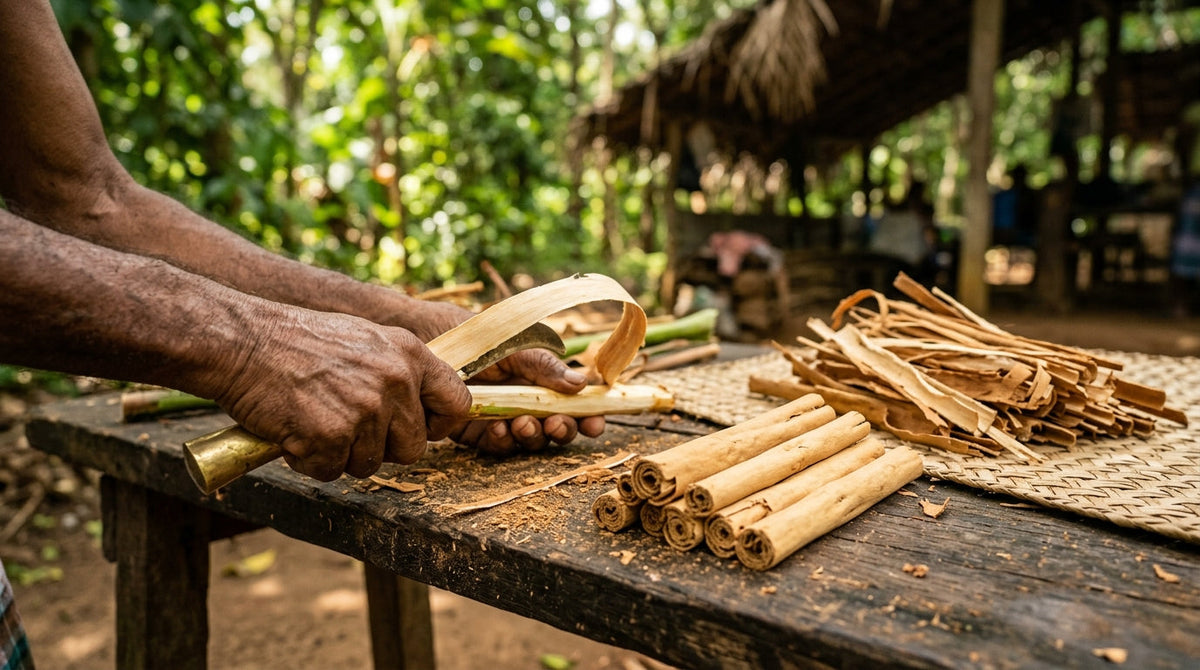
After cutting comes the part that to this day cannot be replaced by machines. The outer layer of bark is removed, then a practised hand loosens the inner bark from the shoot in long strips using a specially shaped knife, the kattha. The cinnamon peelers who take on this work are often trained from childhood. The Sri Lanka Export Development Board explicitly describes the making of quills as a combination of artistry and skill that has been handed down over generations and is unique to the island.

The difference from industrial cassia production is greatest at this point. Cassia bark is stripped off as a thick piece and curls up by itself into a single hard tube as it dries. With Ceylon cinnamon, by contrast, the stick only comes into being through human hands.
How are the typical cinnamon sticks made?
The peeled strips of bark are at first thin, pliable sheets. They are slid into one another and laid on top of each other so that several layers form a single stick. This is precisely what creates the feature by which genuine Ceylon cinnamon can later be recognised: in cross-section, a quill shows many fine, spirally rolled layers, rather like a rolled-up cigar.
The rolled sticks are then left to dry, contracting and becoming firm in the process. Only after that are they cut to length and sorted. The entire sequence, from cutting the shoot to the stick ready for grading, remains manual work.

This construction also explains why Ceylon cinnamon crumbles effortlessly between the fingers, whereas a cassia stick is hard and splinters when broken. It is not a defect in quality but the logical consequence of a stick made of many thin layers.
What do the trade grades Alba, Continental, Mexican and Hamburg mean?
Ceylon cinnamon is not graded by flavour but by the diameter of the finished quill. The Sri Lanka Export Development Board distinguishes four main classes: Alba, Continental, Mexican and Hamburg. At around 6 millimetres, Alba is the finest and most expensive class; the other grades are staggered by increasing diameter up to the range of roughly 20 millimetres (Sri Lanka Export Development Board, 2025).
Within these families there are further gradations, usually listed in the trade as the C series and H series, for example C5 Special or H1. The designations look cryptic but follow a simple logic: the thinner the quill, the more strips had to be laid into one another by hand and the more laborious the production was.
| Trade grade | Characteristics | Classification |
|---|---|---|
| Alba | finest quills, around 6 mm in diameter | most expensive class, highest share of manual work |
| Continental (C series) | slender quills above the Alba thickness | classic premium goods for export |
| Mexican (M series) | sturdier quills | often used for processing and grinding |
| Hamburg (H series) | thickest quills, up to about 20 mm | more robust goods, often for extraction and industry |
Important in practice: a higher grade does not automatically mean more aroma. The classification describes above all appearance and effort. For the kitchen, what matters more is that it is actually Cinnamomum verum at all and how fresh the goods are.
Important
The trade grades say nothing about the variety. A thick cassia stick does not become Ceylon cinnamon just because it resembles a Hamburg quill. What is always decisive is the botanical species, not the diameter.
How do you recognise cinnamon from Sri Lanka when buying?
With whole sticks, telling them apart is easy. A Ceylon quill consists of several wafer-thin layers rolled into one another, is lighter and more evenly coloured and can be crumbled between the fingers. Cassia sticks are single-layered, a darker reddish brown, hard, and they splinter when broken.
With ground cinnamon, only the packaging can help. If it says merely "cinnamon" with no further detail, it is almost always cassia. Genuine cinnamon is as a rule expressly declared as Ceylon cinnamon or as Cinnamomum verum, and the origin Sri Lanka is spelled out alongside.
How patchy the labelling actually is was shown by a market check carried out in 2025 by the Verbraucherzentrale Thüringen, the consumer advice centre of Thuringia: of 31 cinnamon products examined, only 18, or about 58 per cent, carried any indication of the variety at all. Not a single discounter product named the variety (Verbraucherzentrale Thüringen, 2025). There is as yet no legal obligation in the EU to state the type of cinnamon, which makes voluntary declaration and a traceable supply chain all the more important.
Why this distinction matters beyond flavour and what role the constituent coumarin plays in it is something we have described in detail in our article on coumarin in cinnamon.
Why the direct route from Sri Lanka makes a difference

Between the cinnamon garden in the Southern Province and the spice shelf in Germany there are often several intermediate stages in conventional trade. Each of them costs time, and with a spice rich in essential oils, time is the greatest enemy of aroma. The longer ground cinnamon is stored, the more volatile aroma compounds it loses.
At MrCOLOMBO we import directly from smallholders in Sri Lanka and know every stage of this supply chain personally, from cultivation in the Southern Province to dispatch to Germany. Our partner farms are certified organic, and direct import without intermediaries ensures freshness and traceability. If you would like to taste the difference, you will find inspiration in our Ceylon cinnamon recipes.

What does Ceylon cinnamon taste like and how does it stay fresh?
Sensorially, the difference from supermarket cinnamon is marked. Ceylon cinnamon tastes mild, warm and floral, with a fine citrus note on the finish. Cassia, by contrast, comes across as stronger, sharper and more one-dimensional. Those switching from cassia often find genuine cinnamon restrained at first, but then pick out more nuances, because the dominant sharpness is missing.
For recipes designed around cassia, you can therefore increase the amount of Ceylon cinnamon slightly. In savoury cooking, the fine profile comes into its own better than the coarse sharpness anyway.
Because the aroma depends on essential oils, storage is decisive: dark, dry, airtight and away from the cooker. Whole quills keep their aroma considerably longer than ground cinnamon, because the cut surface stays small. If you buy in bulk, you are therefore better off choosing sticks and grinding them fresh as needed. You will find detailed advice on this in our guide to storing spices properly.
Is genuine Ceylon cinnamon from Sri Lanka worth it?
Genuine Ceylon cinnamon is more expensive than cassia, and for understandable reasons: a growing cycle of two to three years, harvesting only in certain months and a peeling and rolling process that to this day remains manual work cannot be made cheaper at will. What you get in return is a finer, more floral aroma, a traceable origin and, since 2022, a legally protected name of origin.
For the occasional cinnamon star biscuit in December, that may be of secondary importance. But if you use cinnamon regularly, in porridge, in coffee or in savoury cooking, genuine Ceylon cinnamon from Sri Lanka is the better choice, in terms of both flavour and composition.