



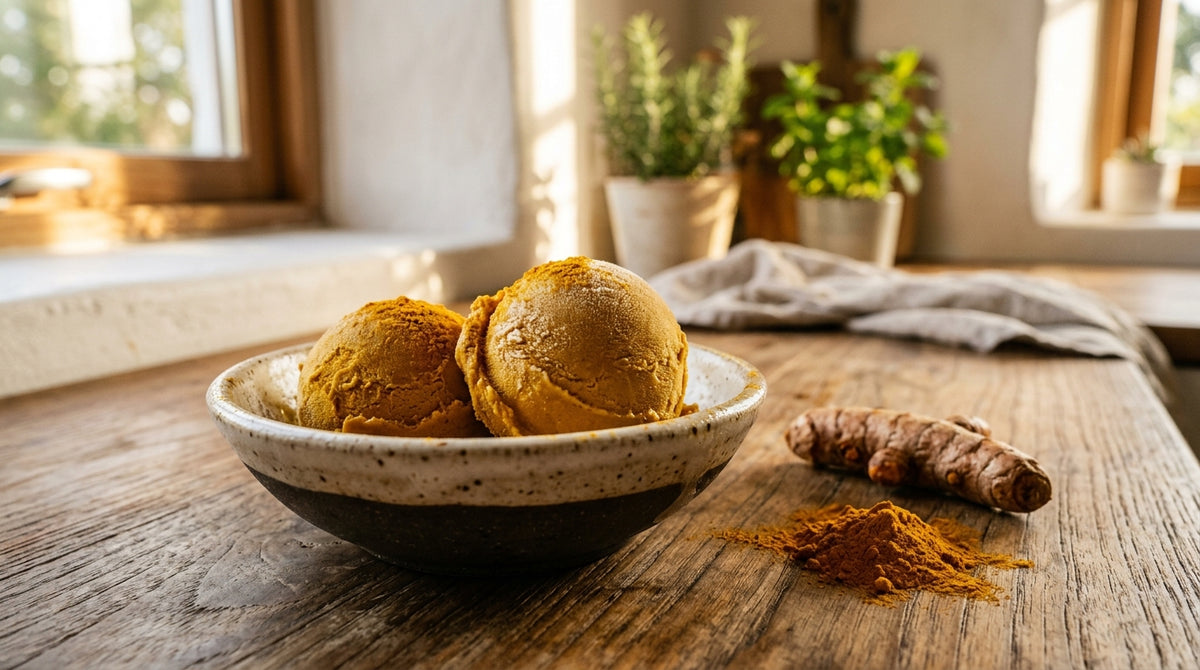
Making turmeric ice cream yourself works best as a cream-based ice cream without an ice cream maker: whipping cream, condensed milk, 1 to 1.5 teaspoons of turmeric and a pinch of freshly ground black pepper produce, after 6 to 8 hours in the freezer, a golden-yellow, creamy dessert. What makes it special is not just the colour but the chemistry: cream-based ice cream is the ideal matrix for actually absorbing curcumin, the golden-yellow plant compound of the turmeric root.
This is exactly where we at MrCOLOMBO come in. We import our turmeric directly from northern Sri Lanka and know the curcumin content of our batch. Curcumin is fat-soluble, and according to Rao et al. (2023) the milk fat in the ice cream acts as a natural carrier with an encapsulation efficiency of 92.6 per cent. Anyone who understands this builds not just a pretty summer ice cream, but one that transports its aroma and its active compound sensibly. This article shows you the recipe, the dosage and the quality criteria.
Short answer
How do you make turmeric ice cream and why is cream ideal? You whip 300 ml of cream until stiff, fold in 180 ml of condensed milk, 1 to 1.5 tsp of turmeric and a pinch of black pepper, and freeze the mixture for 6 to 8 hours.
At a glance
What makes turmeric ice cream so special?
Turmeric ice cream is more than a colourful trend. The decisive point is the fat solubility of curcumin, the main active compound of the turmeric root (Curcuma longa). According to Prasad and Aggarwal (2011), turmeric powder contains around 5 to 6.6 per cent curcuminoids, of which about 75 per cent is accounted for by curcumin itself (Linus Pauling Institute). Stirred neat into water, hardly any of it is absorbed, because curcumin is poorly soluble in water. In cream-based ice cream things look different: the milk fat binds the active compound. Rao et al. (2023) showed that native curcumin releases only 0.8 per cent, whereas in a milk-fat nanoemulsion it releases around 60 per cent. An ice cream made from cream and condensed milk is therefore no gimmick, but a clever carrier matrix for a fat-soluble plant compound.
The ice cream also benefits technologically from the spice. A study by Lucan Colic et al. (2024) on turmeric- and pepper-enriched ice cream found, at a turmeric content of 0.5 to 2 per cent, greater air incorporation, less fat destabilisation and better melting resistance. So the ice cream stays creamy for longer and melts more slowly. Ice cream itself is a multi-phase system of air bubbles, ice crystals, fat globules and an aqueous phase that stabilises at minus 18 degrees (Clarke and Cox, 2024). Turmeric intervenes here as a natural provider of colour and structure, without any need for synthetic additives. Exactly how turmeric is studied in the body is something we describe in our article on turmeric effects.

How much turmeric goes into the ice cream?
The right amount decides between success and failure. Lucan Colic et al. (2023) had 103 test subjects rate turmeric-containing ice cream: the most popular were concentrations of 0.5 and 1.0 per cent, while 3 and 5 per cent were perceived as far too intense and bitter. For a home recipe with around 500 ml of ice cream mixture, that means roughly 1 to 1.5 teaspoons of turmeric powder, i.e. approximately 2.5 to 3.75 grams. That puts you in the ideal sensory range: bright golden yellow, warm and earthy in flavour, but not bitter. If you are making turmeric ice cream for the first time, it is better to start with one teaspoon and work your way up.
The health perspective is also important. The EFSA (2010) and the German Federal Institute for Risk Assessment (BfR, 2021) name an acceptable daily intake (ADI) of 3 mg of curcumin per kilogram of body weight, so for a 70-kg person around 200 mg per day (Verbraucherzentrale, 2026). More powder therefore does not make the ice cream better, only more bitter and hardly more intense in colour.
Our approach at MrCOLOMBO
We recommend first stirring the turmeric into the condensed milk until smooth before you fold it into the cream. That way you avoid lumps and distribute the colour evenly. Which varieties can be combined is something we show in our golden milk recipe.
What flavour note does black pepper bring to turmeric ice cream?
A small pinch of freshly ground black pepper complements the turmeric ice cream with mild heat and is barely noticeable in the sweet dessert.
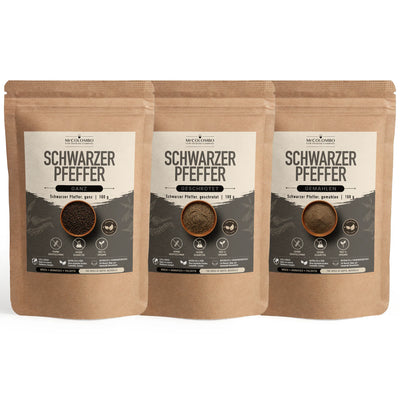
Freshly ground black pepper from Sri Lanka gives the golden ice cream a mild heat. If you like, add a hint of Ceylon cinnamon; we explain the differences in our article Ceylon cinnamon versus cassia cinnamon. This creates a rounded, warm flavour profile.
A small pinch of pepper gives the turmeric ice cream a mild heat.
MrCOLOMBO experience report
How do you make creamy turmeric ice cream without an ice cream maker?
The no-churn method needs no ice cream maker and works reliably. For around 500 ml (about 4 portions) you need 300 ml of whipping cream with at least 30 per cent fat, 180 ml of sweetened condensed milk, 1 to 1.5 teaspoons of turmeric powder, a pinch of freshly ground black pepper, 1 teaspoon of vanilla extract and, optionally, half a teaspoon tip of Ceylon cinnamon. Whip the cream until stiff in 4 to 5 minutes. First stir the turmeric and pepper into the condensed milk, then carefully fold this mixture into the cream. Pour everything into a container and freeze it for 6 to 8 hours, ideally overnight. The active working time is only about 10 minutes.
For the consistency, it is worth giving the cold ice cream mixture a brief stir once after the first 3 hours so that no coarse ice crystals form. If you like it especially creamy, add a tablespoon of neutral vegetable oil or a dash of milk, because more fat keeps the texture softer. A typical fat content of ice cream is 10 to 20 per cent (Clarke and Cox, 2024), and it is precisely this fat content that also binds the curcumin. Take the ice cream out of the freezer 5 to 10 minutes before serving, then it can be portioned easily. A practical tip from experience: turmeric stains containers and spoons, so it is best to use glass or stainless steel. Per portion you are looking at roughly 250 to 360 kcal, depending on the variant.
Step by step
Whip the cream until stiff? Whip 300 ml of cold whipping cream for 4 to 5 minutes until it holds peaks.
Stir in the spices? Stir turmeric and a pinch of pepper into 180 ml of condensed milk until lump-free.
Fold in carefully? Fold the yellow condensed-milk mixture loosely into the cream, do not stir.
Freeze? Pour into a container and freeze for 6 to 8 hours, ideally overnight.
What variants of turmeric ice cream are there?
The basic principle can be varied in many ways. For a vegan version, replace the cream and condensed milk with two tins of cold-stirred full-fat coconut milk and a handful of soaked cashew nuts for extra creaminess. The high fat content remains important, because the coconut and cashew fat binds the curcumin just as milk fat does. An especially quick variant is the nice cream made from frozen mango pieces, a little coconut milk and turmeric in a high-powered blender: ready in a few minutes, naturally sweetened and doubly golden yellow. If you want to save calories, use erythritol instead of sugar and a little inulin against ice crystals and end up at around 126 kcal per 100 g. According to Market Research Future (2025), the market for functional ice cream is growing by about 7.3 per cent a year, with vegan variants growing fastest.
| Variant | Fat base | Contains pepper | kcal / portion |
|---|---|---|---|
| Classic cream | Whipping cream + condensed milk | Yes | 250-360 |
| Vegan coconut | Coconut milk + cashew | Yes | 200-280 |
| Mango nice cream | Mango + coconut milk | Yes | 150-200 |
| Sugar-free | Cream + erythritol | Yes | approx. 126 / 100 g |
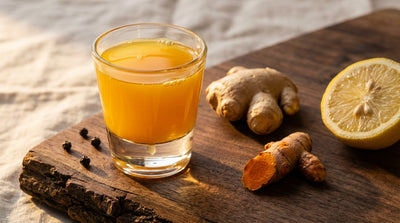
In terms of flavour, turmeric harmonises with warming spices. A pinch of ginger, a little cardamom or Ceylon cinnamon transform the ice cream into a summer variant of classic golden milk, which has been known in India as haldi doodh for over 4,000 years (Tea of Dreams). If you like the warming kick, combine the ice cream with our ginger-turmeric shot as a topping idea. For a fruity note, mango, orange or passion fruit go well and at the same time increase the natural sweetness. In this way, one basic recipe becomes a whole ice cream menu, from creamy cream-based ice cream to light fruit nice cream, each offering its own flavour profile.

Which turmeric powder is the best?
The quality of the powder determines the colour, aroma and purity of your ice cream. OekoTest (2022) tested 19 turmeric powders and rated 16 of them as inadequate: mineral oil components (MOSH) were found in all 19 products, and in one even the banned ethylene oxide. Only a single product received the grade very good. The curcumin content also varies greatly by origin: Madras turmeric delivers about 2 to 4 per cent, higher-quality varieties 4 to 6 per cent (Edel Kraut). So if you want bright, aromatic ice cream, you should not reach for anonymous cheap powder, but look for transparent origin, gentle drying below 40 degrees and organic certification.
That is exactly our standard at MrCOLOMBO. We source our turmeric directly from smallholder farmers in northern Sri Lanka around Jaffna and know every stage of the supply chain personally. Sri Lanka exports around 30,000 tonnes of spices a year and is considered the ninth-largest spice exporter in the world (Sri Lanka Export Development Board). Smallholders there farm about 70 per cent of the cultivated area, which favours small-scale, careful processing. Our turmeric from Sri Lanka is gently ground so that the colouring and essential oils are preserved. What else matters when choosing is something we explore in depth in our article Recognising spice quality.
Shopping checklist
Is the origin transparent? Look for a specific growing region rather than just an EU or non-EU declaration.
Is there organic certification? It reduces the risk of pesticide and ethylene oxide residues.
Is the colour bright? Fresh turmeric is an intense golden yellow; pale powder indicates age or adulteration.
How you handle the powder at home is also part of quality. Turmeric loses colour and aroma in light and warmth, so it belongs in an airtight container stored in the dark. You will find tips on this in our overview of the benefits of organic spices. If you opt for directly imported goods, you get not only more colouring for your ice cream, but also the assurance that no long, opaque chains of intermediaries endanger the purity. That is the difference between a pretty photo and an ice cream you truly trust.
Is turmeric ice cream also suitable for children?
As a spice in ice cream, turmeric is of no concern for the whole family. Curcumin is even officially approved in the EU as the food colour E100 and is considered safe when used as intended (EFSA, 2010). The small amounts in a portion of ice cream are well below the ADI of 3 mg per kilogram of body weight. The US NCCIH (2025) likewise emphasises that conventional turmeric is safe as a cooking spice. The distinction is important: the problem is not food, but high-dose, highly bioavailable dietary supplement capsules, for which the EFSA (2014) describes, in individual cases for children, an exceedance of the intake level via food colours. That does not apply to a home-made summer ice cream with one teaspoon of powder.
Important
This article is for information purposes and does not replace medical advice. Anyone who has gallstones, takes blood-thinning medication or is pregnant should discuss larger amounts of turmeric with a doctor or pharmacist. For health questions, please consult your doctor or pharmacist.
For children, a mild variant is worthwhile: less turmeric, but yoghurt, carrot and orange as an ice lolly make a friendly, fruity dessert with only around 80 to 110 kcal per lolly. The warm colour comes entirely without artificial additives, which fits well with the finding that, according to industry analyses, around 54 per cent of consumers avoid artificial ingredients (Market Research Future, 2025). In this way, turmeric ice cream becomes an honest family recipe: naturally coloured, sensibly composed and uncritical in quantity. If you like, serve it with fresh berries or a dollop of mango purée so that even sceptical little eaters tuck in.
Why is home-made turmeric ice cream worth it?
Turmeric ice cream combines three things that rarely come together: a simple no-churn recipe, a natural golden-yellow colour without additives and a clever food matrix in which the fat-soluble curcumin can actually be absorbed. With 0.5 to 2 per cent turmeric, a pinch of black pepper for mild heat and a high-quality fat base, you turn a summer trend into a well-thought-out dessert. The quality of the powder remains decisive: if you look for transparent origin and organic quality, you avoid the mineral oil and pesticide problems that OekoTest uncovered. Our directly imported turmeric from Sri Lanka provides the foundation for that. Try the basic recipe, vary it vegan or fruity and find your favourite golden variety.