



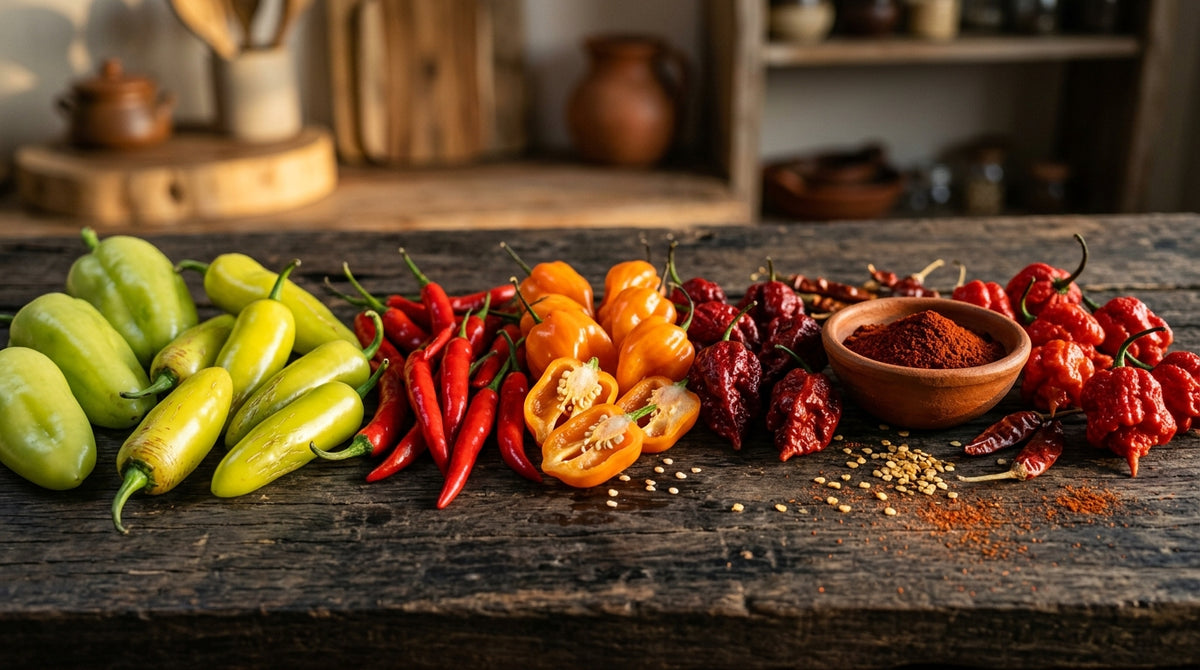
Chilli varieties differ above all in one value: their heat, measured in Scoville heat units (SHU). The range stretches from the practically mild sweet pepper (0 SHU) via the jalapeno (2,500-8,000 SHU) and the habanero (100,000-350,000 SHU) to the currently hottest variety, Pepper X, at 2,693,000 SHU (Guinness World Record 2023). Responsible for the burning sensation is the plant compound capsaicin, which binds to the heat receptor TRPV1 in the mouth.
There are more than 4,000 chilli varieties worldwide, spread across five cultivated Capsicum species. We at MrCOLOMBO import our roasted chilli powder directly from Sri Lanka, where chilli (locally "miris") is a fixed part of almost every meal. In this comparison we rank the most important varieties by heat, origin and use in the kitchen, drawing on studies by the BfR, EFSA and the Chile Pepper Institute of New Mexico State University.
Short answer
Which chilli varieties are there and how hot are they? The most important culinary chillies range from mild (sweet pepper 0 SHU, ancho 1,000-2,500 SHU) via medium (jalapeno 2,500-8,000 SHU, cayenne 30,000-50,000 SHU) to very hot (habanero 100,000-350,000 SHU, Bhut Jolokia over 1,000,000 SHU). Heat is measured on the Scoville scale, today by HPLC analysis, with 16 SHU corresponding to roughly 1 mg of capsaicinoid per kilogram (Chile Pepper Institute, NMSU).
At a glance
The Scoville scale: how heat is measured objectively
The Scoville scale goes back to the pharmacist Wilbur Scoville, who developed an organoleptic test at Parke-Davis in 1912 (Scoville, 1912). A chilli extract was diluted with sugar water until a panel of tasters could no longer detect any heat. The dilution required gave the Scoville value. The method was subjective and fluctuated by up to 50 per cent. That was imprecise. Since the 1980s, heat has therefore been measured objectively by high-performance liquid chromatography (HPLC), which determines the capsaicinoid content directly. The Chile Pepper Institute of New Mexico State University, the only research institution in the world specialising in Capsicum, gives the conversion as follows: 16 SHU correspond to roughly 1 mg of capsaicinoid per kilogram (Chile Pepper Institute, 2021).
Just how much the capsaicin content varies even within a single species is shown by an HPLC study by Barbero et al. (2018): the values ranged from 22.8 mg/kg to 9,097.3 mg/kg of dry matter. Soil, climate, ripeness and drying strongly influence the result, which is why Scoville figures are always ranges rather than fixed numbers. An analysis of 133 Capsicum accessions found peak values of 924.27 micrograms of capsaicin per gram of dry matter (Zia-ur-Rehman et al., 2025). The capsaicinoid profile also differs between species: in Capsicum annuum the ratio of capsaicin to dihydrocapsaicin is around 64:30, in the particularly hot species Capsicum chinense it is 73:25 (Bosland and Coon, 2021). That explains why habaneros not only burn hotter but also differently from jalapenos.

Which chilli varieties are there, from mild to extremely hot?
Culinary chillies can be roughly divided into four heat groups. Mild are sweet pepper and ancho (dried poblano, 1,000-2,500 SHU) with notes of raisin and chocolate. Medium-hot are jalapeno (2,500-8,000 SHU) and Korean gochugaru as well as cayenne (30,000-50,000 SHU). Things get hot with Thai chilli or bird's eye (50,000-100,000 SHU), which according to Thai sources are around 15 times hotter than a jalapeno (Mae Jum, 2024). Very hot are habanero and Scotch bonnet (100,000-350,000 SHU) with a fruity aroma. In the extreme class stand Bhut Jolokia (ghost pepper, over 1,000,000 SHU), Carolina Reaper (1,400,000-2,200,000 SHU) and Pepper X (2,693,000 SHU), all of which come from the breeder Ed Currie.
The following table shows the most common varieties with their typical Scoville values and flavour profiles. Important: these are guide values that fluctuate depending on origin. If you want to tame the heat, remove the pale inner membranes (placenta) and the seeds, because that is where most of the capsaicin sits; this allows it to be reduced by up to 70 per cent without the aroma being lost (Kevin Is Cooking, 2024).
| Variety | Scoville (SHU) | Flavour | Typical cuisine |
|---|---|---|---|
| Sweet pepper | 0 | sweet, mild | European |
| Ancho / Poblano | 1,000-2,500 | raisin, chocolate | Mexican |
| Jalapeno | 2,500-8,000 | green, fresh | Tex-Mex, salsa |
| Cayenne | 30,000-50,000 | hot, neutral | international, powder |
| Thai chilli / Bird's Eye | 50,000-100,000 | direct, grassy | Thai |
| Habanero / Scotch Bonnet | 100,000-350,000 | fruity, tropical | Caribbean |
| Bhut Jolokia (Ghost) | over 1,000,000 | smoky, burning | Indian, hot sauce |
| Carolina Reaper | 1,400,000-2,200,000 | fruity-extreme | challenges |
| Pepper X | 2,693,000 | extreme, briefly fruity | record, not sold commercially |
Cultivation and world market: where chilli grows
Chilli is one of the most important spice plants in the world. According to the FAO, around 38 million tonnes of fresh chillies and peppers were harvested in 2021 (FAO, 2021). The largest producers are China (about 30 per cent), India (22 per cent) and Mexico (11 per cent). India alone harvested around 5.3 million tonnes in 2024 and is at the same time the world's largest exporter of dried chillies. The global market for chilli grew to 10.88 billion US dollars in 2025 and is expected to rise to 17.06 billion US dollars by 2032 (360iResearch, 2025). The drivers are the growing popularity of international cuisines and the trend towards clean-label products. Botanically, all varieties belong to five cultivated species: Capsicum annuum (jalapeno, cayenne, sweet pepper), C. chinense (habanero, Bhut Jolokia), C. frutescens (Tabasco, bird's eye), C. baccatum (aji varieties) and C. pubescens (rocoto).
In Sri Lanka, too, chilli plays a central role, both in the kitchen and in agriculture. According to data from the research institute HARTI, the island produced around 67,397 tonnes of green chilli in 2023 but only about 7,500 tonnes of dried chilli, so that a further roughly 40,055 tonnes were imported from India (HARTI, 2020). There are ten official varieties from MI-1 to MIPC 1; the first local hybrid, MICH HY 1 (2015), offers a yield potential of 32 tonnes per hectare. We at MrCOLOMBO know the growing regions in the dry zone around Jaffna and the Northern Province from our own experience. For our roasted chilli powder we work directly with smallholders, without middlemen. You can read more about the origin of our products in the article on spices from Sri Lanka.
Roasting before grinding is a deliberate technique in South Asian cooking. It breaks down the raw, sharp heat and develops smoky, nutty aromas, much like the Mexican practice of roasting whole chillies for mole. Our chilli powder is made from sun-dried, roasted pods and sits in the medium heat range, comparable to cayenne. If you are looking for mild, colour-giving heat for rice dishes and curries, it serves you well without the food burning unpleasantly. You will find the rest of our selection of hot spices in the Chilli collection.
Which chilli variety suits which dish?
The right chilli depends less on sheer heat than on aroma and cuisine. In Mexico, the "Holy Trinity" of ancho, guajillo and pasilla forms the basis of many mole sauces, often in a ratio of 2:1:1, with the dried pods toasted for around 20 seconds per side (Mexican Please, 2024). Ancho tastes raisin-sweet, guajillo brings berry notes. In Korean cooking, gochugaru dominates, a coarsely ground powder made from sun-dried, deseeded peppers with a sweet-smoky taste and mild to medium heat, the basis for kimchi and gochujang (My Korean Kitchen, 2024). Thai dishes such as green curry or som tam rely on prik kee noo (bird's eye) for a direct, immediate hit of heat.
In Sichuan cooking, facing-heaven chillies (chao tian jiao) meet Sichuan pepper, the famous "ma la" principle of numbness (pepper) and heat (chilli). For the spicy depth of many South Asian dishes, our Sri Lanka curry recipe, in which roasted chilli plays a leading role, is also a good choice. Indian dishes such as Goan vindaloo use Kashmiri chillies, which deliver plenty of colour with moderate heat (Swasthi's Recipes, 2024). A simple rule of thumb: large, fleshy varieties such as poblano or Anaheim are suited to stuffing and roasting, small thin-walled varieties such as cayenne and Thai chilli to drying and grinding. If you want mild heat with colour, reach for roasted chilli powder or Kashmiri types; if you are after heat, for habanero or bird's eye.
In Sri Lanka you don't season to burn, but to create depth. Roasted chilli powder gives a dhal colour and smoke long before it turns hot.
MrCOLOMBO experience report

How does capsaicin act on the body?
The burning of chilli arises because capsaicin binds to the TRPV1 receptor in the lining of the mouth, the same receptor that also responds to heat. The brain interprets the signal as warmth or pain, although no real change in temperature takes place (Yang and Zhong, 2016). It burns without being hot. With repeated stimulation, desensitisation sets in, which explains the paradoxical effect that topical capsaicin preparations are used in pain therapy. Capsaicin is being studied intensively by science: a meta-analysis found that capsaicinoids can raise resting energy expenditure by around 34 kcal per day on average and increase fat oxidation (Whiting et al., 2012). That is a measurable but moderate effect, and not a slimming aid.
There are also observational data for the cardiovascular system. A pooled analysis of 564,748 participants observed lower cardiovascular mortality with regular chilli consumption (Bonaccio et al., 2019), and a meta-analysis of prospective cohort studies found a 12 per cent lower risk of all-cause mortality with regular chilli consumption (Ofori-Asenso et al., 2021). Such studies show associations, not cause and effect. Chillies are also rich in nutrients: depending on the variety, ripe red pods contain 124 to 338 per cent of the daily vitamin C requirement and twice as much as green fruits (Islam et al., 2022). The red pigment capsanthin accounts for up to 50 per cent of the carotenoids (Giuffrida et al., 2020).
Our approach at MrCOLOMBO
We deliberately word things cautiously: chilli is a spice, not a remedy. We base any health-related statements on the EFSA and the BfR. If you want to know more about ingredients and quality, you will find the background in the article on the advantages of organic spices.
How much heat is healthy?
The German Federal Institute for Risk Assessment gives a safe upper limit of about 5 mg of capsaicin per kilogram of body weight per meal (BfR, 2024). For a person weighing 70 kg that would be around 350 mg of capsaicin in one go, an amount that is hardly reached with normal food. Products containing more than 100 mg of capsaicin per kilogram must be labelled, and at very high levels above 6,000 mg/kg the BfR recommends a case-by-case safety assessment. At the same time, the BfR makes clear that traditional chilli consumption in African, Arab, South American and Asian cuisines is not associated with acute damage to health (BfR, 2011). What is risky, by contrast, are extreme heat challenges with superhot extracts.
If you are not yet used to heat, you should approach it step by step, because the body becomes accustomed to capsaicin (desensitisation). The EFSA assesses the health risks of capsaicinoids as the basis for European rules on extremely hot foods (EFSA, 2023). It is also important to remember that heat is perceived very individually and affects children differently from adults.
Important
This article is for information purposes and does not replace medical advice. Infants and small children should be kept away from hot, spicy foods. If you have a sensitive stomach or health-related questions, consult your doctor or pharmacist.
What should you look for when buying chilli?
With chilli, quality is not a luxury but a matter of safety. Öko-Test examined 33 samples of paprika powder and found considerable pesticide contamination; a single product contained 23 different pesticides, while all organic products performed markedly better (Öko-Test, 2024). The Federal Office of Consumer Protection also found that around 26 per cent of the chilli powder samples examined exceeded the maximum residue levels and that mycotoxins such as aflatoxins occur frequently in chilli from third countries (BVL, 2020). We at MrCOLOMBO source our chilli directly from smallholders in Sri Lanka and know every stage of the supply chain personally.
When buying, the same rules apply as for all spices: buy airtight and light-protected packaging, choose small quantities and use them up within three to six months, because essential oils and capsaicin dissipate over time. Whole dried pods keep longer than ground powder. Colour and aroma are the best indicators of freshness: a vivid red and a distinct scent speak for quality, a pale, musty powder for old stock. How to recognise freshness and purity is explained in the article Recognising spice quality; you will find storage tips under Storing spices properly.
Checklist for buying chilli
Organic or conventional? Organic products performed consistently better in the Öko-Test (2024) and carry less pesticide contamination.
Transparent origin? Country and producer should be stated on the label, ideally with a short supply chain.
Whole or ground? Whole pods keep longer and retain more aroma than powder.
Colour and scent? A strong red and an intense smell are indicators of freshness; pale and musty points to old stock.

Conclusion: the right chilli for every taste
The right chilli variety is a question of aroma, cuisine and heat tolerance, not just of the highest Scoville number. For everyday cooking, mild to medium varieties such as roasted chilli powder, cayenne or Kashmiri are often enough, giving colour and depth without overwhelming. If you like it fiery, habanero, bird's eye or the superhots open up a world of their own, but you should keep the BfR recommendations in mind. Quality remains decisive: organic origin and transparent supply chains protect against pesticides and mycotoxins. Our roasted chilli from Sri Lanka stands for exactly this standard. Fancy more spice? Browse our range of spices, imported directly.