



Ube (pronounced "oo-beh") is the purple tuber of the yam species Dioscorea alata, which has been cultivated for thousands of years, above all in the Philippines. Its deep purple colour comes from natural anthocyanins, it tastes mildly sweet with notes of vanilla and pistachio, and it provides around 140 kilocalories per 100 grams (Healthline, 2023). Unlike artificially coloured trend products, ube therefore owes its appearance to a plant pigment that is also found in blueberries and red cabbage.
Botanically, ube is neither a sweet potato nor taro, but a yam species of its own from the Dioscoreaceae family. In Germany the root is currently experiencing a veritable boom: the search volume for "Ube Pulver" (ube powder) rose to around 6,600 queries per month in April 2026 (+817 per cent compared with the previous year, DataForSEO). As a direct importer of tropical roots and spices from Sri Lanka, we at MrCOLOMBO know the whole category of naturally coloured plant powders well, and in this guide we put the hype into fact-based perspective.
Transparency
MrCOLOMBO does not currently sell ube powder. If you are mainly looking for a natural red-purple colour, Beetroot Powder is an available alternative. In terms of flavour, it is no substitute for ube.
Short answer
What is the ube root? Ube is the purple tuber of the yam species Dioscorea alata, a starchy staple food from the Philippines. The colour comes from anthocyanins (around 38 mg per 100 g of raw yam, Adomeniene and Venskutonis, 2022), and the flavour is mildly sweet.
At a glance
What exactly is ube and where does the purple root come from?
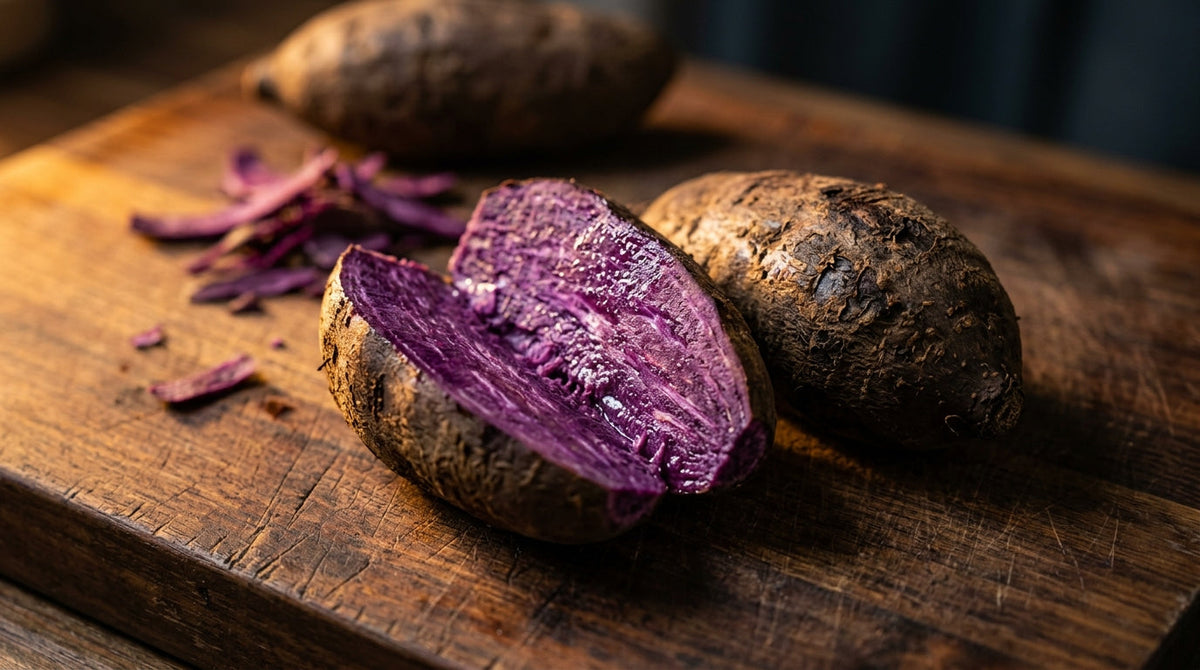
Ube is the Filipino name for the purple tuber of the plant Dioscorea alata, which botanically belongs to the yam family (Dioscoreaceae). The English names are "purple yam" or "greater yam". Around 18 million tonnes of yam are consumed worldwide every year (Obidiegwu et al., 2020), with Dioscorea alata among the most important edible yams. The tuber grows up to a metre long, has a rough dark brown skin and, inside, a colour spectrum ranging from delicate lilac to deep violet. This colour is not down to the variety alone, but depends on the anthocyanin content, which varies between 10 and 90 mg of cyanidin-3-glucoside equivalent per 100 g of dry weight depending on the accession (Srivichai et al., 2020).
The pronunciation causes confusion among German beginners: ube is spoken with two syllables, "oo-beh", not "yoob" or "ub". The word comes from Tagalog, the most important language of the Philippines. The very first Tagalog-Spanish dictionary from 1613 already mentions the tuber (Kapwa Gardens, 2024), which shows how deeply ube is rooted in the islands' culture. Archaeological finds from the Ille Cave on Palawan even point to yam residues around 11,000 years old (Organic Ube, 2024). Ube is therefore not a new invention of social media, but an ancient staple food that only got its global debut through Instagram and TikTok.

To this day, the main growing area is the Philippine archipelago with its 7,641 islands, above all the regions of Central Visayas and Calabarzon (Philstar, 2026). Yet Dioscorea alata grows in the warm, humid tropics across the whole of South East Asia, southern India and also Sri Lanka, where yam tubers are traditionally part of rural cooking around the central growing belts of Matale and Kandy. Anyone growing the root needs a tropical climate with sufficient rain and a long growing season of eight to ten months. It is precisely this knowledge of tropical growing regions and soil conditions that accompanies us at MrCOLOMBO every day, because we personally know our turmeric, moringa and pepper partners in the hills of the Central Province around Matale and Kandy and take responsibility ourselves for the supply chains from the plantation to Germany.
Ube, purple sweet potato or taro: what is the difference?
The most common mistake among German buyers is confusing ube with purple sweet potato and taro. Botanically, these are three completely different plants: ube (Dioscorea alata) is a yam, the purple sweet potato (Ipomoea batatas) belongs to the bindweed family, and taro (Colocasia esculenta) is an arum plant. The most visible difference lies in the colour of the flesh: ube is purple throughout, taro is white to grey with fine purple speckles, and the purple sweet potato varies depending on the variety. In terms of flavour, ube is mildly sweet with notes of vanilla and nut, taro tastes earthy and starchy, and the purple sweet potato is more classically sweet.
| Feature | Ube | Taro | Purple sweet potato |
|---|---|---|---|
| Botanical family | Yam family | Arum family | Bindweed family |
| Flesh colour | Purple throughout | White to grey | Purple |
| Flavour | Sweet, vanilla, nut | Earthy, starchy, mild | Sweetish, slightly floral |
| Anthocyanin content | High | Very low | Medium |
| Glycaemic index | 24 to 35 (low) | approx. 53 (medium) | approx. 63 (medium to high) |
This distinction is not just theory but has a practical background: on social media, purple sweet potatoes are often wrongly sold as ube, sometimes even helped along with artificial colourants (Watson, 2026). Anyone looking for real ube should look for flesh that is purple throughout and the characteristic vanilla scent. The anthocyanin content is the decisive marker here: at around 38 mg per 100 g, ube provides considerably more purple plant pigments than taro, whose anthocyanin share is vanishingly small (Adomeniene and Venskutonis, 2022). So anyone who reaches for ube because of the colourful look and the antioxidants it contains is practically buying the wrong product with taro.

What is in the purple root? The nutrient profile in numbers
Ube is a starchy staple food with an above-average micronutrient profile. A portion of 100 g of cooked tuber provides around 140 kcal, about 27 g of carbohydrates and 4 g of fibre (Healthline, 2023). The vitamin C content is remarkable: Healthline puts it at 40 per cent of the recommended daily amount, and laboratory analyses measure up to 87.43 mg of ascorbic acid per 100 g of dry weight (Induar et al., 2024). Added to this is a high potassium content of 775 to 2,016 mg per 100 g depending on the variety, combined with a low sodium content (Obidiegwu et al., 2020), a ratio that Wireko-Manu et al. (2013) classify as nutritionally favourable for the heart and circulation.
If you appreciate ube's purple colour effect but do not always have the hard-to-find powder to hand, you can turn to related natural colouring powders. Beetroot provides a strong red-purple tone, moringa a rich green, turmeric a bright yellow. All three, just like ube, are coloured by real plant compounds rather than by food colouring. We at MrCOLOMBO know this category of natural, finely ground root and leaf powders first hand, because we source them directly from smallholders in Sri Lanka and have them processed ourselves. If you want to play with colours in the kitchen, this gives you shelf-stable alternatives that can be stirred into smoothies, batter and glazes just like ube powder.
Ube's starch structure is particularly interesting, because it explains the low glycaemic index. The total starch content is 71.79 to 82.54 per cent of dry weight (Liang et al., 2026). A considerable share of this is resistant starch (up to 38.40 per cent) and slowly digestible starch (up to 42.12 per cent). Resistant starch is not broken down in the small intestine and acts in a similar way to dietary fibre. The B-type crystalline pattern of the starch granules additionally slows enzymatic digestion. This is exactly why Healthline (2023) gives the glycaemic index as just 24, considerably lower than that of an ordinary potato.
If you convert the figures to a realistic portion, the profile becomes tangible. A typical dessert portion of around 80 g of cooked ube provides about 112 kcal, a good 3 g of fibre and a notable share of vitamin C and potassium, without any notable fat. In terms of energy, ube is therefore in the range of other tubers, but scores on micronutrients and plant pigments. The German Nutrition Society recommends a predominantly plant-based diet with tubers and roots as the carbohydrate base (DGE, 2024), and ube fits well into this logic as a colourful change. An honest assessment remains important: ube is a nutrient-rich food, not a dietary supplement, and its added value unfolds as part of a varied diet, not through large individual quantities.
Why is ube considered so healthy? Anthocyanins and antioxidants
The scientifically most exciting component of ube is the anthocyanins, those purple plant pigments that also give blueberries and red cabbage their colour. A study by Qiu et al. (2023) identified petunidin-3-O-feruloyl-glucoside-5-O-glucoside as the main anthocyanin in Dioscorea alata, with a share of 76.77 per cent. In the laboratory, these compounds show antioxidant properties: the tuber's DPPH radical scavenging activity reaches high values depending on the measurement method (Obidiegwu et al., 2020), and purified ube anthocyanins significantly increased the activity of the body's own enzymes such as superoxide dismutase in an animal study (Qiu et al., 2023). Important for context: such findings come from cell and animal models and are not a proven effect in humans.
Important
This article is for information purposes and does not replace medical advice. If you have health questions, consult your doctor or pharmacist. The study results mentioned describe laboratory observations and do not constitute any promises of healing.
In addition to the anthocyanins, ube provides further secondary plant compounds. Induar et al. (2024) determined a total phenol content of 248.30 mg per 100 g and a flavonoid content of 390 mg per 100 g of dry weight. Resistant starch has also come into focus as a prebiotic factor: in a laboratory study, resistant starch from Dioscorea alata shortened the growth phase of the gut bacterium Bifidobacterium adolescentis from four to two hours and increased the formation of short-chain fatty acids (Li et al., 2018). In further animal models, resistant starch from ube lowered triglycerides, total cholesterol and LDL and raised HDL in hyperlipidaemic hamsters (Li et al., 2019). These data make ube an interesting object of research, but do not justify any blanket health claims.
This is precisely where an honest assessment is needed, because myths circulate around ube. One persistent misconception concerns the diosgenin contained in yams, which supposedly acts hormonally like progesterone. The German consumer advice centre Verbraucherzentrale (2024) makes it clear: the body cannot convert diosgenin into progesterone on its own; that only works in the laboratory. The German Pharmacists' Association also points out that such hormone promises are not scientifically tenable (Aponet, 2026). Ube is therefore a nutrient-rich food with interesting compounds, but neither a hormone preparation nor a remedy. If you enjoy it for what it is, namely a colouring and tasty tuber, you are on the right track.

What is ube halaya, the national dish of the Philippines?
The best-known ube dish is ube halaya, a velvety purple jam that is served in the Philippines at Christmas, festivals and family celebrations. Classically, cooked, finely puréed ube is slowly simmered down with coconut milk, condensed milk and butter until a dense, spreadable mass forms. Historically, ube halaya was prepared with the milk of the carabao water buffalo (Kapwa Gardens, 2024); it was only American condensed milk after 1898 that changed the recipe for good. Today ube halaya is the basis for countless desserts, from layered halo-halo to the filling of yeast buns. In Germany, "Ube Halaya" is among the most searched ube terms with around 480 searches per month (DataForSEO, 2026).
Ube halaya: the basic recipe in steps
Cook and purée the ube? Boil around 300 g of ube until soft and work it into a smooth purée. Alternatively, mix 4 to 6 tbsp of ube powder with a little water.
Add liquid? Stir the purée with about 200 ml of coconut milk, 150 ml of condensed milk and a pinch of salt in a heavy saucepan.
Simmer down patiently? Stir constantly over a low heat for 25 to 30 minutes until the mass becomes thick and glossy. Finally, work in a little butter.
Cool and serve? Fill into a jar, leave to cool and use as a spread, dessert base or ice cream ingredient. Halaya keeps for around a week in the fridge.
Behind the dish lies more than a recipe, namely a piece of identity. Ube has been regarded as a cultural cornerstone in the Philippines for over 400 years (Kapwa Gardens, 2024), and shared meals with purple sweets are a firm part of festivals and family gatherings (Falstaff, 2022). This cultural depth is also the reason why parts of the Filipino diaspora view the purely aesthetic marketing of ube in the West critically and warn against reducing it to an Instagram effect (taz, 2026). Anyone preparing ube is therefore honouring a tradition that is thousands of years old. A conscious approach to origin and history is therefore just as much part of the subject as the flavour, a standard we at MrCOLOMBO also uphold for our spices from Sri Lanka.
Ube's long journey can be traced through a few milestones. Archaeological traces from the Ille Cave on Palawan go back around 11,000 years (Organic Ube, 2024), the first dictionary names the tuber in 1613, and American condensed milk shaped the halaya recipe from 1898. In the 1970s, a convent business in Baguio made ube sweets known beyond the region, before Instagram made the root go viral in the USA from 2017 and Starbucks finally lifted it into the global mainstream in 2025. Anyone who knows this span understands that today's hype is only the latest episode of a story thousands of years old, and not its beginning.

How do you use ube in lattes, ice cream and cakes?
In modern cuisine, ube is popular above all for its colour and its mild flavour. The ube latte is the entry-level drink par excellence: a teaspoon of ube powder is frothed up with around 200 ml of plant milk and a little maple syrup, and the purple-violet trend drink is ready. Ube ice cream is just as easy using the no-churn method from whipping cream, condensed milk and ube paste or powder, with no ice cream maker at all. If you bake, stir two tablespoons of ube powder into pancake, waffle or cake batter and you get a spectacular purple colouring. This versatility explains why baked goods form the leading ube application segment at 29.6 per cent (Coherent Market Insights, 2026).
If you love the trend for colourful lattes, you do not have to stop at ube. From our range, moringa is suitable for a green latte, turmeric for the classic golden milk and beetroot for a pink-purple drink. We show how to prepare a creamy turmeric latte step by step in the recipe for golden milk, and you will find five everyday ideas for green powder in our easy moringa recipes. This way, playing with natural colours can also be done with ingredients that are reliably available in Germany.
The ube hype is measurable and global. The worldwide ube market was estimated at around 455.3 million US dollars in 2024 and is expected to grow to 943.6 million US dollars by 2035, which corresponds to an annual growth rate of 6.9 per cent (Transparency Market Research, 2024). In the USA, ube appeared 231 per cent more often on restaurant menus within four years, and consumer awareness rose from 15 per cent (2021) to 27 per cent (2025) (Datassential, 2026). All this is fuelled by social media: the hashtag #UbeEverything gathered over 500 million TikTok views, and the Starbucks effect with several ube drinks finally brought the tuber into the mass market in 2025 (CNBC, 2026). Trade media are already asking whether ube will be the new matcha (Food Navigator, 2026).

Which ube recipes work for beginners?
Recipes that simply stir in the powder are suitable for getting started. Ube pancakes are made by adding two tablespoons of ube powder to a normal pancake batter, and deliver a purple breakfast variation in a few minutes. No-bake mini cheesecakes are made from around 200 g of cream cheese, two tablespoons of ube powder, a little icing sugar and cream, chilled in muffin cases. The ube latte already mentioned is the quickest application of all and a good way to get to know the mild flavour. If you prefer something more traditional, use home-cooked ube halaya as a base and layer it with cream and fruit for a simple dessert. What all the recipes have in common is that ube mainly contributes colour and a delicate vanilla-nut note, while sweetness and binding come from the other ingredients. This way, the trend can be tried out in your own kitchen without any special equipment.

Where can you buy ube in Germany, fresh or as a powder?
In Germany, ube is most easily available as a powder, which is shelf-stable and available all year round. Online shops and Asian supermarkets stock ube powder at prices of around 12 to 28 euros per 100 g (Culinarico, Amazon, 2026). Fresh ube tubers, on the other hand, are hard to get hold of and usually only turn up in well-stocked Asian markets in big cities. This is reflected in search behaviour: "Ube Pulver" (ube powder) is now searched for more often than the fresh root, and the query "ube-pulver dm" exploded to around 3,600 searches per month in May 2026 (+1,285 per cent compared with the previous year, DataForSEO). Legally, selling it is straightforward: yam (Dioscorea alata) is not considered a novel food in the EU, as the tuber was already consumed to a significant extent before May 1997 (European Commission, 2024).
Our approach at MrCOLOMBO
MrCOLOMBO does not currently stock ube powder. As soon as that changes, this article will be updated.
It pays to be attentive when buying, because the boom has also produced counterfeits. According to reports, ordinary purple sweet potatoes are declared as ube or products are dressed up with artificial colourants, while prices have more than doubled since 2019 (Watson, 2026). You can recognise real ube powder by an ingredients list that names only ube, by a naturally muted purple rather than a garish neon lilac and by the typical mildly sweet vanilla scent. A rule of thumb: the brighter and more artificial the colour looks, the more sceptical you should be. If you want to pay attention to quality, you can use the same criteria that we describe in our guide to storing spices properly, because ube powder, too, should be kept airtight, dark and dry.
If you want to try the purple effect but would rather rely on reliably available ingredients for now, you will find natural alternatives with us. One intensely colouring powder is our Beetroot Powder with its strong red-purple tone, and a green counterpart is the moringa range. These powders are easy to get hold of in Germany, have a long shelf life and, just like ube, are coloured by real plant compounds. They do not replace the unique flavour of ube, but they are an honest bridge as long as fresh tubers remain rare here.
Why is ube so expensive and what does that mean for buyers?
The global hunger for ube meets a strained supply situation in the tuber's homeland. In the Philippines, ube production fell to 12,483 tonnes in 2025, a decline of 6.71 per cent compared with the previous year, while the cultivated area shrank by 17.1 per cent (Philstar, 2026). At the same time, exports rose: in 2025 the country shipped around 1.7 million kilograms of ube worth 3.06 million US dollars, an increase of 20.4 per cent (PortCalls, 2026). This gap between falling production and rising demand explains the high prices. Part of the problem is home-made: some farmers sell their seed tubers instead of replanting them, while countries such as China and Vietnam are investing strategically in cultivation (taz, 2026).
For you as a buyer, this means two things. Firstly, a certain price for real ube is unavoidable, because the tuber is labour-intensive, is transported over long distances and comes from a region with a declining harvest. If you find a bargain, you should check its authenticity particularly critically. Secondly, it is worth thinking about the ecological footprint, because the long-distance transport of tropical trend products causes relevant CO2 emissions (Aponet, 2026). Conscious, moderate consumption therefore suits ube better than trying to follow every social media trend. It is exactly this attitude, namely putting quality and fair supply chains above sheer quantity, that also guides our work with spices from Sri Lanka, about which you can read more in our article on our spices from Sri Lanka.
Is ube worth it or is it just a hype?
Ube is both: a legitimate pleasure and a hype with downsides. At the same time, ube is not a remedy, its transport is relevant for the climate, and the market is prone to counterfeits. If you enjoy real ube consciously and in moderation, you are doing nothing wrong, but you should pay attention to authenticity and origin. If you mainly want to play with natural colours in the kitchen, natural root and leaf powders from our range offer reliable companions that are readily available in Germany. That way, the joy of colour remains, without the trend degenerating into empty consumer goods.