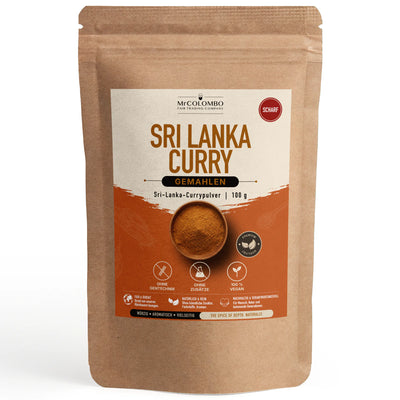
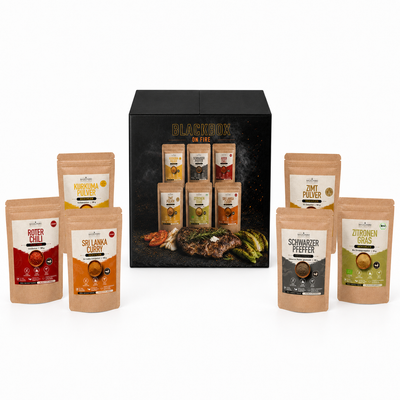
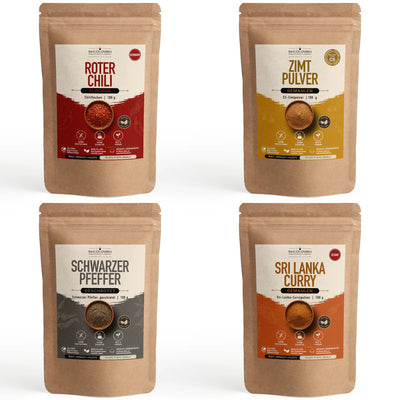
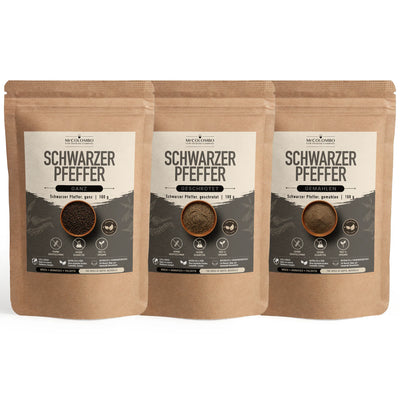





Spiced butter is a whipped blend of butter and seasoning ingredients, known in professional terms as beurre composé. Making it yourself means kneading soft butter with ground spices, shaping it into a log and chilling it. The ratio is 125 g of butter to 1 to 2 tablespoons of spice mix, with a resting time in the fridge of at least four hours. Butter is around 80 per cent fat (DGE, 2023), which makes it an excellent carrier for aroma compounds, almost all of which are fat-soluble.
What most recipes online leave out are precisely the two points that decide the result: spice quality and shelf life. Neither is a minor matter, because a Foodwatch laboratory test in 2026 found pesticides banned in the EU in 45 of 64 samples of rice, spices and tea. We import cinnamon, pepper and turmeric directly from smallholder farmers in Sri Lanka and know how differently two spoonfuls of ground cinnamon can taste. That is why you get five fully worked-out variations here, along with the question of origin and the storage rules that can be derived from the German Federal Institute for Risk Assessment's guidance on home-made herb oils.
Short answer
How do you make spiced butter yourself? Bring 125 g of butter to room temperature, beat it until creamy with 1 to 2 tablespoons of ground spices and a pinch of salt, roll it up in baking parchment into a log and chill for at least four hours. With ingredients that contain no fresh herbs or garlic, it keeps in the fridge for around five to seven days, and frozen for around three months. With fresh garlic or fresh herbs, the rule is: keep it chilled at all times and use it up within two to three days. For comparable herb oils, the BfR (2016) explicitly advises against making them in advance to keep in stock.
At a glance
What is spiced butter and why does butter carry aromas so well?
Spiced butter is a whipped blend of butter and dry or fresh seasoning ingredients, known in French cuisine since the 19th century as beurre composé. Antonin Carême and Auguste Escoffier codified the technique, the maître d'hôtel butter made from parsley, lemon and salt is regarded as the original form, and the German-language Würzbutter goes back to the Restaurant du Coq d'Or in Geneva in the 1930s. What was once a niche has long since become a mass market: according to a commercial market analysis by Growth Market Reports, the global market for compound butter stood at 1.54 billion US dollars in 2025 and is expected to grow to 2.63 billion by 2034, with herb butter forming the largest single segment.
In Germany, per-capita butter consumption rose in 2025 to 5.6 kilograms, an increase of 250 grams on the previous year (BLE, 2026), and the ButterTok trend on TikTok, running since 2023, is visibly shifting demand towards premium and flavoured butters.
That butter of all things is the best carrier for spices has chemical reasons. Technically speaking, it is a water-in-fat emulsion: the fat forms the continuous phase, with tiny water droplets distributed within it. Harold McGee describes in "On Food and Cooking" (2004) how butters with a higher fat content develop more intense, nuttier aromas when heated. Roberts, Pollien and Watzke (2003) also showed in the Journal of Agricultural and Food Chemistry that the vast majority of aroma molecules are lipophilic, meaning they dissolve preferentially in fat rather than in water. Cinnamaldehyde from cinnamon, piperine from pepper and curcumin from turmeric all belong to this group. In water they remain largely undissolved and therefore flat in flavour; in butter with around 80 per cent fat they disperse completely. This is exactly why the Ayurvedic tradition of roasting spices in ghee has worked for thousands of years.

How do you make spiced butter yourself, step by step?
Making spiced butter yourself needs neither a mixer nor any special equipment: the basic technique is identical in every professional kitchen and consists of five steps, four of which together take ten minutes. The fifth, the resting time in the fridge, takes at least four hours and makes the difference between floury and rounded. As a rule of thumb, the US food magazine Saveur gives one stick of butter to 1 to 2 tablespoons of mix-ins, which corresponds to the 125 g that is standard in Germany. With the butter itself, it is worth looking at the fat content: butter is around 80 per cent fat (DGE, 2023), the rest is essentially water. The higher the fat content, the less water the butter brings in, and it is precisely this water content that decides whether the finished log slices cleanly or crumbles.
Spiced butter in five steps
Temper the butter. Take 125 g of butter out of the fridge at least 60 minutes before preparation, until it yields to finger pressure but does not shine or sweat. Butter that is too warm separates; butter that is too cold cannot be mixed through.
Beat until creamy. Beat the tempered butter with a fork or a hand mixer for about a minute until creamy. A hand mixer only pays off from around 250 g; below that, a fork is enough.
Work in the spices. Add 1 to 2 tablespoons of spice mix and a good pinch of salt and work them in evenly until no dry pockets are visible.
Shape into a log. Roll the mixture in baking parchment into a cylinder around four centimetres in diameter and twist the ends like a sweet wrapper.
Chill and let it infuse. Leave to rest for at least four hours, better overnight, at 4 to 7 degrees Celsius. Then cut into discs five millimetres thick.
What decides the flavour of a spiced butter is the resting time of at least four hours. Ground spices need several hours to release their aroma compounds into the fat phase. Why this works at all was shown by Roberts, Pollien and Watzke (2003) in the Journal of Agricultural and Food Chemistry: how quickly and how strongly an aroma compound is released from a fat-continuous phase depends directly on the type of fat and on the hydrophobicity of the aroma molecule. A freshly mixed spiced butter therefore still tastes floury, with the spices standing individually side by side. After a night in the fridge, the same mixture tastes rounded and cohesive. If you are in a hurry, you can put the log in the freezer for 45 minutes, but that only gains you firmness for slicing, not aroma.
Our approach at MrCOLOMBO
We grind pepper and cinnamon only just before kneading. Whole Ceylon cinnamon sticks and whole peppercorns retain their volatile aroma compounds considerably longer than pre-ground products; more on this in our article on storing spices properly.
Which 5 spiced butter variations are really worth it?
All five of the following spiced butter recipes start from 125 g of butter and follow the modular principle: same basic technique, different seasoning. They deliberately cover different fields of use, from steak butter to a rice accompaniment to a sweet breakfast variation. The quantities are starting values that you can fine-tune after the first slice.
1. Ceylon pepper and garlic butter for steak and grilled vegetables
The Ceylon pepper and garlic butter is the classic in the tradition of maître d'hôtel butter. Knead 125 g of butter with 1 level teaspoon of coarsely cracked black pepper, 2 finely chopped garlic cloves, 2 tablespoons of chopped parsley, a teaspoon of lemon juice and half a teaspoon tip of salt. The pepper makes the difference here: the Sri Lanka Export Development Board (2026) describes Ceylon pepper as particularly rich in piperine. The island, however, covers only around 2 to 2.5 per cent of global demand. Piperine is the substance behind the heat, and because it is fat-soluble, it disperses particularly evenly in butter. The berries are harvested by hand as soon as the first ones on the spike turn from green to red, and are then dried in the sun until the skin is black and wrinkled. Because the Ceylon pepper and garlic butter contains fresh garlic, it must be kept in the fridge at all times and should be used up within two to three days.
2. Curry, turmeric and pepper butter for rice, fish and roasted vegetables
The most aromatically dense and technically the most interesting is the curry, turmeric and pepper butter. For 125 g of butter you need 2 teaspoons of Sri Lanka curry powder, half a teaspoon of turmeric, a quarter teaspoon of freshly ground black pepper and a pinch of salt. Toast the spices beforehand for 30 seconds in a dry pan over medium heat until fragrant, and let them cool completely. Curcumin, the yellow pigment in turmeric, is practically insoluble in water, reaching values there of only around 11 ng/ml (Stohs et al., 2020), but dissolves well in fat. In a small human study with three participants (Khajeh pour et al., 2023), black pepper extended the half-life of curcumin from 2.2 to 4.5 hours. The amount excreted in urine within 24 hours rose from around 49 to 218 micrograms.
The combination of turmeric, black pepper and fat is not a kitchen myth but measurable. As early as 1998, Shoba and colleagues measured a 20-fold increase in bioavailability in healthy volunteers after a single dose of 2 grams of curcumin plus 20 milligrams of piperine. These study doses, however, are far above what half a teaspoon of turmeric and a pinch of pepper in a butter log deliver, so the order of magnitude cannot be transferred to the kitchen. For cooking, it simply means: if you use turmeric, add pepper and a fat, otherwise the pigment stays largely undissolved and the butter tastes flat. Another practical effect: the toasted curry blend binds in the butter instead of clumping during cooking. One disc on hot basmati rice or on steamed cauliflower is enough for two portions. If you are interested in the composition of a Ceylonese curry blend in more detail, you will find it in our Sri Lanka curry recipe.
3. Ceylon cinnamon and honey butter for breakfast and baked goods
Things turn sweet with the Ceylon cinnamon and honey butter, the only breakfast variation of the five. Mix 125 g of butter with 1 teaspoon of ground Ceylon cinnamon, 2 tablespoons of runny honey, a pinch of salt and optionally a quarter teaspoon of vanilla. Stir in the honey last and only until it is incorporated, otherwise the mixture becomes tough and is hard to slice later. On warm toast, plaited brioche, pancakes or baked pumpkin it is unbeatable, and because it contains only dried spices, it keeps in the fridge for five to seven days and frozen for around three months. It is not suitable for children under twelve months because of the honey, as honey can contain spores of Clostridium botulinum. This restriction applies regardless of how fresh the honey is or whether it has been heated.
With cinnamon butter, the type of cinnamon decides the coumarin load. The Austrian AGES (2024) measures coumarin levels in Ceylon cinnamon of up to 185 mg/kg, but in cassia cinnamon 1,880 to 3,260 mg/kg, roughly 10 to 17 times as much. Coumarin is a natural aroma compound for which the EFSA (2004) derived a tolerable daily intake of 0.1 milligrams per kilogram of body weight. The BfR and the AGES have worked with this value ever since. For a person weighing 70 kilograms, that is 7 milligrams a day. One teaspoon of cassia cinnamon of around 2.5 grams can use up this value on its own; the same amount of Ceylon cinnamon stays below one milligram. So if you eat cinnamon butter regularly, you are considerably more relaxed with true Ceylon cinnamon (Cinnamomum verum). The tolerable intake is not a limit above which something happens, but a lifelong tolerable daily average; exceeding it once is uncritical, exceeding it permanently is not.
| Type of cinnamon | Coumarin content | 1 tsp (2.5 g) contains | Share of TDI at 70 kg |
|---|---|---|---|
| Ceylon cinnamon (Cinnamomum verum) | up to 185 mg/kg | up to 0.46 mg | around 7 per cent |
| Cassia cinnamon | 1,880 to 3,260 mg/kg | 4.7 to 8.2 mg | 67 to 116 per cent |
According to the Sri Lanka Export Development Board (2026), around 90 per cent of true Ceylon cinnamon comes from Sri Lanka; since 2022, Ceylon Cinnamon has been registered EU-wide as a protected geographical indication under Regulation (EU) 2022/144. Our bark comes from the central region of the island, where humid, warm coastal air and sandy soils produce the thin, multi-layered rolled quills by which true cinnamon is instantly recognisable. It is harvested by hand: the peelers cut the shoots, which are around two years old, remove the outer bark and scrape out the inner bark layer, which curls up on its own into the characteristic quills as it dries. We have broken down the full comparison of Ceylon cinnamon versus cassia cinnamon separately.

4. Chilli and lemongrass butter for fish and wok dishes
Asian-inspired is the chilli and lemongrass butter; chilli and lime combinations have been a perennial favourite for years in cooking communities such as the subreddit r/Cooking, although there is no robust numerical evidence for this. For 125 g of butter, take 1 teaspoon of chilli flakes, 1 level teaspoon of lemongrass powder, the grated zest of half an organic lime, 1 tablespoon of chopped coriander and salt. Lemongrass brings a citrusy freshness that, unlike lime juice, introduces no water into the emulsion and therefore does not make the butter separate. Our chilli flakes from Sri Lanka are processed with few seeds and deliver a medium, non-stinging heat. It melts superbly over pan-fried salmon, prawns or fried rice noodles. Because the chilli and lemongrass butter contains two fresh ingredients in the coriander and lime zest, it must be kept in the fridge at all times and should be used up within two to three days.
5. Cardamom and orange butter for desserts and pastries
The most delicate of all five variations is the cardamom and orange butter, inspired by the Ayurvedic tradition of binding spices in ghee. Mix 125 g of butter with half a teaspoon of freshly crushed green cardamom, the grated zest of an organic orange, 1 tablespoon of icing sugar and a pinch of salt. Only open the cardamom pods just beforehand. The essential oil sits exclusively in the black seeds and evaporates within minutes once the pod has been cracked open. It goes on milk rolls, into semolina pudding, on baked apricots or as the fat component in a sponge batter. Half a teaspoon of cardamom corresponds to around eight to ten pods, which is enough for a whole log. Because the cardamom and orange butter contains fresh orange zest, it must be kept in the fridge at all times and should be used up within two to three days. It is only partly suitable for freezing, because the citrus zest loses a good deal of its aroma on thawing.
Transparency note
We do not stock cardamom or lemongrass. So we do not cover variations 4 and 5 with a product of our own. If you are looking for the rest of the spice palette, you will find the selection in our range of spices from Sri Lanka.
Why does spice quality decide the flavour?
With spiced butter there is nowhere for poor-quality produce to hide. In a sauce, mediocre pepper disappears between wine, stock and cream; in cold butter it stands there naked. The same applies to contaminants: a laboratory test by Foodwatch (2026) found pesticides banned in the EU in 45 of 64 samples of rice, spices and tea examined, with cumin and paprika among those affected, and Öko-Test (2022) detected mineral oil components and pesticides in turmeric powder. For a product that ends up uncooked and concentrated on bread, that is relevant. For dried black pepper, the FSSAI specification that the Spices Board India carries in its quality guidelines therefore sets a moisture ceiling of 13 per cent, because above that there is a risk of mould. Which other criteria count when buying is covered in our article on the quality of black pepper.
Butter as the base ingredient deserves the same scrutiny as the spices. In 2023 Stiftung Warentest tested 30 butter brands and awarded the grade "good" 24 times, with own-label brands sometimes on a par with branded products. Öko-Test came to a stricter verdict in 2022: 19 of 20 butters tested contained mineral oil components of the MOSH group, only a single product scored "good", and 17 failed with "poor" or "inadequate". For spiced butter we recommend a sweet cream butter with at least 82 per cent fat, because it brings in less water and the log therefore slices more firmly. Cultured butter brings a slight acidity that goes well with the cinnamon and honey variation but clashes with the curry butter. If you want to avoid lactose, you can switch to clarified butter, in which water and milk protein have largely been removed, but you must then expect a firmer, less spreadable consistency.
Two spoonfuls of ground pepper, a year old and from the supermarket shelf, taste of dust in cold butter. Freshly cracked highland pepper tastes of resin, citrus and warmth. The difference is there in the first bite.
MrCOLOMBO experience report
MrCOLOMBO's spices come from three regions of Sri Lanka: pepper from the central highlands around Kandy and Matale, cinnamon from the humid central region near the south-west coast, turmeric and chilli from the drier north around Jaffna. We buy directly from smallholder farmers and know every stage of the supply chain personally, from the harvest to the drying area to the container. Turmeric is lifted eight to ten months after planting, when the foliage yellows; the rhizomes are then boiled, dried in the sun and only ground shortly before dispatch.
According to figures from the Sri Lanka Export Development Board (2026), Sri Lanka's spice exports in 2025 stood at around 449.9 million US dollars, with cinnamon alone accounting for around 58 per cent of that. As a state export agency, the Board has an economic stake, so its figures should be read as the industry's own statements.
Direct import saves not only middlemen but above all time: the shorter the chain, the fresher the essential oils. How that works in practice is described in our article on Spices from Sri Lanka.
Checklist for buying spices
Is the origin named specifically? "Sri Lanka, Matale region" is a statement, "EU/non-EU" is not.
Is there a grinding date or harvest year on the pack? Ground spices lose a great deal of aroma within six to twelve months.
Does the spice smell immediately on opening? If you have to hold the tin to your nose to notice anything, you have old stock.
Is the cinnamon rolled thin and in multiple layers? Then it is Ceylon cinnamon. Thick, hard, single-rolled bark is cassia.
Do you buy whole instead of ground wherever possible? Whole peppercorns and quills keep their aroma many times longer.
How long does home-made spiced butter keep?
The shelf life of home-made spiced butter depends entirely on which ingredients go into it. Pure dried-spice variations such as the curry and turmeric or the cinnamon and honey butter keep in a closed container in the fridge for around five to seven days and frozen for around three months. As soon as fresh ingredients are added, meaning garlic, fresh herbs, citrus zest or onions, things become more delicate.
The German Federal Institute for Risk Assessment advises in its communication 001/2016 against making and storing herb oils and vegetables preserved in oil in advance in private households, because home methods cannot reliably prevent toxin formation by Clostridium botulinum. The reason is a low-oxygen, moist environment in which the germ can multiply. Spiced butter with fresh ingredients is not a herb oil, but it follows the same principle: make small batches, keep chilled at all times, use up quickly. The BMEL leaflet on kitchen hygiene additionally recommends keeping all preparations covered in the fridge.
Important
For spiced butter with fresh garlic, the rule is: never store at room temperature, not even overnight. Morse and colleagues documented in 1990 a botulism outbreak caused by an unrefrigerated garlic-in-oil product, in whose remains high concentrations of Clostridium botulinum were detected. Solomon and Kautter had already shown in 1988 that five spores per gram are enough for bottled chopped garlic to form toxin at room temperature over 75 days, without its appearance or smell becoming noticeable.
The BfR describes in its botulism FAQ (2025) non-specific initial symptoms such as nausea and vomiting, followed by double vision and speech disorders. For the same reason, the following applies to the cinnamon and honey variation: honey does not belong in the diet of children under twelve months, because it can contain spores of Clostridium botulinum. This article is for information purposes and is no substitute for medical advice.
The botulism risk with spiced butter containing fresh ingredients is easy to avoid in practice. The Extension Service of Oregon State University (2013) recommends for herbs and garlic in fat either acidification or immediate consumption with continuous refrigeration below 7 degrees Celsius. For everyday life, this means: make garlic and herb butter only in small quantities and use it up within two to three days, or freeze it in portions straight away. To do this, cut the log into discs before freezing and place baking parchment between the slices, so that you can take them out individually. Dried spices, unlike fresh ingredients, introduce hardly any water and are therefore the longer-keeping choice. But the reverse also applies: no spice preserves a butter log. If you want to be on the safe side, always calculate the shelf life according to the most perishable ingredient.

Which spiced butter goes best with what?
Each of the five spiced butter variations has a clear field of use, and the timing when serving makes a difference. According to McGee (2004), butterfat does not melt at a fixed temperature but over a range of around 32 to 35 degrees Celsius, which is just below the temperature of a steak ready to serve. A cold disc on hot food therefore melts over about 30 seconds and releases its aroma in stages, whereas butter stirred in warm disperses immediately and loses its aroma peak. For steak and grilled vegetables, the rule is: place the disc on top only after resting, not during frying. With rice and roasted vegetables the opposite works, there the butter may be folded in. The overview in the following table summarises what has proven itself in our kitchen, including the realistic shelf life in the fridge for each.
| Variation | Goes with | Fridge | Freezable |
|---|---|---|---|
| Ceylon pepper and garlic | Steak, grilled vegetables, baguette | 2 to 3 days | Yes |
| Curry, turmeric and pepper | Rice, fish, roasted vegetables, lentils | 5 to 7 days | Yes |
| Ceylon cinnamon and honey | Toast, plaited brioche, pancakes, pumpkin | 5 to 7 days | Yes |
| Chilli and lemongrass | Salmon, prawns, rice noodles, corn | 2 to 3 days | Yes |
| Cardamom and orange | Milk rolls, semolina pudding, pastries | 2 to 3 days | Partly |
A portion of spiced butter can be calculated precisely. The German Nutrition Society (2023) lists butter at around 750 kilocalories per 100 grams as a very energy-dense food and gives 60 to 80 grams of total fat per day as a guide. A disc five millimetres thick from a log four centimetres in diameter weighs around six grams and therefore provides about 45 kilocalories. A log made from 125 g of butter yields around 20 such discs, so depending on the dish it is enough for six to ten portions. Precisely because spiced butter tastes so intense, you need less of it than of plain butter. You will find suitable spices for all variations with us as black pepper, Ceylon cinnamon and turmeric.
Is home-made spiced butter worth the effort?
Home-made spiced butter is worth the effort for three reasons. Firstly, preparation takes ten minutes of active work; the rest is waiting time in the fridge. Secondly, from a technical point of view butter is the best carrier for spice aromas, because practically all the relevant aroma compounds are fat-soluble and butter is around 80 per cent fat (DGE, 2023). Thirdly, you decide for yourself what quality goes in, which, given the pesticide findings by Foodwatch (2026) and the coumarin levels in cassia cinnamon of 1,880 to 3,260 mg/kg (AGES, 2024), is no side issue. The most important rule remains chilling: as soon as fresh garlic or fresh herbs are involved, the log belongs in the fridge at all times and on your bread within a few days. If you start with whole spices and grind them fresh, you will taste the difference from the very first disc.