








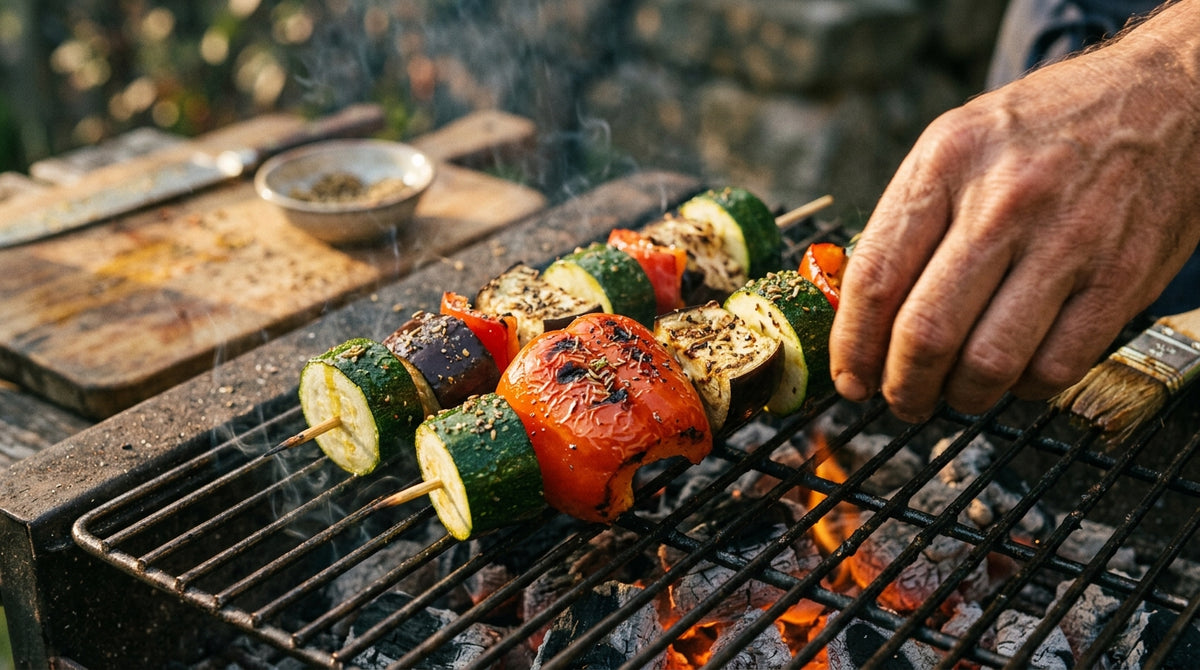
Grilled vegetables are seasoned in two steps: before grilling, only oil, salt and coarse spices; after grilling, the fine aromas such as fresh herbs, lemon and ground pepper. The reason is measurable: essential oils from spices react very differently to temperatures of up to 180 degrees Celsius, and their chemical composition demonstrably changes in the process (Tomaino et al., 2005). Anyone who sprinkles everything on beforehand therefore loses exactly the notes they actually want to taste. Added to this is a safety argument that hardly any barbecue guide mentions: a marinade with red grape vinegar reduced the formation of the four most important polycyclic aromatic hydrocarbons (PAH4) in grilled vegetables by 75 per cent, cider vinegar by 68 per cent, lemon juice by 52 per cent (Kacmaz Ozcetin and Artok, 2025). Acid is therefore not just flavour, but the most effective lever against unwanted grilling compounds. In practice, this means: two tablespoons of vinegar or the juice of half a lemon in the oil marinade, coarse spices before the grate, fine aromas only afterwards on the hot vegetables.
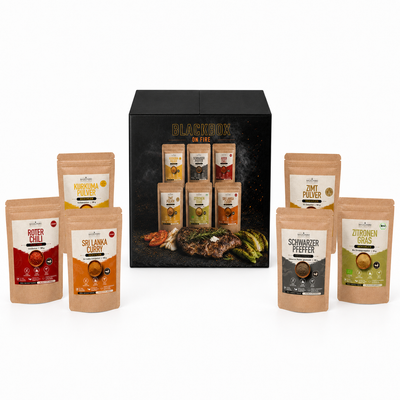
What is almost always missing from German barbecue articles is the question of the origin of the spices. It is not a detail for gourmets, but a question of quality: in 2025, Öko-Test examined a total of 21 varieties of pepper and awarded the grade "good" to only five organic products; mineral oil components (MOSH) were detected in several samples, and in one brand even MOAH. When grilling, every gram of spice goes directly onto hot vegetables and into the mouth, without being diluted by sauce or stock. That is exactly why, with barbecue spices, a look at the growing region is more worthwhile than with any other cooking process. We at MrCOLOMBO import directly from smallholders in Sri Lanka, without intermediaries, and know every stage of the supply chain personally. The pepper that goes over our grilled vegetables grows in the districts of Matale, Kandy, Kegalle and Kurunegala on around 32,800 hectares (Sri Lanka Export Development Board), in the warm, humid hill country between the Central Province and the north-west, where two monsoon seasons a year provide the necessary rainfall.
Short answer
How do you season grilled vegetables properly? Before grilling, oil, salt and coarse, heat-stable spices such as cracked pepper, cumin or paprika go onto the vegetables; after grilling, the heat-sensitive aromas: fresh herbs, lemon or vinegar acidity and finely ground pepper. Water-rich varieties such as aubergine and courgette are pre-salted for 20 to 30 minutes so that osmosis draws water out of the cells, the sponge-like structure collapses and oil absorption during frying decreases (McGee; Compound Interest, 2018). An acidic marinade additionally reduces PAH formation by up to 75 per cent (Kacmaz Ozcetin and Artok, 2025).
At a glance
Why do grilled vegetables need different seasoning from meat?
Vegetables and meat react completely differently to grilling heat, and that has direct consequences for seasoning. Meat brings its own fat and plenty of protein, it holds on to spices and withstands long cooking times. Vegetables, by contrast, consist largely of water, have hardly any fat of their own and are often done in two to four minutes per side. Dry spices simply find no grip on a wet slice of courgette and slide off when it is turned. That is why fat counts as a carrier: in grilling practice, vegetables, cheese and tofu are brushed with oil before being placed on the grate so that the surface neither dries out nor burns. The oil performs three tasks at once: it transports fat-soluble aroma compounds from the spice to the surface, distributes the heat more evenly and prevents sticking to the grate. Without this layer of fat, even the best spice remains decoration that ends up on the grate at the first turn. One to two tablespoons of oil per kilogram of vegetables are perfectly sufficient for this.
When it comes to nutrient content, vegetables react differently on the grill than in the pot. A review of 22 vegetable varieties from 18 studies from the years 2017 to 2022 shows that almost all cooking methods reduce total antioxidants, polyphenols and vitamin C (Kosewski et al., 2023). How strongly depends heavily on the method: vitamin C loss is between 33 and 95 per cent for frying, between 6 and 93 per cent for boiling and between 5 and 92 per cent for steaming (Khatun et al., 2019). When it comes to grilling, one point clearly speaks in favour of the grate. In a study of 20 vegetable varieties, grill-like contact methods, microwaving and baking caused the lowest antioxidant losses, while boiling and pressure cooking performed worst (Jiménez-Monreal et al., 2009). For vegetables, grilling is therefore not a makeshift solution but one of the gentler preparation methods, as long as they do not char. The German Nutrition Society recommends three portions of vegetables and two portions of fruit daily, together around 650 grams. Anyone who puts some of that over the grill in summer loses less than the worry about "grilled-to-death" vegetables would suggest.
Barbecue habits in Germany have shifted towards vegetables. In a survey with 504 participants, meat with 56 per cent, vegetables with 38 per cent and grilling cheese with 33 per cent took the top spots, and 22 per cent of respondents wanted to put more plant-based alternatives on the grill in future (epap, 2023). According to an industry report, people barbecue around 1.6 billion times a year in Germany. Vegetables are thus no longer the side dish pushed into the corner of the grate between the bratwurst and the neck steak. Anyone who treats them as a dish in their own right must also season them in their own right, instead of simply adopting the meat seasoning. That is exactly where the most common mistake lies: classic barbecue spice blends are designed for fat, salt and long cooking times and quickly taste overpowering on a tender slice of courgette. A good vegetable blend therefore relies on less salt and more aromatic seeds. We show you how to build your own blend in the article Making barbecue spices yourself.

What happens to spices and aromas during grilling?
From around 140 degrees Celsius, the Maillard reaction starts on the surface of the vegetables, in which hundreds of different aroma compounds are formed from amino acids and sugars (McGee). This is the reaction that gives a grilled pepper its nutty depth and a corn cob its caramel note. Spices, however, do not come through this heat unscathed. A study of essential spice oils at temperatures of up to 180 degrees Celsius showed clearly different reactions: nutmeg oil was the only one of the oils tested that was actually a stronger radical scavenger after heating than before, while basil, cinnamon, clove, oregano and thyme changed measurably in their composition (Tomaino et al., 2005). In practical terms, this means: coarse, resinous and seed-based spices such as cumin, coriander seeds, cracked pepper or paprika may go onto the vegetables before grilling. Fine, volatile aromas from fresh basil, parsley or finely ground pepper, on the other hand, evaporate in the smoke and belong only after grilling. Anyone who is unsure can test the rule on a single sprig of rosemary: directly over the embers, it burns to ash in under a minute.
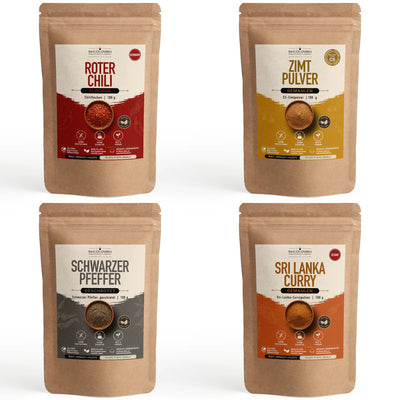
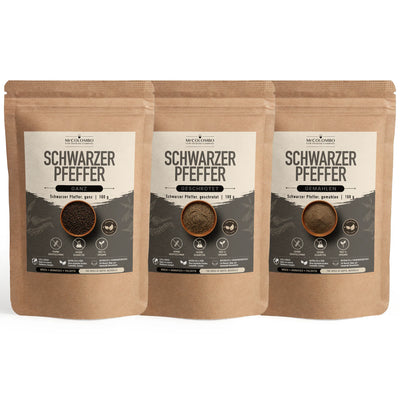
Grain size helps decide whether a spice survives the grilling heat. Finely ground pepper has a many times larger surface area per gram than cracked pepper and loses its volatile components correspondingly faster; it also burns more easily on the grate and turns bitter. Cracked corns, by contrast, release their aroma more slowly and stay stuck to the surface in the oil marinade. A second, often overlooked effect: in a study on grilled vegetables, black pepper itself reduced PAH4 formation by 30 per cent, garlic powder by 34 per cent (Kacmaz Ozcetin and Artok, 2025). On the grill, spices are therefore not only flavour carriers but part of the chemical protective layer. We have summarised what you should look for in the quality of peppercorns in Black pepper quality. That is why our Ceylon pepper is available whole, cracked and ground: for the grate, the cracked version is the safest choice, for the plate afterwards, the freshly ground one.
Why grain size of all things makes such a difference is explained by the chemistry of the peppercorn. The heat comes from the alkaloid piperine, which in black pepper lies between 2,531 and 8,073 milligrams per 100 grams, on average around 4,418 milligrams (Lee et al., 2021). Piperine is not volatile and survives the grilling heat largely unchanged. The scent, by contrast, comes from the essential oil, which consists of 47 to 64 per cent monoterpene hydrocarbons and 30 to 47 per cent sesquiterpenes; in the corn, beta-caryophyllene dominates with 37.4 per cent, limonene with 13.4 per cent and delta-3-carene with 11.5 per cent (Nurjanah et al., 2025). It is precisely these terpenes that evaporate first. Anyone who grinds pepper finely and sprinkles it over the vegetables opens up millions more cut surfaces from which the aroma escapes, while the heat remains. This produces the typical effect: the vegetables taste hot, but smell of little.
Why does oil go onto the vegetables before the salt?
The order of seasoning is not a ritual, but physics. Salt draws water from the vegetable cells to the surface by osmosis. If it lands first on a dry slice, a film of water forms there that slows down the Maillard reaction, because the surface first has to dry again before it gets above 140 degrees Celsius. Oil applied first partially seals the surface, then distributes the salt more evenly and ensures direct heat contact with the grate. With water-rich vegetables such as aubergine, the reverse route is nevertheless sensible; there, you deliberately salt first and wait, because the loss of water makes the sponge-like cell structure collapse. After around 30 minutes of salting time, this effect is fully developed and oil absorption during frying drops noticeably (McGee; Compound Interest, 2018). Only then is the oil added, otherwise it seals exactly the pores through which the water is supposed to escape.
When do you season grilled vegetables: before, during or after?
The most effective technique from grilling practice contradicts what most people do: hot vegetables absorb aromas much better than raw ones. Instead of marinating courgette and peppers for hours beforehand, in recipe practice the vegetables are doused with a mixture of oil, lemon juice, garlic and herbs straight off the grate while still hot (recipe site RecipeTin Eats). The reason lies in the cell structure: the heat has broken open the cell walls, the vegetables give off steam and literally draw in the marinade as they cool. With raw vegetables, on the other hand, a marinade hardly penetrates deeper than one to two millimetres. In its marinade test for fish and meat, Stiftung Warentest specifies a minimum marinating time of one hour and confirms that acid from vinegar, lemon juice or wine makes the texture tender (Stiftung Warentest, 2023). Both routes can be combined: a short oil-salt marinade beforehand, an aromatic acid-herb marinade afterwards. In practice, that costs five minutes of preparation before lighting up and two minutes when the vegetables come off the grate.
| Timing | What goes on | Why | Heat-stable |
|---|---|---|---|
| 20-30 min beforehand | Salt on aubergine and courgette | Osmosis draws water out, the sponge-like structure collapses | Yes |
| Just before the grate | Oil, cracked pepper, cumin, paprika | Fat as an aroma carrier, coarse spices survive the heat | Yes |
| At least 1 hr beforehand | Acid marinade with vinegar or lemon | Reduces PAH formation by up to 75 per cent, makes the texture tender | Yes |
| Straight after the grate | Fresh herbs, lemon, fine pepper, chilli flakes | Volatile aromas are preserved, hot vegetables soak them up | No |
A common mistake when pre-marinating concerns the amount of oil. If fatty marinade drips into the embers, exactly the smoke gases you want to avoid are produced, because polycyclic aromatic hydrocarbons also form with vegetables when marinade drips into the embers or when peppers, mushrooms and aubergine char (BfR). The solution is simple: let the vegetables drain briefly before placing them on the grill, wipe off excess marinade with the brush and rather re-oil once more in the second half of grilling. Anyone who works with a grill tray or a vegetable basket avoids the problem entirely and can even add coarsely cracked pepper only in the last two minutes, without anything falling into the embers. That saves spice and protects the volatile aromas that would otherwise end up in the smoke. Whether you use a ready-made blend or individual components for this is a question of control over the result, which we compare in detail in the article Spice blends or single spices.
Which spices go with courgette, aubergine and peppers?
Courgette brings little flavour of its own and therefore tolerates strong companions. Olive oil with garlic powder, salt and cracked pepper before grilling has proven itself, followed by fresh herbs and lemon juice, at one to three minutes per side on the preheated grill. Aubergine works differently: its flesh is sponge-like and soaks up oil, which is why pre-salting for 20 to 30 minutes makes the decisive difference. After that, Mediterranean notes with oregano and thyme suit it just as well as a yoghurt tandoori marinade of turmeric, coriander, chilli and cumin, which should be left to soak in for at least two hours. Peppers are the surprise winner in the nutrient comparison: during contact grilling, the total polyphenols in green peppers rose from 2.75 to 15.43 milligrams GAE per gram, in red ones from 17.26 to 23.56 milligrams, an increase of 36 per cent, while firmness decreased by 69 to 93 per cent (Olędzki and Harasym, 2023).
Not every constituent survives the grate. The luteolin content in green peppers fell from 46.00 to 29.96 milligrams per kilogram fresh weight through grilling, i.e. by around 35 per cent (Durucasu and Tokuşoğlu, 2007). That is not an argument against grilling, but one for short cooking times and medium heat. Anyone who still wants to sear peppers hard for the aroma cuts them into large pieces instead of strips so that the ratio of surface area to volume stays smaller. As for the spices, the same basic rule applies to all three varieties: a maximum of three to four components per vegetable, otherwise the profiles overlap. A good Mediterranean base consists of olive oil, garlic, oregano and cracked pepper, a warm and spicy alternative of oil, cumin, paprika and a pinch of Ceylon cinnamon. Save the squeeze of lemon for the plate so that the acid does not boil away on the grate.
You smell the difference before you taste it: coarsely cracked pepper develops a warm, resinous note on hot slices of aubergine, while finely ground pepper burns on the same grate within seconds and turns bitter. On the grill, it is not the amount of spice that decides, but the timing.
MrCOLOMBO experience report
Does Ceylon cinnamon go with savoury grilled vegetables?
In Germany, cinnamon is regarded as a baking spice; in Sri Lanka, it naturally belongs in savoury curries. On the grill, it comes into its own above all with sugar-rich vegetables such as sweet potato, corn and pumpkin, because it prolongs the caramel notes of the Maillard reaction instead of masking them. The variety is decisive: true Ceylon cinnamon (Cinnamomum verum) grows almost exclusively in Sri Lanka and holds around 90 per cent of the world market share for true cinnamon, graded by quill diameter into the classes Alba, Continental, Mexican and Hamburg (Sri Lanka Export Development Board). Its aroma is milder and more floral than that of the considerably sharper cassia variety found in many supermarket blends. A pinch is enough, because cinnamon asserts itself against almost everything. In practical terms, that means: a quarter of a teaspoon of ground Ceylon cinnamon to one kilogram of sweet potato wedges, combined with paprika and cumin. With courgette and mushrooms, on the other hand, it hardly fits at all, as there it masks the delicate natural aroma.

How do you season corn, sweet potato and mushrooms on the grill?
For corn, mushrooms and sweet potato, there is as yet no grill-specific body of research; here, general cooking principles apply rather than measured values. Corn contains a lot of starch and sugar, which is why the surface caramelises quickly while the inside is still raw. Two-stage cooking has proven itself: first pre-boil the cob for 8 to 10 minutes in salted water, then put it on the grate only for the roasted aromas. Seasoning follows after grilling; that is also the principle of Mexican elote, in which the finished hot cob is brushed with a mayonnaise, soured cream and cumin mixture, rolled in grated cheese and dusted with chilli powder (Food52; The Kitchn). Anyone who prefers it without soured cream uses butter, lime juice, chilli flakes and salt. The reason for the late seasoning is the same as with herbs: chilli powder burns on the grate and turns bitter. For pre-boiling, lightly salted water is sufficient; sugared water makes the kernels turn black considerably faster during grilling.
Mushrooms behave on the grill like a sponge that first gives off water and then absorbs aroma. Button mushrooms consist of over 90 per cent water (USDA FoodData Central), which escapes when heated and initially cools the surface. Anyone who salts them beforehand accelerates this water loss by osmosis (McGee) and ends up with tough, shrunken mushrooms. The reverse route is better: put them on dry, let them brown, and only then salt and season with rosemary-thyme oil or garlic butter. Sweet potato, in turn, needs pre-cooking, because under pure grilling heat it chars on the outside before it is soft on the inside. Ten minutes in salted water or eight minutes in the microwave are enough. After that, a marinade of orange juice and harissa suits it just as well as a warmer version with Ceylon cinnamon and paprika. For both varieties, the rule is: oil only after pre-cooking, otherwise the fat drips into the embers while the grill is still heating up. We classify which heat levels are suitable for this in the article Chilli varieties compared.
How do you avoid PAHs and acrylamide when grilling vegetables?
The idea that harmful substances only form with meat during grilling persists stubbornly and is not true. Polycyclic aromatic hydrocarbons also form with vegetables when marinade drips into the embers or when peppers, mushrooms and aubergine char, which is why the recommendation of the German Federal Institute for Risk Assessment is "golden, not charred" (BfR). Added to this is acrylamide, which forms from the amino acid asparagine and reducing sugars from as low as around 120 degrees Celsius and rises sharply between 170 and 180 degrees Celsius (BfR); the BfR MEAL study found sometimes high levels in heavily browned vegetable products. Both groups of substances form exactly where the visually coveted black edge from the barbecue videos comes from. The good news: both can be significantly reduced with simple steps, without giving up roasted aromas. The strongest lever is the marinade, the second strongest is temperature control, the third is the choice of grill zone. All three cost neither time nor money; they only change the order of the steps at the grate.
Important
Cut away black, charred patches on the vegetables generously and do not eat them. Let the marinade drain before placing the vegetables on the grill so that no fat drips into the embers, and finish cooking the vegetables in the indirect zone instead of directly over the embers. This article is for information purposes and does not replace medical or nutritional therapy advice.
An acidic marinade is the strongest single lever against harmful substances in grilled vegetables and yet appears in hardly any German-language barbecue guide. In a study on grilled vegetables, including potato, aubergine, bottle gourd, onion and peppers, a marinade with red grape vinegar reduced PAH4 formation by 75 per cent, cider vinegar by 68 per cent, lemon juice by 52 per cent, garlic powder by 34 per cent and black pepper by 30 per cent (Kacmaz Ozcetin and Artok, 2025). Translated into practice: two tablespoons of red wine vinegar or the juice of half a lemon in the oil marinade are more effective than any tongs technique. Anyone who additionally uses garlic powder and cracked pepper combines flavour with measurable protection. For temperature control, the rule is: first sear briefly over high heat for the grill marks, then finish cooking in the indirect zone, instead of leaving the vegetables over an open flame for minutes on end. As a rule of thumb, two to four minutes of direct heat per side apply; everything else belongs at the edge of the grate.
How do you recognise barbecue spices of good quality?
When grilling, the spice goes onto the food undiluted, which is why purity carries more weight here than when cooking. The test results are sobering: Öko-Test had 19 turmeric products tested, 16 failed, all 19 contained mineral oil components (MOSH), and only one product received the grade "very good". Of 34 kitchen herbs tested, 21 of them oregano and 13 marjoram, only a third of the oregano products received the grade "good", and three failed because of pyrrolizidine alkaloids (Stiftung Warentest). The reason almost always lies in the supply chain: long transport routes, mixed batches from different countries, storage in plastic containers and open transhipment points. The more intermediaries there are between field and jar, the more points there are at which contaminants can get in. That is exactly why traceability is not a marketing promise, but a quality criterion with a measurable effect. With ready-made blends for grilling, there is the added fact that salt and anti-caking agents often make up the largest share of the volume and the actual spice only a fraction.
How much processing plays a part is particularly evident with black pepper. The spikes are harvested when the first berries turn from green to yellowish red. After that, in many operations they are briefly dipped in hot water and then dried in the sun for several days until the water content is around 10 per cent and the plump berry has become the black, wrinkled corn. Only this removal of water makes the pepper storable. The later it is ground, the more essential oil is still in the corn, and that is exactly why we crack our pepper only shortly before dispatch instead of months in advance. A freshly opened jar smells resinous and citrusy; a two-year-old supermarket powder smells above all dusty. Anyone who puts both side by side on a slice of courgette needs no laboratory test to tell the difference. On the grill, that counts twice over, because here no sauce and no stock can mask a missing aroma.
Our approach at MrCOLOMBO
We import directly from smallholders in Sri Lanka, without intermediaries, and know every stage of the supply chain personally. The pepper comes from the highlands around Matale and Kandy, the Ceylon cinnamon from the central region, turmeric and chilli from the north around Jaffna. Read more in our article on the spices of Sri Lanka.
Checklist for buying barbecue spices
Is a specific growing region stated on the packaging? "Sri Lanka, Matale district" is a statement; "EU and non-EU agriculture" is not.
Is the spice available whole or cracked? Whole corns and coarse grinds lose their essential oils much more slowly than fine powder.
Does the blend smell of spice or of nothing? A strong scent on opening is the simplest freshness test there is.
Does the ready-made blend contain anti-caking agents, sugar or flavourings? With barbecue spices, the ingredient list is often longer than necessary; three to five ingredients are enough.
How is the spice stored? Dark, dry and tightly sealed, so that light and air do not break down the aromas.
One point belongs to honesty: not every popular statement about spices stands up to scrutiny. The frequently quoted figure according to which 20 milligrams of piperine from black pepper increase curcumin absorption by 2,000 per cent comes from a single study from 1998 with a small number of participants that has never been independently replicated (Shoba et al., 1998). More recent pharmacokinetic analyses show considerably more moderate effects. Quantity also plays a role: the EFSA sets the acceptable daily intake for curcumin at 3 milligrams per kilogram of body weight, which is around 210 milligrams at 70 kilograms (EFSA, 2010). For grilling practice, this simply means: turmeric and pepper belong together in the marinade because they go together in flavour, not because of a figure from a press release. Honest classification beats the catchier value here, precisely because such percentages get copied endlessly around the internet. How to store spices properly so that they keep this quality is explained in Storing spices properly.

What is the most important rule when seasoning grilled vegetables?
Seasoning grilled vegetables properly is not a question of the amount of spice, but of the order. Oil as a carrier, coarse heat-stable spices before the grate, acid in the marinade, fine aromas only on the finished hot vegetables. Anyone who pre-salts water-rich varieties such as aubergine and courgette for 20 to 30 minutes gets firmer slices and less oil absorption (McGee; Compound Interest, 2018); anyone who pre-cooks corn and sweet potato for 8 to 10 minutes prevents the typical combination of charred outside and raw inside. Anyone who follows the BfR principle "golden, not charred" and stays at two to four minutes of direct heat per side does not have to go without roasted aromas (BfR). Anyone who changes only one thing at the next barbecue should make it the acid: two tablespoons of red grape vinegar in the marinade reduce PAH4 formation by 75 per cent (Kacmaz Ozcetin and Artok, 2025) and at the same time make the texture tender. In the end, the biggest difference is made by the quality of what comes out of the jar: fresh, traceable and coarsely ground. Our entire range of spices from Sri Lanka is designed for exactly that.