




Making curry paste yourself means grinding fresh chillies, lemongrass, galangal, coriander and turmeric in a mortar or blender into an aromatic seasoning base. The difference between the three classics is quickly explained: red paste uses dried red chillies, green paste fresh green chillies and herbs, yellow paste plenty of turmeric and mild heat.
Anyone who has pounded their own paste once will taste the difference from ready-made products immediately. A home-made paste needs no preservatives, and you decide on every single ingredient. This is exactly where MrCOLOMBO comes in: we import turmeric, pepper and coriander directly from smallholder farmers in Sri Lanka and know every stage of the supply chain personally. This guide shows you all three pastes with exact quantities, the scientific background to each ingredient and honest quality tips.
Short answer
What distinguishes red, green and yellow curry paste? The colour reveals the main ingredient: red paste contains dried red chillies (medium heat), green paste fresh green chillies plus coriander leaves and Thai basil (hottest), yellow paste plenty of turmeric and only a little chilli (mild). All three share the aromatic foundation of coriander, lemongrass, galangal, garlic and shallots. According to the German Food Code (BMLEH), curry is not a legally fixed recipe but a blend based on turmeric.
At a glance
What is curry paste and how do red, green and yellow differ?
Curry paste is a moist seasoning blend of fresh and dried ingredients that serves as the flavour base for Thai curries. Unlike Indian curry powder, which the British colonial era established as a dry blend, Thai paste thrives on fresh aromatics. The German Food Code (BMLEH, guidelines for spices) defines curry as a ground blend of turmeric with fenugreek, cumin, coriander, pepper and other spices, but deliberately does not fix the exact composition. That explains why every region cultivates its own recipe.
The three basic pastes follow a clear logic. Red paste owes its colour to dried red chillies and sits at medium heat. Green paste only emerged in the early 20th century in central Thailand (onoffspices, historical source) and, thanks to fresh green bird's eye chillies, is the hottest of the three. Yellow paste, with plenty of turmeric and little chilli, is the mildest and, according to tastythaifood, shows a slight Indian influence. The global market for these pastes reached around 1.24 billion US dollars in 2024 and is growing by 6.1 per cent a year (Growth Market Reports, 2024).
| Feature | Red paste | Green paste | Yellow paste |
|---|---|---|---|
| Main chilli | dried, red | fresh, green | little, mild |
| Heat (1-10) | 6 | 8 | 3 |
| Lead spice | Chilli, galangal | Coriander leaves, basil | Turmeric |
| For beginners | Yes | No | Yes |

How do you make red curry paste yourself?
Red curry paste is the most versatile classic and the ideal starting point. The heat comes from dried red chillies, which you soak in warm water for ten minutes before pounding. This makes them supple and releases the aromas. Capsaicin, the pungent compound, binds to the TRPV1 channel of the nerve cells and simulates a heat signal there (Yang and Zheng, 2017). For an intense but not burning paste, allow around 8 to 10 dried chillies.
For roughly one jar you need: 10 dried red chillies (soaked), 4 shallots, 4 cloves of garlic, 3 stalks of lemongrass (only the white inner part), a thumb-sized piece of galangal, 1 teaspoon of coriander seeds, 1 teaspoon of cumin, 1 teaspoon of black pepper, the zest of half a lime and 1 teaspoon of salt. Briefly dry-roast the coriander, cumin and pepper until fragrant, then pound all the ingredients one after another, from hard to soft, into a paste.
If you have no whole dried chillies to hand, you can replace some of them with roasted chilli powder, which distributes the heat more evenly. If you like it authentic, stick with the mortar. You will find the right black pepper and the chilli in our chilli range. This red base goes with chicken, beef and robust vegetables and is the foundation of many dishes from our Sri Lanka curry recipe.
How does green curry paste succeed and why is it hotter?
Green curry paste is the hottest of the three variants because it is based on fresh green bird's eye chillies, which at full ripeness still carry their entire capsaicin content. The green colour is intensified by coriander leaves with root and Thai basil. It is precisely these herbs that also provide the aromatic foundation: coriander contains up to 74 per cent linalool in its essential oil (Talebi et al., 2024), which is responsible for the fresh, slightly lemony note.
For one jar you need: 8 fresh green chillies, 1 bunch of coriander with root, a handful of Thai basil, 3 shallots, 4 cloves of garlic, 3 stalks of lemongrass, a piece of galangal, 1 teaspoon of coriander seeds, 1 teaspoon of cumin, the zest of one lime and 1 teaspoon of salt. You control the heat by removing the chilli seeds, because that is where most of the capsaicin sits. Galangal is essential here and no substitute for ginger: Alpinia galanga shows a markedly higher antioxidant capacity than ginger (Na Nongkhai et al., 2024) and tastes more resinous and lemony.

Lemongrass is the Thai DNA of this paste. Its oil consists of around 79 per cent citral (Luang-In et al., 2024), the typical citrus aroma. Use only the tender white inner part of the lower half; the rest is too fibrous. If you are looking for fresh lemongrass, it is worth taking a look at our lemongrass range. Green paste harmonises wonderfully with fish, seafood and coconut milk.
How do you prepare mild yellow curry paste?
Yellow curry paste is the mildest and therefore the perfect introduction for anyone who does not like things too hot. Its bright colour comes from the curcumin in turmeric, which varies greatly depending on origin: Sri Lankan turmeric reaches 2.86 to 4.51 per cent curcumin (Senanayake et al., 2021), while geographical origin determines the content massively overall (Poudel et al., 2019). Fresh turmeric root gives the most intense colour, but high-quality powder is the practical alternative that is available all year round.
For one jar of yellow paste you mix: 3 dried red chillies (mild, soaked), 2 tablespoons of fresh turmeric or 1 tablespoon of turmeric powder, 3 shallots, 4 cloves of garlic, 2 stalks of lemongrass, a piece of galangal, 1 tablespoon of coriander seeds, 1 teaspoon of cumin, 1 teaspoon of curry powder and 1 teaspoon of salt. A little trick from science: black pepper contains piperine, which promotes the absorption of curcumin in the body. A review paper (Epelde, 2025) examined the combination of turmeric and piperine. That is why a pinch of pepper belongs in every yellow paste. You can read more about the yellow spice in our article Turmeric and its effects, and the right powder is available in the turmeric collection.
Mortar or blender - which gives the better aroma?
The traditional stone mortar produces a more intense aroma than the blender, and there is a physical reason for this. When pounding, the plant cells are broken open slowly so that the essential oils escape undamaged. A hand blender, on the other hand, generates frictional heat that partly destroys volatile aroma compounds such as the heat-sensitive citral in lemongrass. Experienced cooks at Thai markets pound a paste in 15 to 20 minutes, as authentic recipes describe (eatingthaifood).
Even so, the blender is not a mistake but a legitimate compromise for everyday life. If you are short of time, add a dash of neutral oil, blend in short bursts and let the appliance cool down in between. The result comes astonishingly close to the mortar. Our tip from experience: always dry-roast the whole spices first, whichever method you choose. Neither mortar nor blender can create that roasted aroma afterwards.
A good mortar is not a nostalgic tool. It is the best aroma instrument in Thai cooking, because it releases oils instead of burning them.
MrCOLOMBO experience report
How long does home-made curry paste keep?
Home-made curry paste keeps in the fridge for about two to three weeks if you cover it with a layer of oil (kochbar). Salt and the lime juice act as natural preservatives because they lower water activity and pH, thereby slowing the growth of microorganisms. The essential coriander oil additionally shows antimicrobial properties against various germs (Talebi et al., 2024). What matters is a clean, airtight jar and an always clean spoon.
Storing curry paste properly
Pour on a layer of oil? A thin layer of neutral oil on top of the paste keeps oxygen out and extends the shelf life.
Freeze in portions? Frozen in ice cube trays, the paste keeps for up to two months and is always portioned and ready to hand.
Use a clean jar? Sterilised jars and a clean spoon prevent germs from getting in in the first place.
For stocking up, freezing is the best method. Freeze the finished paste in ice cube trays and then store the cubes in a freezer bag. That way you always take out exactly the amount you need for a dish. It is no accident that this meal-prep idea is one of the strongest trends around home-made seasoning pastes.
Why is home-made paste better than shop-bought?
Home-made curry paste is better because you control the purity and origin of every ingredient. Ready-made products have repeatedly attracted negative attention here. As early as 2007, Stiftung Warentest found high levels of plasticisers in 18 of 25 Asian seasoning pastes; one Aldi curry paste even exceeded the limit for DINP by 165 times. More recent and weightier is the foodwatch laboratory report (2026): banned pesticides were found in 67 per cent of 64 spice samples tested.
Important
This article is for information purposes and does not replace medical advice. If you have health questions, consult your doctor or pharmacist. According to the DGE (2024), spices containing capsaicin should be used in moderation, as in large quantities they can irritate the stomach lining.
Shop-bought turmeric powder is not automatically clean either. An Öko-Test (2022) examined 19 turmeric products: all contained mineral oil hydrocarbons (MOSH), 16 exceeded the critical threshold. That is exactly why we at MrCOLOMBO rely on direct import from Sri Lanka with traceable origin. If you want to explore the background in more depth, you will find it in our article on spices from Sri Lanka.
What should you look for when buying spices?
When buying spices, origin, freshness and transparency decide the quality of your paste. Sri Lanka is a first-class country of origin for turmeric, pepper and coriander. The curcumin content of turmeric grown there is 2 to 6 per cent depending on the growing area (Department of Export Agriculture Sri Lanka), and the export value rose by over 61 per cent between 2019 and 2023. The main growing regions are Kurunegala, Kandy and Matale, where a warm climate and nutrient-rich soil promote the high active-compound content.
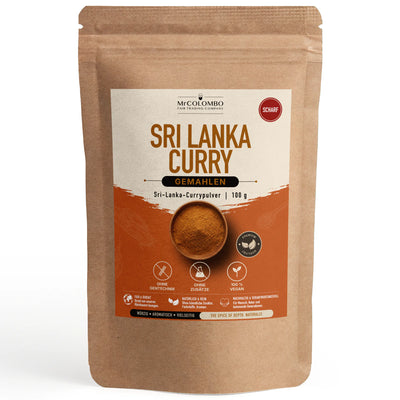
Look out for three things: a clear country of origin instead of the vague label non-EU, an intense aroma as a sign of freshness and a transparent supply chain. We import directly from smallholder farmers and know the plantations personally, from the turmeric field in the Central Province to dispatch to Germany. If you prefer a ready-made, balanced base to mixing your own, our Sri Lanka curry powder is a good start. Our guide Recognising spice quality shows you how to tell good produce from bad.

Our approach at MrCOLOMBO
Every batch of our spices has a traceable origin. Instead of anonymous mass-market goods, we rely on single origin from Sri Lanka and direct trading relationships, so that you know exactly what ends up in your paste.
Is making curry paste yourself really worth it?
Yes, home-made curry paste is worth it three times over: it tastes fresher, you control every ingredient and you avoid the contaminant problems of many ready-made products. Red, green and yellow differ above all in the choice of chilli and the proportion of turmeric, but share the same aromatic foundation of coriander, lemongrass and galangal. With high-quality spices of traceable origin, 20 minutes of work becomes a seasoning base that is superior to any shop-bought paste. If you want to delve deeper into Ceylon cuisine, you will find more ideas in our coconut sambal recipe.