




F enugreek (Trigonella foenum-graecum) provides 33.5 milligrams of iron per 100 grams of seeds - that corresponds to 419 percent of the recommended daily intake and makes the unassuming golden-brown seeds one of the most iron-rich spices in the world (USDA National Nutrient Database). In Sri Lanka, where the spice has been known for centuries under its Sinhala name "Uluhal", it is a firm part of everyday cooking. The global fenugreek market reached a volume of 1.5 billion US dollars in 2024 and, according to Cognitive Market Research, is growing at an annual rate of 5.2 percent - a clear sign that this spice is currently enjoying a renaissance.
Even so, most German home cooks know fenugreek at best as an ingredient on the label of their curry powder. That is a pity, because the seeds of this plant from the legume family combine a unique flavour profile - somewhere between maple syrup and roasted caramel - with a remarkable nutrient profile. This article shows where the spice comes from, which constituents make it so special and how to use it properly in your own kitchen. If you are interested in the diversity of Sri Lanka's spices in general, you will find the perfect introduction here.
At a glance
Where does fenugreek come from and how did it reach Europe?
The history of fenugreek goes back at least to the Neolithic period. Archaeological finds attest to its cultivation as early as the Chalcolithic, and the ancient Egyptian Ebers Papyrus from the year 1550 BC describes it as a remedy for external application on burns. From North Africa and the Near East, the plant spread along the ancient trade routes to South Asia and Europe. Around 800 AD, Charlemagne ordered its cultivation in the monastery gardens of the Frankish Empire - one of the earliest documented cultivations in Central Europe.
In Sri Lanka, fenugreek - known there under its Sinhala name "Uluhal" - holds a special place within the spice culture. The Sri Lanka Tourism Board confirms fenugreek as an integral part of the island's traditional spice gardens, which have shaped the international spice trade for more than 3,000 years. In the spice gardens of the Central Province, which we visit regularly for our direct imports, fenugreek often grows right next to Ceylon cinnamon and turmeric - a sign of how naturally this spice belongs to everyday life in Sri Lanka. In Sri Lankan cooking you will find both the seeds as a spice in curry powders and the fresh leaves in salads such as the traditional "Uluhal Kola" - a sambol with fresh coconut, lime and green chilli. If you would like to dive deeper into Ayurvedic spice cooking, you will discover there its classification as a Vata- and Kapha-reducing spice in the Tridosha system.
Today, India produces around 74 percent of the world harvest, estimated at 1.3 million tonnes per year (Spices Board India, 2024). But Sri Lanka, Turkey, Egypt and North Africa also contribute to the global supply. The Asia-Pacific region dominates the trade with a market share of over 40 percent, followed by North America with 25 percent. The Latin name Trigonella foenum-graecum literally means "Greek hay" - a hint that the ancient Greeks valued the herb as cattle fodder before it found its way into the kitchen.

Which constituents make fenugreek so special?
According to the USDA National Nutrient Database, fenugreek seeds provide 323 kilocalories, 23 grams of protein, 25 grams of fibre and 176 milligrams of calcium per 100 grams. Particularly striking is the iron content of 33.5 milligrams per 100 grams - that is 419 percent of the recommended daily intake. Of course, nobody eats 100 grams of fenugreek in one go, but even a teaspoon (about 3.5 grams) already provides more than one milligram of iron. This places fenugreek alongside turmeric and black pepper in the ranks of nutrient-dense organic spices.
The largest share of the seed mass is made up of galactomannans - soluble fibres which, according to Faisal et al. (2024), account for between 45 and 60 percent of the seed composition. These polysaccharides swell strongly on contact with water and give soaked fenugreek seeds their characteristic mucilaginous consistency. In the food industry, galactomannans are used as a natural thickener and stabiliser.
Bioactive compounds at a glance
In addition to the macronutrients, fenugreek contains several bioactive compounds that are being intensively studied in research. Diosgenin, a steroidal saponin, occurs according to Visuvanathan et al. (2022) in concentrations of 0.1 to 0.9 percent. Trigonelline, an alkaloid with the typical bitter character, is present at 0.2 to 0.38 percent. The amino acid 4-hydroxyisoleucine makes up about 0.09 percent of the seeds and is almost unique in the plant kingdom - in relevant quantities it occurs almost exclusively in fenugreek (Avalos-Soriano et al., 2016). Furthermore, Akhtar et al. (2025) report flavonoids and other secondary plant compounds that are the subject of ongoing investigations.
| Nutrient | Per 100 g | Daily intake (%) |
|---|---|---|
| Iron | 33.5 mg | 419 % |
| Protein | 23 g | 46 % |
| Fibre | 25 g | 98 % |
| Calcium | 176 mg | 18 % |
| Calories | 323 kcal | - |
Why does fenugreek smell of maple syrup?
Anyone smelling fenugreek seeds for the first time involuntarily thinks of maple syrup, caramel or freshly baked waffles. A single molecule is responsible for this: sotolon (4,5-dimethyl-3-hydroxy-2(5H)-furanone). Blank et al. (1997) were the first to identify sotolon by gas chromatography-mass spectrometry as the key aroma compound in fenugreek. With a concentration of 3 to 12 milligrams per kilogram of seeds and an extremely low odour threshold of just 0.02 nanograms per litre of air, sotolon is one of the most potent natural aroma compounds of all.
How dominant this aroma can be was demonstrated spectacularly in Manhattan in 2005: a mysterious smell of maple syrup settled over large parts of New York and triggered hundreds of emergency calls. According to an investigation by McGill University, the smell was ultimately traced back to a fenugreek processing plant in New Jersey. The wind had carried the sotolon across the Hudson River. Sotolon passes through the human body largely unchanged and can alter the smell of sweat and urine - an effect which, in medicine, occasionally leads to false-positive suspected cases of maple syrup urine disease (MSUD) in breastfed infants (NCBI LactMed, 2026).
Practical tip
Toasting the seeds over medium heat (about 2 to 3 minutes in a dry pan) intensifies the caramel-like notes of the sotolon while at the same time reducing the bitterness of the trigonelline. Only crush the seeds in a mortar after toasting - this is how the full aroma unfolds.

How do you use fenugreek properly in the kitchen?
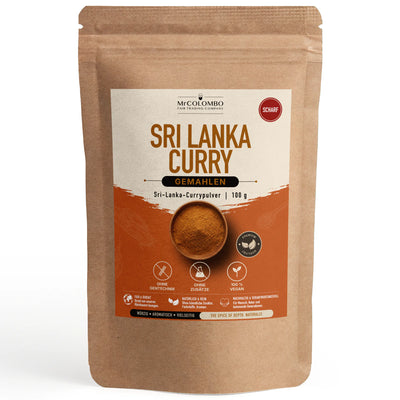
Fenugreek exists in the kitchen in three forms: as whole seeds, as ground powder and as fresh or dried leaves (Kasuri Methi). Each form has its own dosage and its optimal point of use. Whole seeds are typically toasted in hot oil at the start of cooking until they turn golden brown and smell nutty - a technique known in India as "tadka" or "tempering" which, according to the food chemist Gernot Katzer, ranks among the most important flavouring methods of South Asian cuisine. In Sri Lanka, fenugreek seeds are an integral part of the spice blend for curry powder and are often toasted and ground together with coriander, cumin and black pepper. If you want to prepare an authentic Sri Lanka curry, there is no getting around fenugreek.
Ground fenugreek powder should be used sparingly - half a teaspoon is enough for a dish serving four people. The dried leaves (Kasuri Methi) are milder than the seeds and release their aroma best when you rub them between your palms and only add them in the last few minutes of cooking. That is the insider tip of many Indian cooks for creamy dishes such as Butter Chicken or Methi Matar Malai. Fenugreek also has its place beyond Asian cooking: a yoghurt dip with a pinch of ground fenugreek and honey is a surprisingly good accompaniment to oven-roasted vegetables or flatbread.
Three forms of preparation at a glance
| Form | Dosage | Point of use |
|---|---|---|
| Whole seeds | 1 tsp per dish | Toast in oil at the start |
| Ground powder | 0.5 tsp per dish | Cook in towards the end |
| Dried leaves | 1 tbsp per dish | Last 2-3 minutes |
What does science say about fenugreek?
The body of scientific studies on fenugreek has grown considerably in recent years. A meta-analysis by Kim et al. (2023) pooled 10 randomised controlled trials (RCTs) with a total of 706 participants and observed changes in various metabolic parameters under fenugreek supplementation: fasting blood glucose was on average 26.66 mg/dL lower, and the HbA1c value showed a reduction of 0.54 percentage points. Shabil et al. (2023) confirmed in a systematic review of 14 RCTs and 894 participants a statistically significant association with the HbA1c value. These results are the subject of research and cannot simply be transferred to the general population.
Fakhr et al. (2023) evaluated 29 RCTs in an even more extensive meta-analysis and, in addition to changes in blood glucose, also observed associations with triglyceride levels and waist circumference. The US federal agency NCCIH (National Center for Complementary and Integrative Health) rates the state of the evidence as "promising but not conclusive" and stresses that further long-term studies are needed. If you are interested in the scientific assessment of spice constituents, you will also find fascinating parallels in the state of research on turmeric.
Important
This article is for information purposes and does not replace medical advice. Fenugreek can interact with blood-sugar-lowering medication and blood thinners. If you have health questions or are taking medication, consult your doctor or pharmacist. Pregnant women should avoid fenugreek preparations, as a labour-inducing effect has traditionally been described.
Traditional recognition
Independently of modern research, fenugreek enjoys official recognition in herbal medicine. As early as 1990, the German Commission E gave fenugreek seeds a positive assessment for external application and as a traditional remedy for loss of appetite. The US FDA classifies fenugreek extracts as "Generally Recognized as Safe" (GRAS). In the Ayurvedic system, fenugreek is assigned to the rasa "Tikta" (bitter) and is traditionally described as a Vata- and Kapha-regulating remedy - a tradition of use that is maintained to this day in Sri Lanka through institutions such as the Bandaranaike Ayurveda Research Institute.

What should you look out for when buying and storing?
Fenugreek (Trigonella foenum-graecum) is available as whole seeds, ground or as dried leaves - and the differences in quality are considerable. High-quality fenugreek seeds can be recognised by an even golden-brown colour without dark spots or traces of mould. The seeds should be hard and, when bitten, develop an intensely bittersweet taste with a distinct maple note. Pale, floury-looking seeds indicate overly long storage or inferior drying. Whole seeds keep their aroma for up to two years when stored cool and dry in an airtight container - ground powder, by contrast, noticeably loses intensity after three to six months. If you would generally like to know how to recognise high-quality spices, you will find further practical tips in our guide.
An important safety note: in 2011, a severe EHEC outbreak (serotype O104:H4) in Germany was traced back to contaminated fenugreek seeds from Egypt. According to the BfR (German Federal Institute for Risk Assessment) and EFSA, the risk concerned raw sprouts and seedlings exclusively. Heated fenugreek seeds - that is, toasted, cooked or processed into curry powder - were at no point affected. The BfR recommends always heating raw sprouts to at least 72 degrees Celsius for at least 2 minutes.
When buying, it is worth looking at organic certification and transparent supply chains. Fenugreek from certified organic farming is cultivated without synthetic pesticides, which for many consumers is a decisive purchasing criterion for a spice that is consumed in small quantities. We have summarised further information on how direct import of spices works in a separate article.
Fenugreek deserves a permanent place in your spice collection
Fenugreek is far more than a footnote on the ingredient list of curry powder. The combination of a unique maple syrup aroma, a remarkable nutrient profile and a cultural history stretching from the pharaohs to the spice gardens of Sri Lanka makes this spice a real discovery for every kitchen. Whether as toasted seeds in a tadka, as Kasuri Methi in creamy curries or as a powder in a home-made yoghurt dip - the versatility of fenugreek surprises even experienced cooks.
If you are taking the plunge, the best way to start is with whole seeds and a hot pan. The scent of the sotolon drifting caramel-like through the kitchen usually wins you over on the very first toasting - and turns a forgotten spice into a constant companion.